Kroger says its artificial-intelligence shopping assistant is already increasing basket sizes, an early sign that the grocery chain’s AI push may lift sales rather than just cut costs.
Kroger AI Assistant Raises Basket Sizes
That matters because grocery is a low-margin, volume-driven business. If AI can move customers from meal planning to checkout with less friction, it can generate more items per trip, improve digital conversion and deepen loyalty without relying on heavy discounting. For Kroger, the upside is not just a better app — it is a more valuable customer relationship and a stronger revenue engine across stores and e-commerce.
Yael Cosset, Kroger’s executive vice president and chief digital officer, said the effect has been broad-based, with adoption spread relatively evenly across customer segments. He said he initially expected shoppers who gave the assistant detailed instructions to buy fewer products, but the opposite has happened: by taking work out of meal planning, the tool appears to leave room for incremental purchases.
That is the kind of second-order benefit investors should care about. Retail AI has often been sold as a productivity story, with promise in labor savings, forecasting and inventory management. Kroger is showing the more powerful case: AI can become a demand-growth tool. If the assistant helps shoppers build baskets from recipes, dietary restrictions or photos, then the technology is doing more than answering questions. It is acting as a digital merchandiser that can steer volume into the cart.
The company is also pushing AI deeper into operations, using it for replenishment, forecasting and order assembly inside stores. That matters because the customer-facing experience only works if the backend can deliver the right size, variety and availability when shoppers check out. In other words, AI that sells more has to be matched by AI that stocks better.
Cosset stressed that Kroger’s “crown jewel” is its data, and that is where the real moat may sit. The company says it processes trillions of forecasting dimensions and has built an AI gateway above its data and data-science stack, allowing it to use internal models while also integrating outside providers. That flexible approach is important in a market where no single AI model is likely to dominate for long, and where retailers that surrender their data layer risk losing both accuracy and control.
For investors, the takeaway is bigger than Kroger itself. Grocers and mass retailers that own high-quality first-party data can turn AI into a traffic-and-basket engine, not just a cost center. That favors the platforms with scale, loyalty programs and dense fulfillment networks, while pressuring laggards that lack clean data or operational discipline. It also strengthens the case for technology vendors that provide the underlying model, cloud and workflow infrastructure that make these assistants useful.
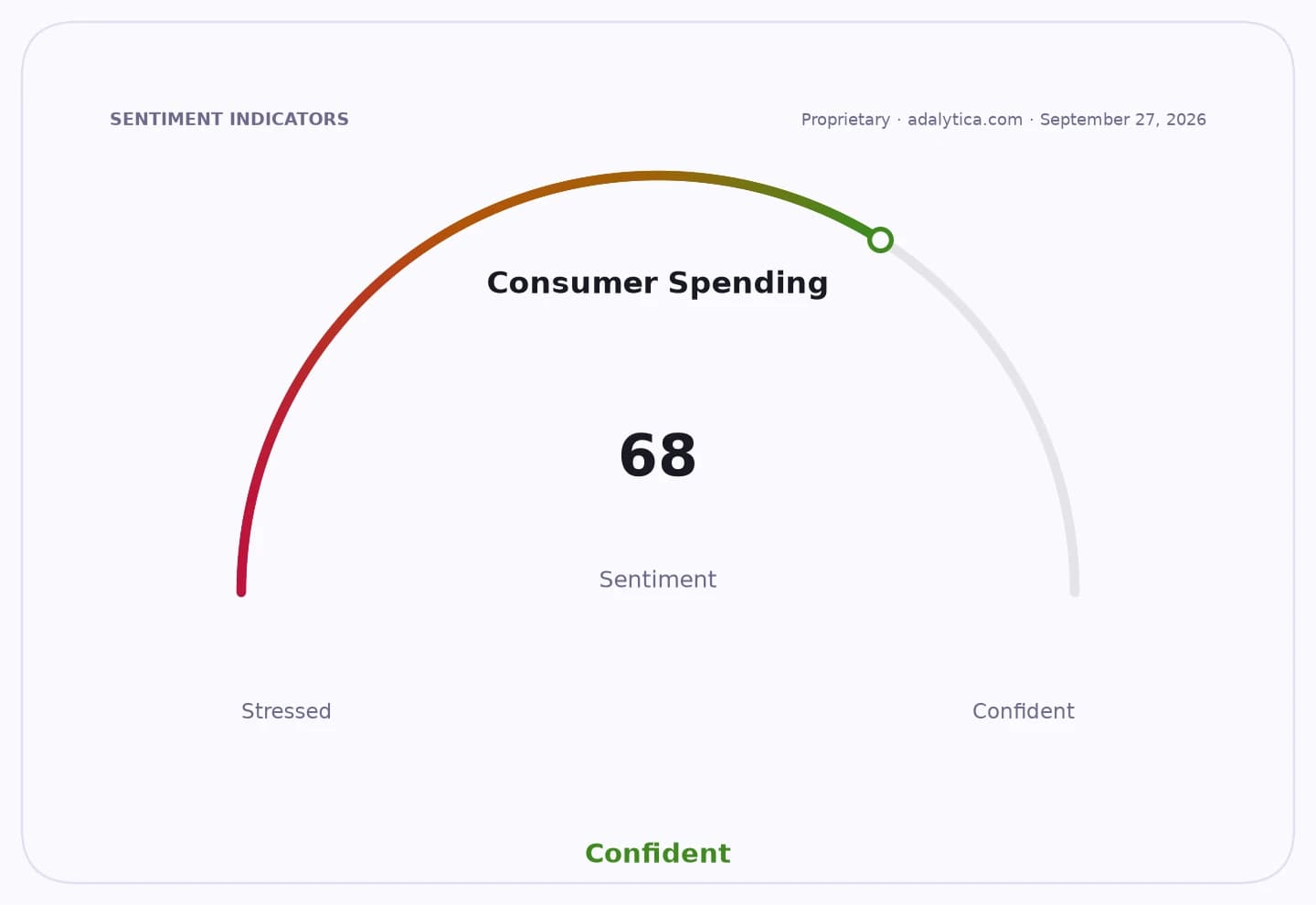
Kroger’s own stock has already been trading above its 50-day moving average in recent sessions, while consumer-spending sentiment from Adalytica remains in neutral territory, underscoring that shoppers are still selective even as retailers look for ways to grow baskets. That is precisely why an AI assistant that nudges larger purchases matters: it creates growth without needing a broad consumer boom.
The market is still underestimating how quickly retail AI can move from experimentation to monetization. Kroger is showing the template: protect the data, integrate the backend, train workers and use the customer interface to make shopping easier and bigger. If that model scales, the winners will be the retailers that own the relationship and the infrastructure behind it. For investors, the best positions are in the companies turning AI into a transaction engine, not a gimmick.
| Entity | Gains | Losses |
|---|---|---|
| Kroger (KR) | ▲Larger baskets, stronger loyalty | ▼Higher execution risk |
| CPG partners | ▲More item volume | ▼Less shelf friction for rivals |
| AI infrastructure vendors | ▲More enterprise workloads | ▼Complacent software stacks |
| Smaller grocers | ▲None | ▼Data and scale disadvantage |