The world just recorded its biggest drop in deforestation this decade, but that progress may not last if Latin America’s political pendulum swings to the far right.
Latin America Forest Loss Falls 15% in 2025
A new Forest Declaration Assessment says global forest loss fell 15% in 2025 from a year earlier, driven largely by a 33% decline in Latin America. That is a meaningful victory for climate policy, commodity markets and long-term investors because forests are not just carbon sinks; they are also buffers against drought, floods and supply-chain disruption. But the report’s central warning is that these gains remain fragile, especially in Brazil and Colombia, where upcoming elections could bring governments less willing to enforce anti-deforestation rules.
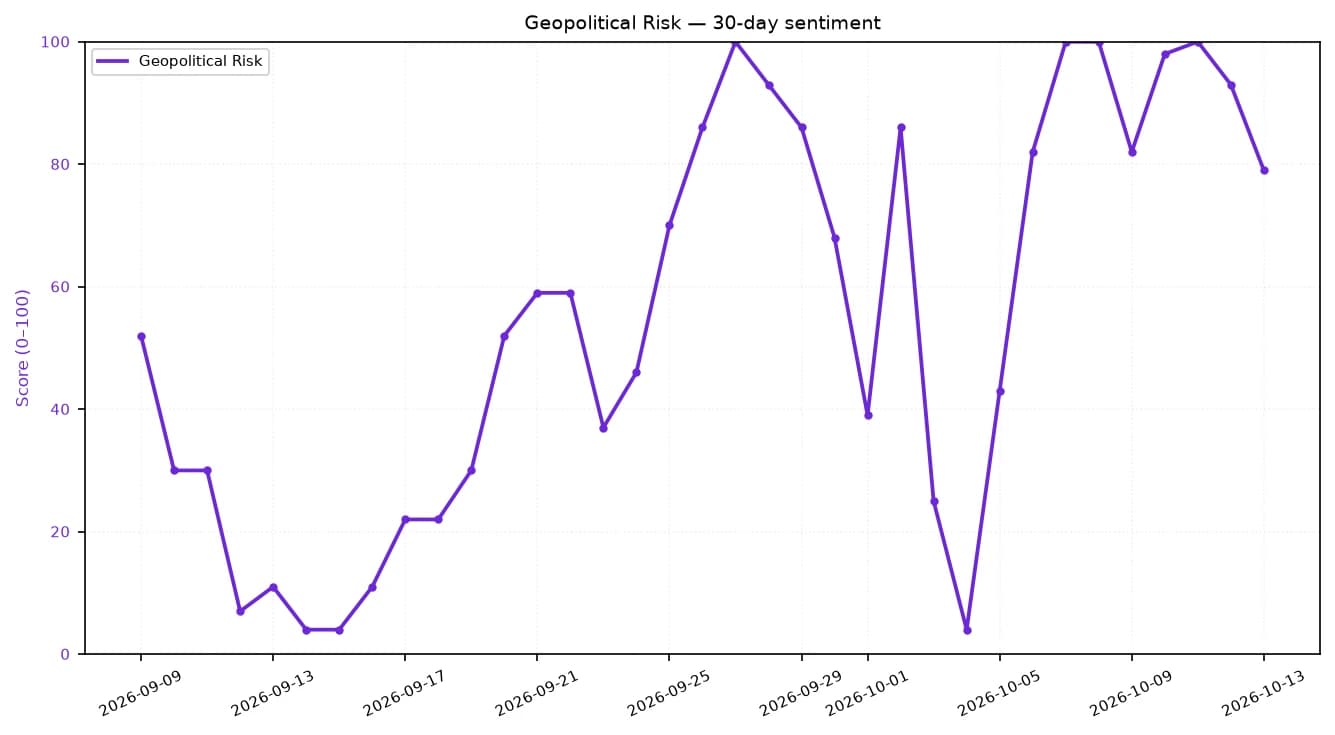
Sentiment IndicatorsⓘProprietary · adalytica.com · October 16, 2026
This is a snapshot — live sentiment, awareness and momentum for 130+ markets update continuously in the dashboard.Open AlphaPulse
For investors, this matters because forest policy is no longer a niche environmental issue. It affects agribusiness expansion, mining, oil and gas licensing, sovereign risk, local-currency stability and the cost of doing business across some of the region’s most important economies. When enforcement weakens, deforestation typically rises, and so do the risks of trade friction, reputational damage and future regulation for companies exposed to beef, soy, timber and land conversion.
Brazil is the key swing factor. Home to about 60% of the Amazon, it has already shown how quickly policy can change the trajectory of forest loss. Under President Luiz Inácio Lula da Silva, authorities strengthened satellite monitoring and relaunched the anti-deforestation plan, helping curb commodity-driven clearing in the Brazilian Amazon. The contrast with Jair Bolsonaro’s presidency is stark: budget cuts, staff shortages and the dismantling of environmental governance helped drive forest loss higher between 2019 and 2021, the report notes.
That history is why markets should pay attention to political developments, not just weather patterns or commodity prices. In Brazil, the question is whether environmental protections become durable enough to survive electoral cycles. In Colombia, the report warns that pledges to expand oil and gas exploration and agricultural land could reverse recent gains, even as officials also promise enforcement against those financing deforestation. That tension captures the broader story across Latin America: governments want growth, but growth built on land expansion can quickly collide with forest conservation.
The stakes are not limited to one region. The report says the world is still about 70% short of what would be needed to halt deforestation by 2030, even after 2025’s improvement. In Africa, forest degradation is worsening, and the Congo Basin has now seen deforestation rise to 2.4 million hectares, close to the Amazon’s 2.5 million. That underscores a bigger investment theme: the global transition to more sustainable land use depends as much on politics and institutions as on technology.
For long-term investors, the lesson is straightforward. Policy wins can compound, but only if they are built into law, enforcement capacity and local institutions instead of resting on one administration. That makes Latin America’s upcoming elections worth watching closely, especially for anyone exposed to commodities, emerging markets or climate-linked supply chains. The recent improvement in forest loss is encouraging, but the report is a reminder that environmental progress can vanish quickly when political incentives change. Hold the names and markets that benefit from stronger governance, but keep the region’s policy risk on your watchlist.
| Entity | Gains | Losses |
|---|---|---|
| Forests and climate advocates | ▲Slower forest loss | ▼Policy rollback risk |
| Lula-aligned environmental policy | ▲Better enforcement | ▼Bolsonaro-aligned expansion agenda |
| Agribusiness, mining and energy expanders | ▲Easier land access | ▼Tighter rules and scrutiny |
| Long-term emerging-market investors | ▲Stronger institutional governance | ▼Election-driven volatility |