League is moving healthcare AI out of pilot mode and into production, betting that the next phase of adoption will be won not by the smartest model, but by the safest operating framework.
League launches healthcare AI tools on Forge

The company said on Nov. 16 that its AI Front Door for payers and AI Care Companion for providers are now generally available on its Forge platform, with deployments as fast as 12 weeks. The release matters because it tackles the main barrier holding back member- and patient-facing AI in healthcare: the risk of misinformation, unsafe actions and weak accountability when agents interact directly with people.
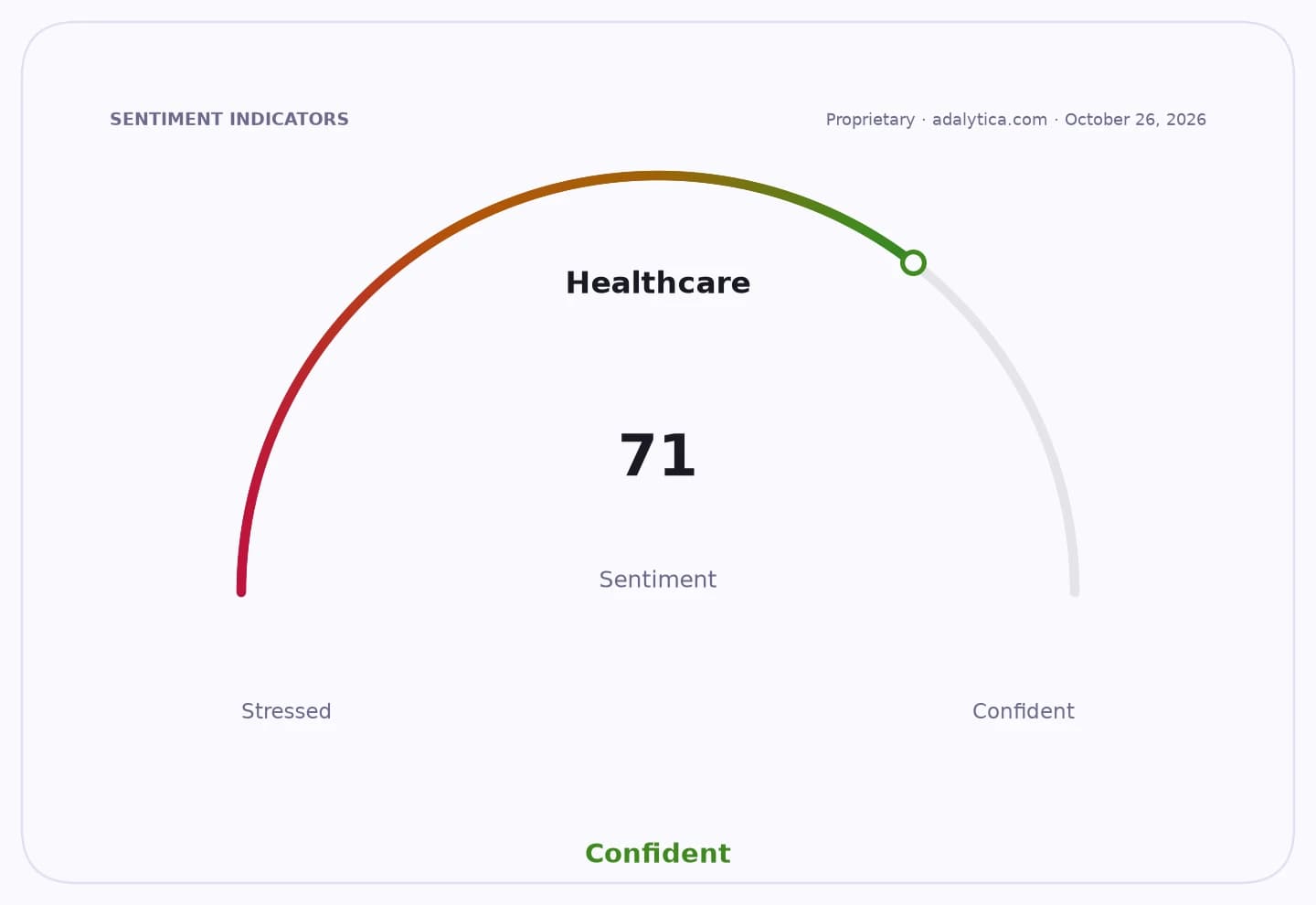
Sentiment Indicators
That is increasingly where the market is headed. In a League and Healthcare Dive survey of 150 healthcare executives, 61% said they had deployed agentic AI, and 70% of that group were already using it in member- or patient-facing applications. But only 16% had reached broad deployment, underscoring how quickly enthusiasm runs into compliance and safety concerns. The top requirements for confidence were built-in healthcare compliance, automatic escalation to a person and runtime controls over what agents can say or do — the exact guardrails League is trying to productize.
The economics are straightforward. Healthcare organizations are under pressure to cut administrative friction, reduce avoidable emergency visits and keep patients on treatment pathways, all while operating in a high-cost system where labor remains expensive and call-center volumes are a drag on margins. League’s AI Front Door is aimed at payer workflows such as benefits navigation, care finding, care-gap outreach and health coaching, while AI Care Companion is designed for provider workflows between visits and after hours, including scheduling, reminders, symptom checks and protocol-based routing. If these tools work as intended, they could lower service costs and improve adherence; if they fail, they risk amplifying the very inefficiencies they are meant to remove.
Artificial Intelligence — 30-day sentimentadalytica.com
Explore this data interactively — full history, time series and cross-market comparisons.
What separates League’s offering from generic chatbot rollouts is the control stack. The company says responses are limited to approved material rather than the model’s general knowledge, restricted information is screened before it reaches the model, and prohibited responses are blocked before they reach patients or members. Before launch, agents must pass synthetic-patient tests, edge-case scenarios and golden datasets. After launch, they are monitored for drift and revalidated when changes are made, with an audit record kept for every interaction. That architecture is built for a sector where human review, traceability and escalation are not optional extras but procurement requirements.
League is also leaning on healthcare-specific model evaluation to argue it can beat larger general-purpose systems on the tasks that matter. It said an internal escalation model reached 99.72% accuracy with 0.374-second latency, versus 95.36% accuracy and 1.121 seconds for Gemini 3.5 Flash Lite. The company also said its Synthetic Question Generator and Semantic Expansion tools improved coverage and answer quality versus Gemini 3.5 Flash, though at the cost of some added latency. For investors, those figures are less about headline model performance than about a broader thesis: in regulated vertical AI, domain tuning and workflow design may matter more than scale alone.
The launch also fits a wider industry pattern. OpenAI has expanded its healthcare offerings, while other startups are pushing AI deeper into clinical operations and hospital workflows. That competition suggests healthcare is becoming one of the most commercially important battlegrounds for agentic AI, but also one of the most unforgiving. Vendors that can prove safety, auditability and measurable workflow gains should win earlier enterprise budgets; those that cannot may find their products stuck in sandboxes.
For League, the immediate question is whether safety controls become a differentiator strong enough to turn healthcare AI from a demo into a repeatable revenue stream. For buyers, the key issue is whether the tools cut administrative load without creating new clinical or legal liability. For the wider AI market, the message is that in healthcare, the winning agent may be the one that is trusted to act.
| Entity | Gains | Losses |
|---|---|---|
| League | ▲Broader enterprise adoption | ▼Slower rollout if controls fail |
| Payers and providers | ▲Lower admin burden | ▼Exposure to AI errors |
| Patients and members | ▲Faster support and routing | ▼Risk from misrouted advice |
| Generic chatbot rivals | ▲Industry validation | ▼Pressure to prove safety |