Oracle and AstraZeneca are deepening their collaboration to connect artificial intelligence research with patient care, a move that underscores how drugmakers are increasingly tying AI spend to clinical and commercial payoff rather than treating it as an isolated tech experiment.
Oracle and AstraZeneca deepen AI healthcare partnership
Healthcare
The partnership matters because healthcare remains one of the few big industries where AI can affect both revenue growth and cost structure at the same time. If the companies can use Oracle’s cloud and data infrastructure to speed research, improve trial design and sharpen care delivery, the gains could extend from faster drug development to more efficient healthcare workflows.
Sentiment Indicators
For Oracle, the deal reinforces a push to expand beyond enterprise software into higher-value healthcare and life sciences work, where recurring cloud demand can support growth. For AstraZeneca, it fits a broader strategy of using data and machine learning to strengthen its oncology-heavy pipeline and improve execution across discovery, development and treatment.
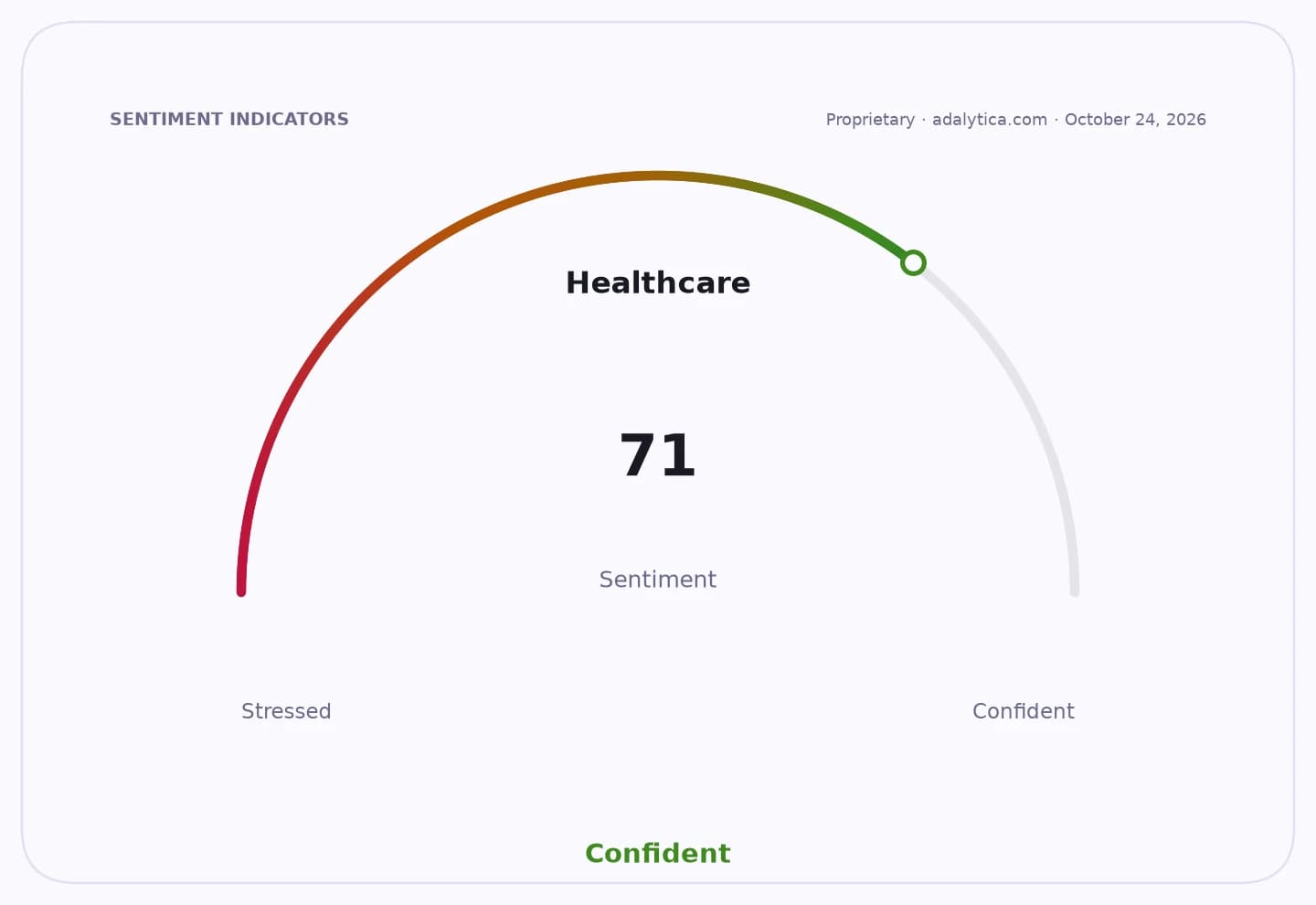
The timing also lands as investor interest in healthcare AI remains elevated. Adalytica’s Healthcare Spending Sentiment gauge sits at 71, in “Greed” territory, even after a 29-point pullback over the past month, suggesting the market still expects meaningful capital to flow into digital health and AI-enabled drug development.
AstraZeneca shares have been firmer than Oracle’s recent tape. AZN closed at 171.49 on Oct. 23, above its 50-day moving average of 163.08 and still below its 200-day average of 180.25, with RSI readings at 72.8 showing strong momentum. Oracle, by contrast, finished at 126.16, below both its 50-day moving average of 142.47 and 200-day average of 157.45, as RSI at 36.7 and a negative MACD point to a stock that has yet to regain durable trend support.
The broader backdrop is a healthcare sector under pressure to prove that AI can cut time and cost without adding regulatory or data-liability risk. Global efforts, including the AI Healthcare Seoul Declaration and new regulatory discussions around patient data and liability, are pushing companies to show that AI can be deployed responsibly in medicine.
Investors will be watching for follow-through in the form of clinical updates, cloud spending commitments and evidence that the collaboration can move beyond a headline into measurable productivity gains. In a market where SPY sentiment is in “Extreme Fear,” any sign of durable, monetizable AI adoption in healthcare is likely to get attention.
| Entity | Gains | Losses |
|---|---|---|
| Oracle | ▲More healthcare cloud demand | ▼Pure software peers |
| AstraZeneca | ▲Faster R&D and trial efficiency | ▼Slower-moving drug developers |
| Healthcare AI investors | ▲Higher adoption visibility | ▼Skeptics of AI monetization |
| Traditional care workflows | ▲Data-driven tools | ▼Legacy manual processes |