Lithuania could trim about 300 million euros from the state wage bill each year by cutting public sector employment 10%, the Lithuanian Free Market Institute said, turning a politically sensitive staffing debate into a fiscal question with direct implications for taxes, borrowing and private-sector competitiveness.
Lithuania Wage Bill Cut Could Save 300 Million Euros
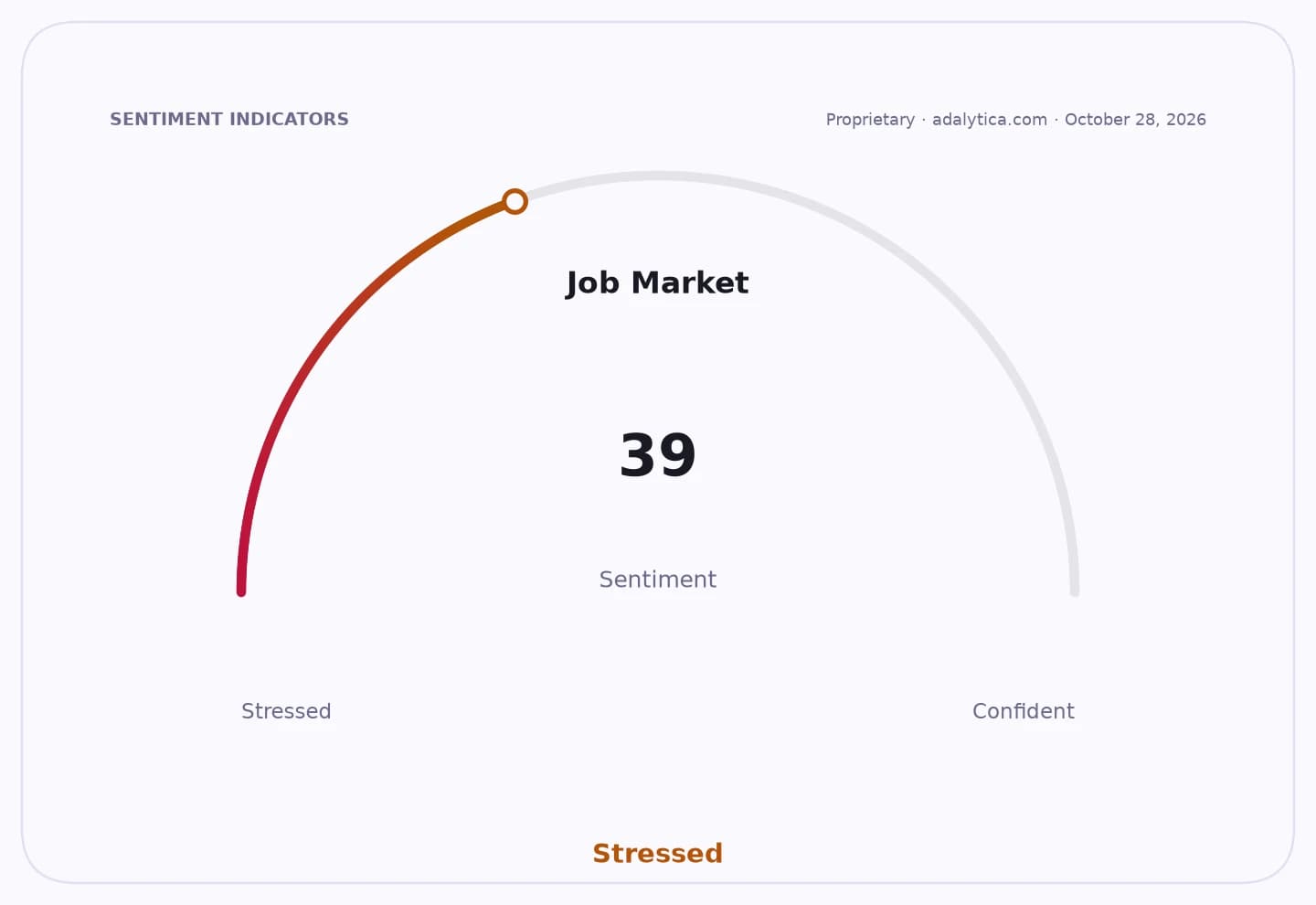
Job Market
The estimate gives the Finance Ministry’s efficiency drive a hard budgetary frame at a time when governments across Europe are under pressure to show restraint without weakening public services. In Lithuania, where inflation remains elevated and the labor market is still relatively tight, the issue is not only how much the state spends, but whether the public sector is absorbing workers and wage growth that could otherwise support productivity in the private economy.
Sentiment Indicators
LLRI’s calculation focuses on payroll savings, implying the biggest near-term benefit would come from lower recurrent spending rather than one-off cuts. That matters for investors because wage costs are among the stickiest parts of government expenditure, and any credible effort to reduce them can improve perceptions of medium-term fiscal discipline. It also points to a possible rerating of policy priorities if the government chooses to shift resources away from administration and toward investment, debt reduction or tax relief.
The debate lands in an economy that is still expanding, but where policymakers must balance growth with cost pressures. Conventional labor-market indicators show unemployment at 4.1% in October, suggesting Lithuania is not dealing with a broad jobs crisis that would normally make public-sector downsizing easier to absorb. At the same time, inflation remains well above pre-pandemic norms, with consumer prices rising to 337.5 on the CPI index in October, reinforcing the case for tighter control of government outlays.
For markets, the immediate relevance is less about the mechanics of layoffs than about the signal on fiscal stance. A government that can credibly reduce staffing by 10% would likely be seen as more willing to tackle structural spending than one relying on temporary measures. That could matter for sovereign-risk pricing over time, particularly if investors conclude the savings are durable enough to offset other spending commitments.
The bear case is political and operational: cuts of this scale can slow service delivery, provoke labor opposition and prove harder to execute than modelled. The bull case is that a leaner state could improve efficiency, ease pressure on wages and leave more room for private enterprise to drive growth. Either way, the proposal puts public-sector payroll at the center of Lithuania’s fiscal debate and forces investors to weigh reform credibility against execution risk.
| Entity | Gains | Losses |
|---|---|---|
| Lithuanian government finances | ▲Lower wage bill | ▼Public-sector payroll |
| Private sector employers | ▲More labor supply | ▼Public administration staffing |
| Bond investors | ▲Better fiscal discipline | ▼Spending rigidity risk |
| Public employees and unions | ▲— | ▼Job security and bargaining power |