Inflation is again weighing on U.S. holiday retail demand, and large department-store groups are sounding less confident even as the season gets underway.
Macy's and Kohl's Face Weak Holiday Demand
Consumer Confidence
The latest consumer-price data point to only modest near-term relief: the CPI is projected to rise 0.35% in November, after a 0.35% increase in October, keeping prices elevated and leaving households with little room to stretch discretionary budgets. That matters most for apparel and department stores, where winter shopping depends heavily on confidence, credit availability and willingness to trade up.
Sentiment Indicators
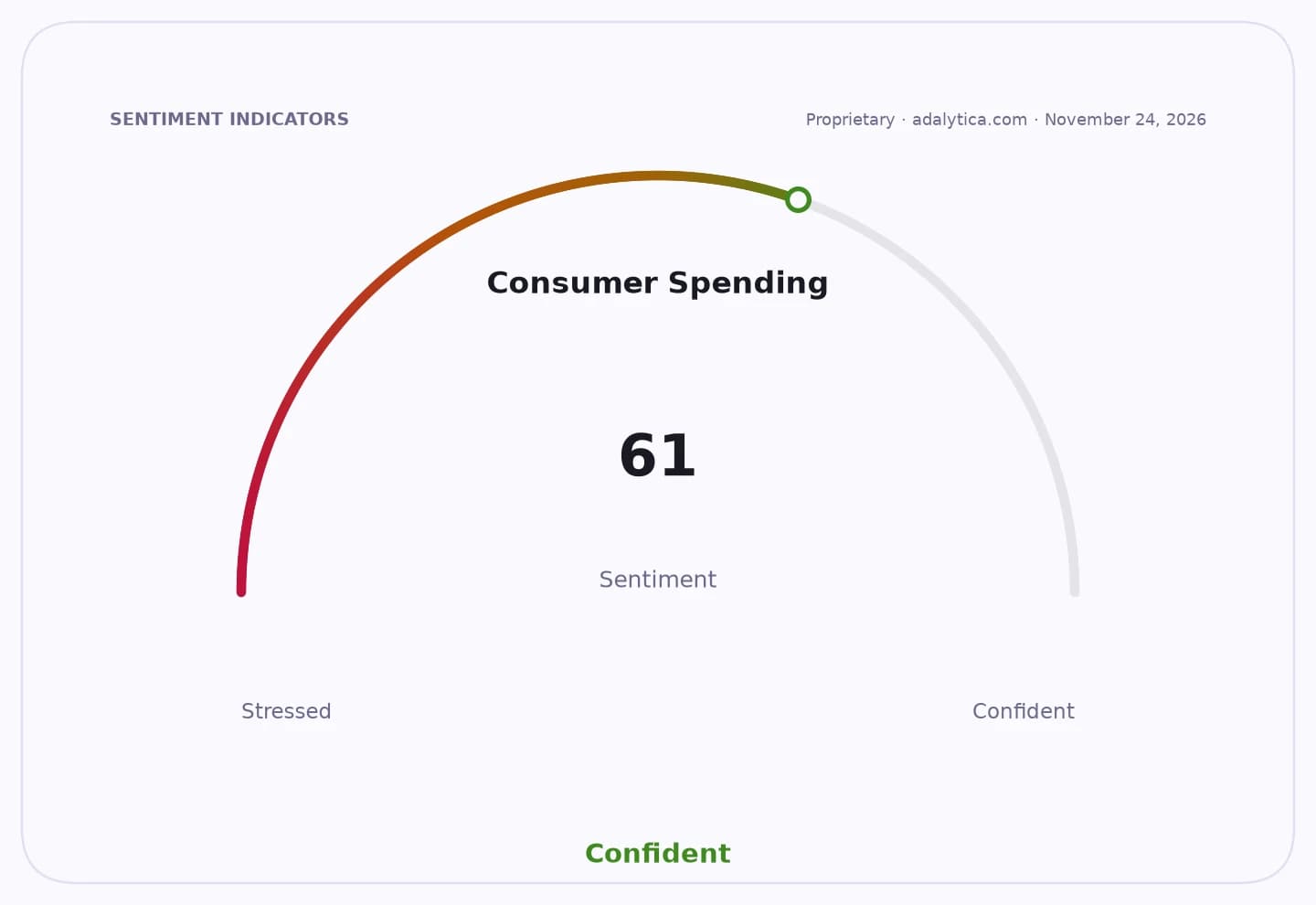
The strain is showing in sentiment. Adalytica’s Consumer Confidence Recession Sentiment gauge sits at 18, firmly in “fear” territory, while consumer spending sentiment, though neutral at 61, has fallen sharply over the past month. Retail goods spending sentiment remains only neutral at 32, suggesting shoppers are still buying, but with caution and more selectivity. For retailers, that combination usually means heavier discounting, tighter inventory management and weaker margins.
The pressure is visible in the share performance of major chains. Macy’s has rallied from a year-low to around $24.48, but it remains well below levels that would suggest a durable recovery in demand, while Kohl’s has been far more volatile, climbing to $25.33 after trading as low as $15.36 earlier in the year. The moves reflect a market split between hopes for a holiday rebound and concern that promotional activity will eat into profitability if traffic disappoints.
Consumer Spending — 30-day sentimentadalytica.com
Explore this data interactively — full history, time series and cross-market comparisons.
Technical indicators underscore that the stocks are trying to stabilize rather than break out decisively. Macy’s is trading above both its 50-day and 200-day moving averages, with momentum improving after a late-November rebound. Kohl’s has also recovered above its 50-day and 200-day averages, but its recent swings and softer momentum readings suggest investors are still treating the rally as fragile. In both cases, the shares are being pulled by the same force: whether consumers keep spending through winter or retrench under the weight of still-high prices.
The broader market implication is straightforward. If inflation remains sticky and confidence stays weak, department stores will likely rely on markdowns to move seasonal goods, which can preserve revenue at the cost of profitability. If holiday demand proves more resilient than current sentiment implies, the groups with cleaner inventories and better execution could see some short-covering and multiple expansion. But for now, the dominant story is defensive: households are cautious, and large textile and apparel retailers are lowering expectations for winter spending.
| Entity | Gains | Losses |
|---|---|---|
| Price-sensitive shoppers | ▲Lower prices | ▼Fewer premium choices |
| Discount retailers | ▲Traffic gains | ▼Margin pressure |
| Macy’s and Kohl’s | ▲Potential volume lift from promotions | ▼Weaker pricing power |
| Apparel suppliers | ▲Inventory clears faster | ▼Smaller order visibility |