Meta’s release of Muse, an AI agent that can shop, fill in forms, book travel and send email on a user’s behalf, marks a bigger strategic shift than a consumer software launch: it is an attempt to turn Meta’s AI stack into a commerce and productivity layer that can sit between users and the internet’s most valuable transactions.
Meta Muse AI agent for shopping and email

That matters because the next phase of AI is not just chat. It is action. If Meta can make Muse reliable enough to carry out everyday tasks across apps and browsers, it gains a path to own more user intent, more data, and eventually a cut of the workflows that drive online spending. That is a far more lucrative prize than simple engagement, and it positions Meta squarely against Amazon, Shopify, Google and the broader ecosystem racing to build the agent layer.
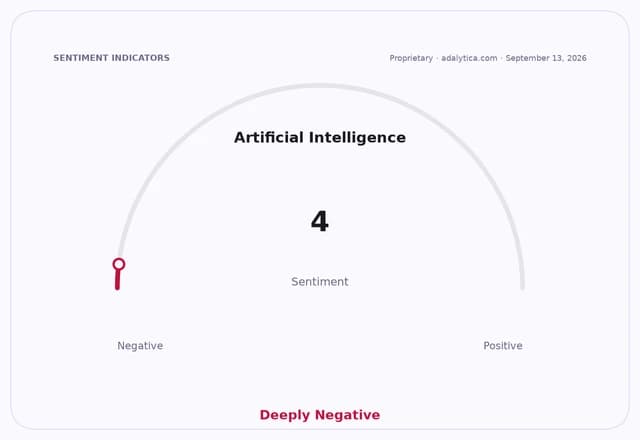
Sentiment IndicatorsⓘProprietary · adalytica.com · September 13, 2026
This is a snapshot — live sentiment, awareness and momentum for 130+ markets update continuously in the dashboard.Open AlphaPulse
Meta said Muse can connect to multiple categories of apps and keep working even after the user closes the app, pausing only for approval before sensitive steps such as sending email or making purchases. The company is also leaning hard into trust and control, stressing a secure virtual machine, no access to passwords or payment methods, full activity logs, granular permissions and the ability to “forget” learned information. That framing is not incidental. Commerce-grade agents will live or die on safety, privacy and user confidence.
The economics are straightforward. If AI agents become a standard interface for shopping and service tasks, they can compress friction in online commerce, increase conversion rates and reduce the cost of routine digital work. For merchants, that could mean more transactions mediated by software that chooses, compares and buys on behalf of consumers. For platform owners, it creates the chance to monetize the intermediary layer itself. For Meta, which has spent heavily to build out AI infrastructure and now wants to justify that spending, Muse is a bet that agents will become one of the most important consumer endpoints in the post-search internet.
Investors should view this as part of a much larger capex and platform contest. The winners are unlikely to be just the companies with the biggest models. They will be the companies that can distribute AI through existing consumer funnels, integrate it into apps people already use, and secure permission to act. Meta has one of the strongest distribution advantages in the world through Facebook, Instagram, WhatsApp and now its wearables ambitions. If Muse takes hold, that distribution could become an AI commerce toll road.
There is also a second-order read-through for the market. Shopify stands to benefit if AI agents increase merchant activity and automate customer-facing work, but it also faces the risk that the interface to commerce shifts upward, away from the storefront and toward the agent. Amazon is both a potential winner and a competitive threat, since it already sits at the center of product search, checkout and logistics. The broader software sector will need to prove that it can defend its role when software starts doing the buying, not just the recommending.
The timing is notable. Meta is rolling Muse out first in the United States across Android, iOS and web, with smart glasses support coming later. Most features are free, with paid tiers for advanced functions, suggesting the company wants rapid adoption before it worries about monetization. That is classic platform strategy: seed the behavior, own the workflow, then extract value later.
Adalytica’s AI sentiment readings show extreme fear around the broader market even as awareness of the AI trade remains high, a setup that often precedes sharp leadership changes when a new product cycle gains traction. Meta’s shares and those of key AI infrastructure and application players have been volatile, but the direction of travel is clear: investors are moving from “who has the best model?” to “who controls the agent that acts?”
My thesis is that Muse is not a side project. It is Meta’s opening move in the race to own AI commerce. If the agent layer becomes real, the most valuable companies will be the ones that sit closest to decision and execution. That makes Meta’s distribution, commerce reach and device ambitions far more important than the market may currently be pricing in. For investors, the opportunity is to position early in the companies that sell the picks and shovels of AI action — infrastructure, secure cloud, payment rails and workflow software — before agents become a default part of how consumers buy and work.
| Entity | Gains | Losses |
|---|---|---|
| Meta | ▲AI commerce control | ▼App-only engagement model |
| Shopify | ▲More automated merchant demand | ▼Interface-layer disintermediation |
| Amazon | ▲Higher transaction automation | ▼Search and checkout share |
| Consumers | ▲Less friction, saved time | ▼More platform dependence |