Mexico’s public sector employed 6.04 million people in 2025, but the near-flat 0.1% rise in jobs and a 0.3% increase in real output point to an engine of government activity that is growing only marginally and remains heavily concentrated in administration, schools and health care.
Mexico public sector jobs and output edge up in 2025
That combination matters because the public sector accounts for 14.7% of Mexico’s gross value added, making it a large and relatively stable pillar of the economy even when private demand is uneven. For investors, the message is not that the state is shrinking — it is that public employment is essentially capped, while productivity gains are limited and spending is being absorbed by payrolls rather than faster expansion.
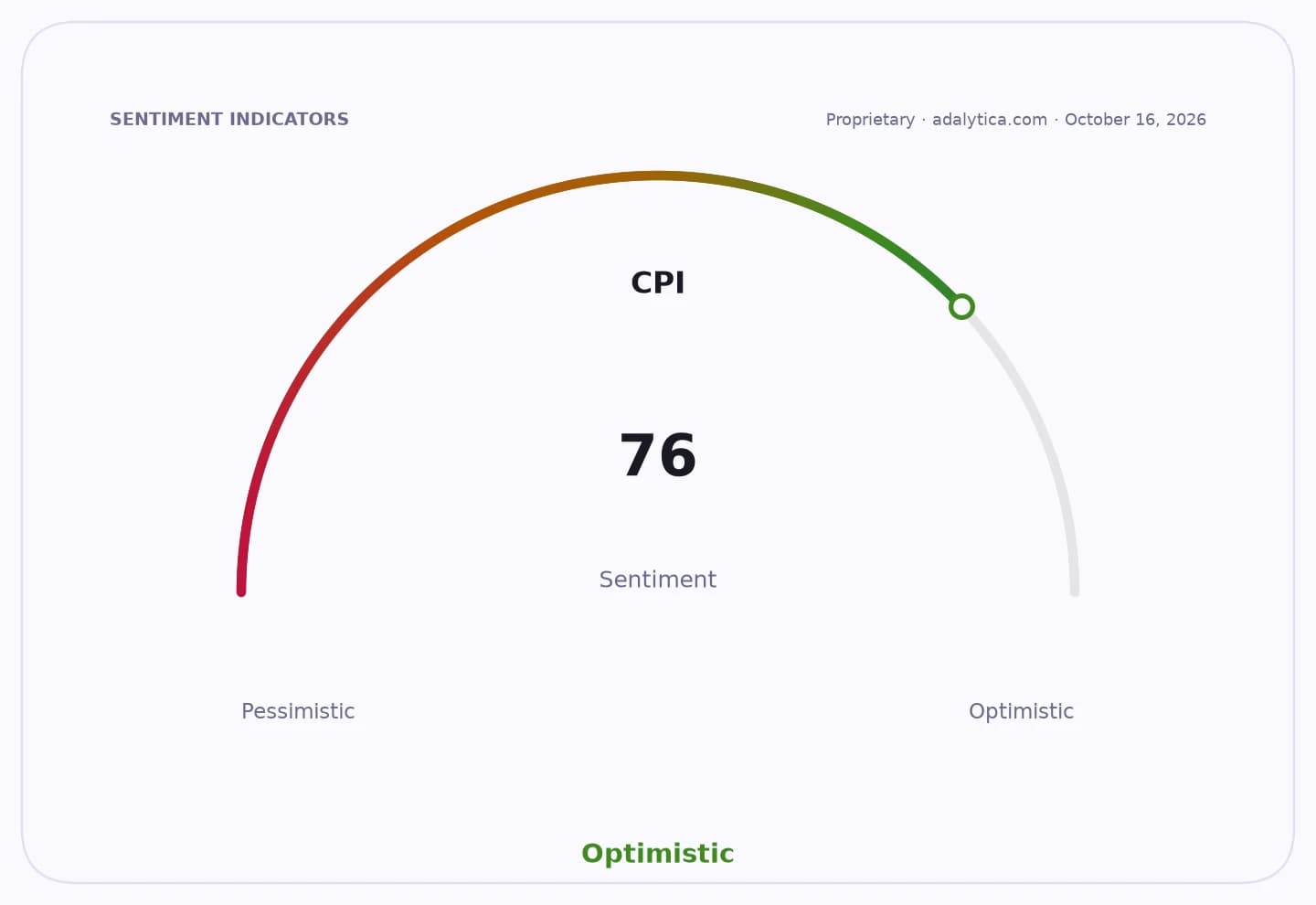
Sentiment IndicatorsⓘProprietary · adalytica.com · October 16, 2026
This is a snapshot — live sentiment, awareness and momentum for 130+ markets update continuously in the dashboard.Open AlphaPulse
The National Statistics Institute, or Inegi, said the government-general segment accounted for 5.60 million jobs, or 92.8% of the total, while public companies employed 436,355 people. Activities tied to government, education and health absorbed most of the workforce, underscoring how little of the public sector is exposed to cyclical growth industries.
The output figures show the same pattern. Real gross value added rose just 0.3% in 2025, with government-general activity up 0.2% and public companies down 0.4%. In current pesos, the sector generated 4.92 trillion pesos in gross value added and 7.78 trillion pesos in production, a reminder of its scale even as its growth rate lagged the broader needs of an economy that still relies on public spending to cushion slower private investment.
Health care is the clearest example of the sector’s imbalance. Health and social assistance made up 15.6% of public-sector jobs but contributed 12.6% of value added, suggesting labor intensity is high and productivity gains remain modest. Education accounted for 28.8% of jobs and 20.4% of value added, while legislative and government activities represented 47% of employment and 25.3% of value added.
For policymakers, the data highlight a familiar constraint: Mexico’s public sector is large enough to matter macroeconomically, but not growing fast enough to become a stronger source of demand or productivity. For markets, that generally points to steady but limited fiscal impulse, with little evidence of a sweeping hiring cycle that might pressure bond yields or change the outlook for consumption in a meaningful way.
For companies with exposure to Mexican household income and public procurement, the picture is mixed. Stable government payrolls can support baseline spending, but the absence of faster public-sector expansion suggests no major new lift to domestic demand. That leaves investors watching whether private investment and reform-led efficiency gains can do what the public sector is not: produce faster growth without materially widening the state’s wage bill.
| Entity | Gains | Losses |
|---|---|---|
| Public employees | ▲Stable payroll base | ▼Limited hiring growth |
| Mexican government | ▲Fiscal continuity | ▼Low productivity expansion |
| Consumer-facing firms | ▲Steady income support | ▼Weak demand impulse |
| Public companies | ▲Large operating footprint | ▼Output contraction |