AI is no longer just helping people write emails and code — it is starting to shape decisions, and that is the bigger investable shift. As businesses and governments move from using AI as a copilot to trusting it with risk assessment, administration and allocation choices, the value in the AI stack is migrating toward the companies that supply the compute, cloud and enterprise plumbing behind those decisions.
Microsoft, Nvidia Ride AI Decision-Making Shift

That matters because decision-making is one of the most profitable layers of the economy. Whoever owns the workflow that determines what gets approved, priced, routed or funded can capture recurring revenue with far more durability than the app layer ever could. Microsoft, with its enterprise reach and cloud distribution, and Nvidia, with the chips that power the underlying inference engines, sit closest to that monetization curve. The market, in my view, still underestimates how quickly AI decision systems can turn into a new toll road.
Microsoft’s stock has already recovered sharply from its summer drawdown, rising back to $483.24 on Aug. 21 after plumbing $352.17 in late June. Even after that rebound, the technical picture still looks constructive rather than euphoric: the shares sit comfortably above the 50-day moving average of $419.09 and the 200-day moving average of $429.43, while RSI has eased to 47.6 from overbought levels earlier this month. That is important because it suggests the move is being digested rather than exhausted.
Nvidia remains the purest expression of the AI infrastructure trade. The stock has held above its 50-day and 200-day moving averages, and the latest close of $214.72 came with RSI near 59.5, well below the overheated readings that often mark a short-term top. The message is simple: the market is still paying up for compute, and the demand case is being reinforced by the spread of AI into decision-making systems that require more inference, more model calls and more server time, not less.
The bigger narrative is that AI is moving from novelty to utility. Once companies start using models to triage claims, screen risk, manage logistics or support administrative judgments, the spend shifts from experimental software licenses to infrastructure budgets, cloud usage and security controls. That is why the most attractive exposure is not just the branded AI app; it is the picks-and-shovels layer that captures every new decision made by a machine.
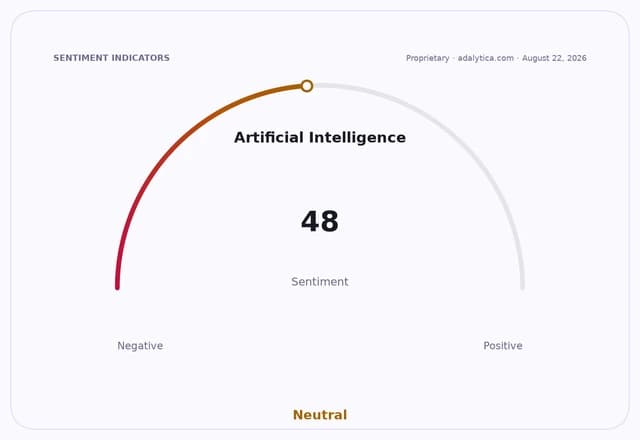
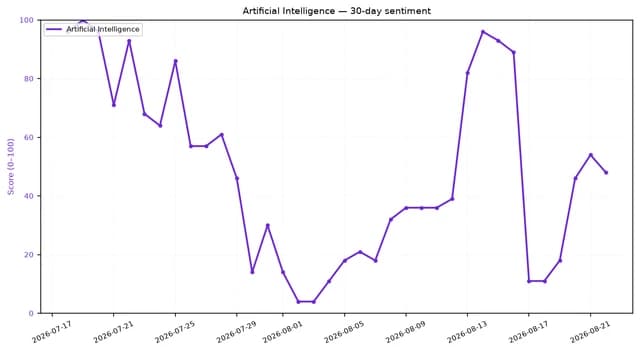
Adalytica’s Microsoft earnings sentiment reads at 93, or “Extreme Greed,” while its AI sentiment remains neutral at 48. That combination is telling. Investors are bullish on the obvious beneficiaries, but the broader AI decision economy still looks underowned in the public imagination. When sentiment is already rich on the obvious names but awareness remains low, the opportunity often lies in the second-order winners that benefit as AI becomes embedded in daily decision-making.
Vietnam’s stated ambition to have AI inform most administrative decisions by 2030 is another reminder that this is not just a U.S. corporate story. Governments are moving toward automation of judgment at scale, and that expands the addressable market far beyond consumer chatbots. The implications run through cloud platforms, chipmakers, cybersecurity, data infrastructure and the software vendors that sit inside regulated workflows.
For investors, the takeaway is straightforward: the AI trade is not ending, it is changing form. The next leg is less about proving AI can answer questions and more about proving it can make decisions at scale. That favors Microsoft as the enterprise distribution hub, Nvidia as the compute monopoly, and the broader cloud and infrastructure ecosystem as the hidden winner. The market may still be pricing AI as a feature; the smarter bet is that it becomes the operating layer of the economy.
| Entity | Gains | Losses |
|---|---|---|
| Microsoft | ▲Enterprise AI monetization | ▼Legacy software margins under pressure |
| Nvidia | ▲Rising inference and compute demand | ▼Buyers facing higher capex |
| Cloud/infrastructure vendors | ▲Recurring usage growth | ▼Standalone app makers |
| Human decision layers | ▲Faster automation | ▼Control, pricing power, relevance |