AI’s biggest legal overhang just got broader, and that matters because the next phase of the artificial intelligence boom will be decided as much in courtrooms as in data centers.
Microsoft, OpenAI sued by Seattle Times and Newsday

The Seattle Times and Newsday have sued OpenAI and Microsoft, accusing the companies of using their journalism to train AI models without permission and to reproduce protected passages. The case adds two more mainstream news outlets to a growing wave of copyright challenges that could force AI developers to pay up for content they once treated as freely available fuel.
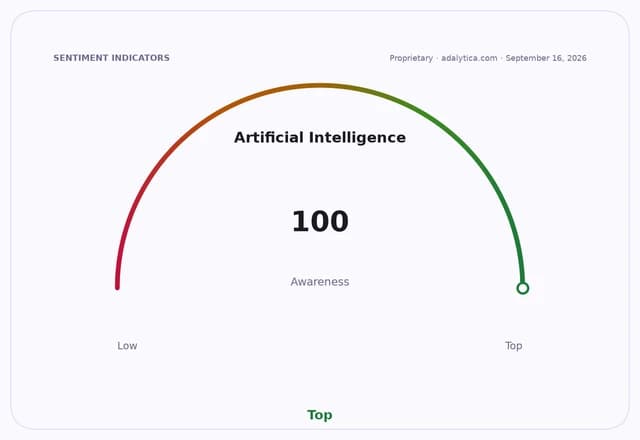
Sentiment IndicatorsⓘProprietary · adalytica.com · September 16, 2026
This is a snapshot — live sentiment, awareness and momentum for 130+ markets update continuously in the dashboard.Open AlphaPulse
That is economically significant because the model-training bill is starting to move from an assumed zero to a negotiated cost. If publishers win leverage, the economics of large language models change: licensing fees, settlement payouts and tighter data sourcing would all add friction to a business that has already burned billions in compute and cloud infrastructure. For Microsoft, which has a long-term strategic partnership with OpenAI, the risk is not just legal expense but the possibility that AI margins get squeezed just as adoption is accelerating across enterprise software.
Investors should care because this is exactly the kind of litigation that can reshape the winners and losers in the AI stack. Companies with the deepest balance sheets and the strongest distribution may be able to absorb licensing costs; smaller model makers and application-layer startups may not. That makes the lawsuit a potential tailwind for incumbents that can negotiate rights at scale, and a headwind for pure-play AI firms whose business models depend on cheap, frictionless access to data.
Microsoft shares have already been volatile, and the stock’s recent trading has been marked by sharp swings around its 50-day moving average and a retreat from its highs, even as long-term AI enthusiasm remains strong. The market may be underestimating how quickly copyright disputes can become a recurring cost of doing business in generative AI, not a one-off nuisance. Microsoft’s own filings acknowledge that AI training and output can trigger infringement claims and that royalty-bearing data access agreements may be needed.
The broader narrative is simple: AI is moving out of the phase where speed alone matters and into the phase where access, rights and pricing power matter more. The government crackdown on Chinese AI copying and the rising number of publisher lawsuits both point to the same endgame — a more regulated, more expensive, but potentially more defensible AI industry. For investors, that argues for favoring the toll roads of the AI economy: cloud providers, infrastructure suppliers and platform companies with pricing power, while staying cautious on model developers most exposed to content claims.
The next catalyst is whether this lawsuit becomes another isolated headline or a template for industry-wide licensing deals. If it is the latter, the market will have to reprice AI earnings assumptions, and the biggest beneficiaries will be the companies that can monetize scarcity rather than merely consume data.
| Entity | Gains | Losses |
|---|---|---|
| Publishers | ▲Licensing leverage | ▼Free-riding risk |
| OpenAI | ▲Scaled model access | ▼Legal costs |
| Microsoft | ▲AI platform control | ▼Margin pressure |
| AI investors | ▲Clearer economics | ▼Multiple compression |