Montenegro’s plan to sharply raise minimum wages under its “Euro model” could push pay faster than output, creating a mismatch that economists say would likely feed inflation, squeeze small firms and raise unemployment rather than lift living standards.
Montenegro Minimum Wage Plan Raises Inflation Fears

That is the central warning from a new chamber of commerce analysis seen by local media, which argues the proposed administrative wage jump is unsustainable without a stronger rise in productivity. The issue matters because wages can only be financed by what an economy produces: if pay rises faster than value added, the gap is usually closed through higher prices, smaller payrolls, more borrowing or a hit to corporate margins.
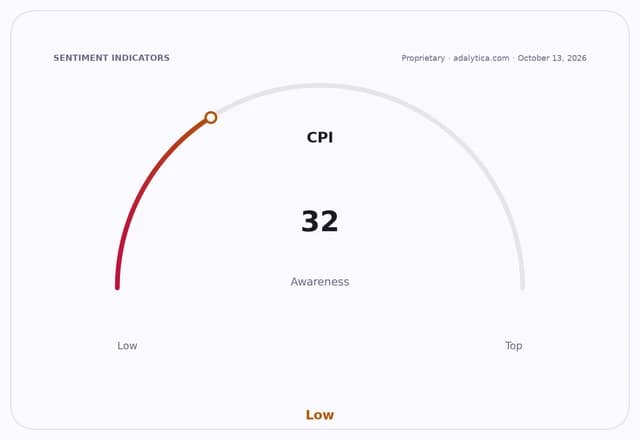
Sentiment IndicatorsⓘProprietary · adalytica.com · October 13, 2026
This is a snapshot — live sentiment, awareness and momentum for 130+ markets update continuously in the dashboard.Open AlphaPulse
Prime Minister Milojko Spajić has framed the policy as a way to raise purchasing power, improve labor market competitiveness and slow emigration to the EU. But the debate now goes to the heart of how Montenegro wants to converge with Europe: through faster productivity and investment, or by decree. The warning from the business community is that the latter route risks copying the symptoms of richer economies without their productive base.
The chamber’s analysis says Montenegro could end up with higher net minimum wages than 15 EU members despite far lower output per capita. It points to Malta, Cyprus and Slovenia as examples where larger economies support much higher pay scales, while Montenegro would be attempting to leapfrog its fundamentals. The strongest version of the proposal would lift the minimum wage for university graduates to as much as 1,400 euros, putting the country among the highest minimum-wage jurisdictions in the EU on a relative basis.
For investors, the key question is not whether wages can rise in nominal terms — they already have. It is whether the economy can absorb another large step without damaging employment, bank credit quality, company profitability and fiscal balances. Private-sector firms, especially small enterprises, would be the first to feel the pressure. Public-sector workers would likely gain purchasing power, but that would be financed by taxpayers and could widen the gap between state and private pay.
The macro backdrop makes the debate sharper. Montenegro’s GDP per capita stood at 13,271 euros last year, or roughly 32% of the EU average in nominal terms, and about 54% once price differences are adjusted. Actual individual consumption has improved, reaching 71% of the EU average, but that still leaves the country well below the bloc and highlights how much convergence remains to be done. The chamber’s point is that wage policy is running ahead of that convergence.
Economists quoted in the local reports say the danger is straightforward: if the minimum wage moves above the market-clearing level, unemployment tends to rise. In Montenegro’s case, they argue, that risk is amplified by weak productivity growth, imported inflation and a labor market still shaped by political connections and an uneven private sector. In that scenario, firms would either raise prices, cut headcount or delay investment.
The government’s supporters will argue that higher wages can help retain workers, particularly in a region where emigration has hollowed out labor markets. That is a legitimate economic objective. But the bear case is that wage compression without productivity reform simply transfers income from employers and consumers to employees in the short run, then destroys jobs or erodes purchasing power later through inflation.
The chamber’s alternative is to phase in increases gradually and pair them with pro-production measures, including a 50 million-euro entrepreneurship fund and agricultural grants. That approach is slower and politically less dramatic, but it targets the bottleneck that matters most: the supply side. More investment, more competition and higher productivity would make wage gains durable. Without that, Montenegro risks discovering that it can administratively raise pay, but not the economy that must support it.
| Entity | Gains | Losses |
|---|---|---|
| Minimum-wage workers | ▲Higher nominal pay | ▼Risk of inflation erosion |
| Small private firms | ▲— | ▼Higher labor costs |
| Public-sector employees | ▲Better purchasing power | ▼Higher tax burden risk |
| Government | ▲Short-term political support | ▼Fiscal and macroeconomic credibility |