Real wages are set to decline across most of Europe’s biggest economies over the next two years, with Germany the only major outlier, underscoring how higher energy costs and still-sticky inflation are eroding household spending power just as labor markets begin to cool.
Europe Real Wages to Fall, Germany to Rise

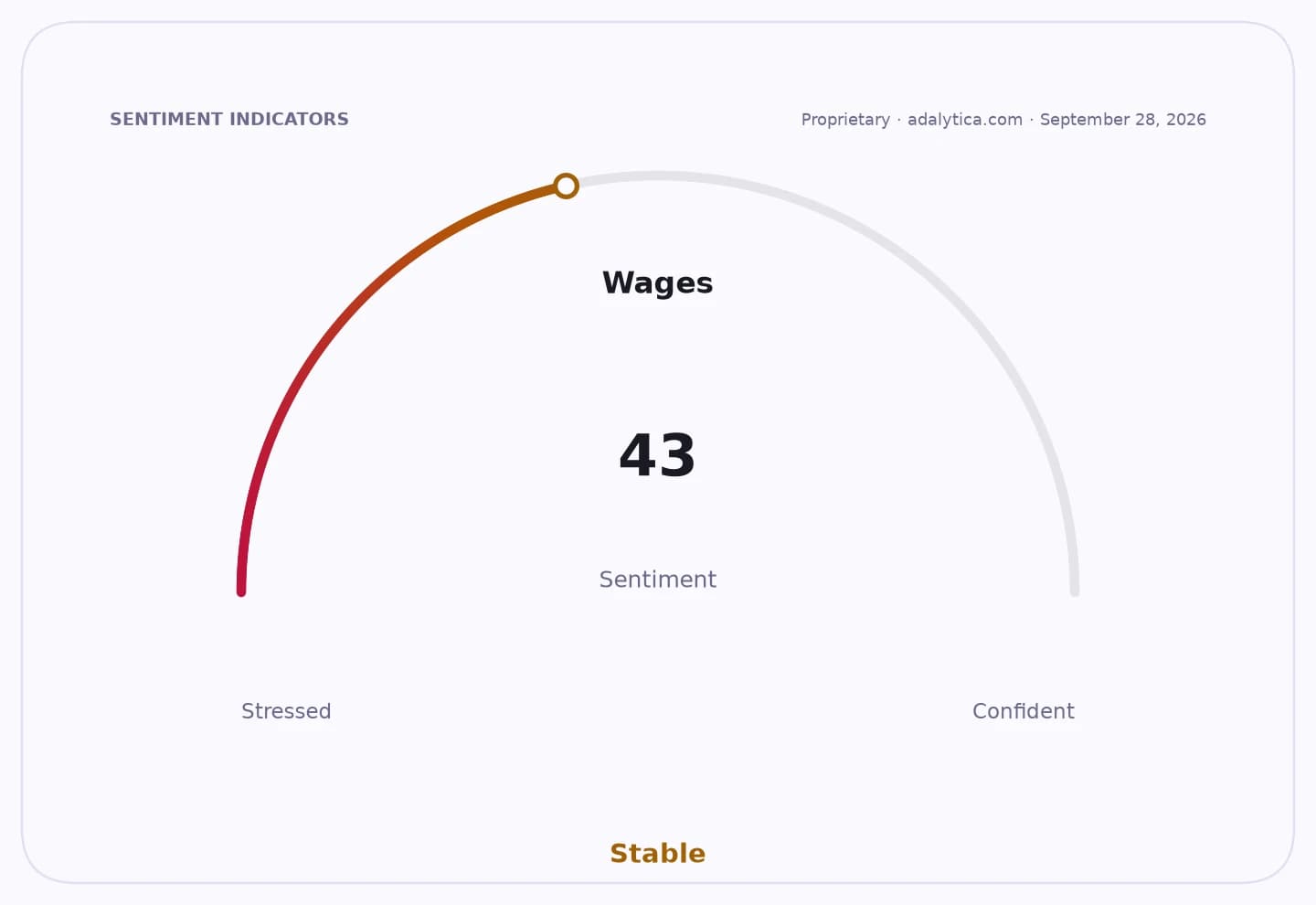
The OECD’s latest Employment Outlook projects real pay to fall in Italy, Spain, France and the UK between the first quarter of 2026 and the first quarter of 2027, while Germany is expected to post gains throughout the period. For investors, the split matters because weaker real incomes typically restrain consumer demand, while countries that preserve purchasing power tend to support domestic growth, wage-sensitive sectors and retail spending.
Sentiment IndicatorsⓘProprietary · adalytica.com · October 9, 2026
This is a snapshot — live sentiment, awareness and momentum for 130+ markets update continuously in the dashboard.Open AlphaPulse
Italy faces the sharpest deterioration. The OECD sees real wages in the third quarter of 2026 running 1.9% below the first quarter of that year, with the gap still 0.6% wide at the end of 2027. Inflation in Italy was estimated at 4.1% in September, and OECD economist Alexandre Georgieff said high energy costs are poised to erase recent gains in real pay because of the country’s dependence on imported oil and gas.
Spain’s decline is smaller but more persistent. Real wages are forecast to stay 0.7% below early-2026 levels through all of 2027, even as job creation remains strong. Inflation was estimated at 5% in September, suggesting households may keep seeing spending power squeezed despite a relatively resilient labor market.
The UK is expected to see a deeper but shorter-lived hit. Real wages are projected to fall 1.6% below early-2026 levels by the final quarter of that year before recovering to 1% above the starting point by the end of 2027. UK inflation was estimated at 3.1% in August, and Charles Cotton of the CIPD said Britain is especially exposed to energy-price volatility from Middle East tensions, while employers are growing more cautious on pay awards.
France should suffer the mildest decline among the group, with real wages bottoming out 0.5% below early-2026 levels in the second quarter of next year before almost fully recovering by late 2027. Inflation there was estimated at 3.4% in September, below the euro-area average of 3.8%, but Georgieff said wage adjustment is likely to be slow as unemployment rises.
Germany is the exception. Real wages are projected to rise 1.7% by the fourth quarter of 2027, supported by a tight labor market, stronger fiscal stimulus and rising capacity use after years of stagnation. The country’s minimum wage is also scheduled to rise 8.4% at the start of 2026 and another 5% in 2027, reinforcing domestic income growth.
For markets, the backdrop points to a Europe split between economies where consumer demand may remain under pressure and Germany, where higher household income could help underpin spending. The euro area overall is still expected to see a brief 0.4% dip in real wages around mid-2026 before a recovery later in 2027, but the uneven country mix suggests patchy support for growth, uneven retail performance and continued sensitivity to energy prices.
| Entity | Gains | Losses |
|---|---|---|
| Germany households | ▲Higher real wages | ▼None in forecast |
| Italy, Spain, France, UK consumers | ▲Some wage recovery later | ▼Near-term purchasing power |
| Exporters to Germany | ▲Stronger domestic demand | ▼— |
| Retailers in Italy/Spain/UK | ▲— | ▼Softer consumer spending |