Higher energy costs are set to squeeze Spain’s growth and push inflation higher, according to BBVA Research, which says a prolonged jump in oil and gas prices could add up to 0.9 percentage point to inflation by 2027 while shaving as much as 0.5 point off GDP.
Spain Energy Costs Raise Inflation and Slow Growth
That is the real economic significance of the bank’s latest outlook: Spain is facing a classic supply shock at a time when financial conditions are already tightening. For households, that means weaker purchasing power. For businesses, it means higher input costs and more pressure on margins. For policymakers, it complicates the European Central Bank’s path just as the economy is still trying to absorb earlier rate rises.
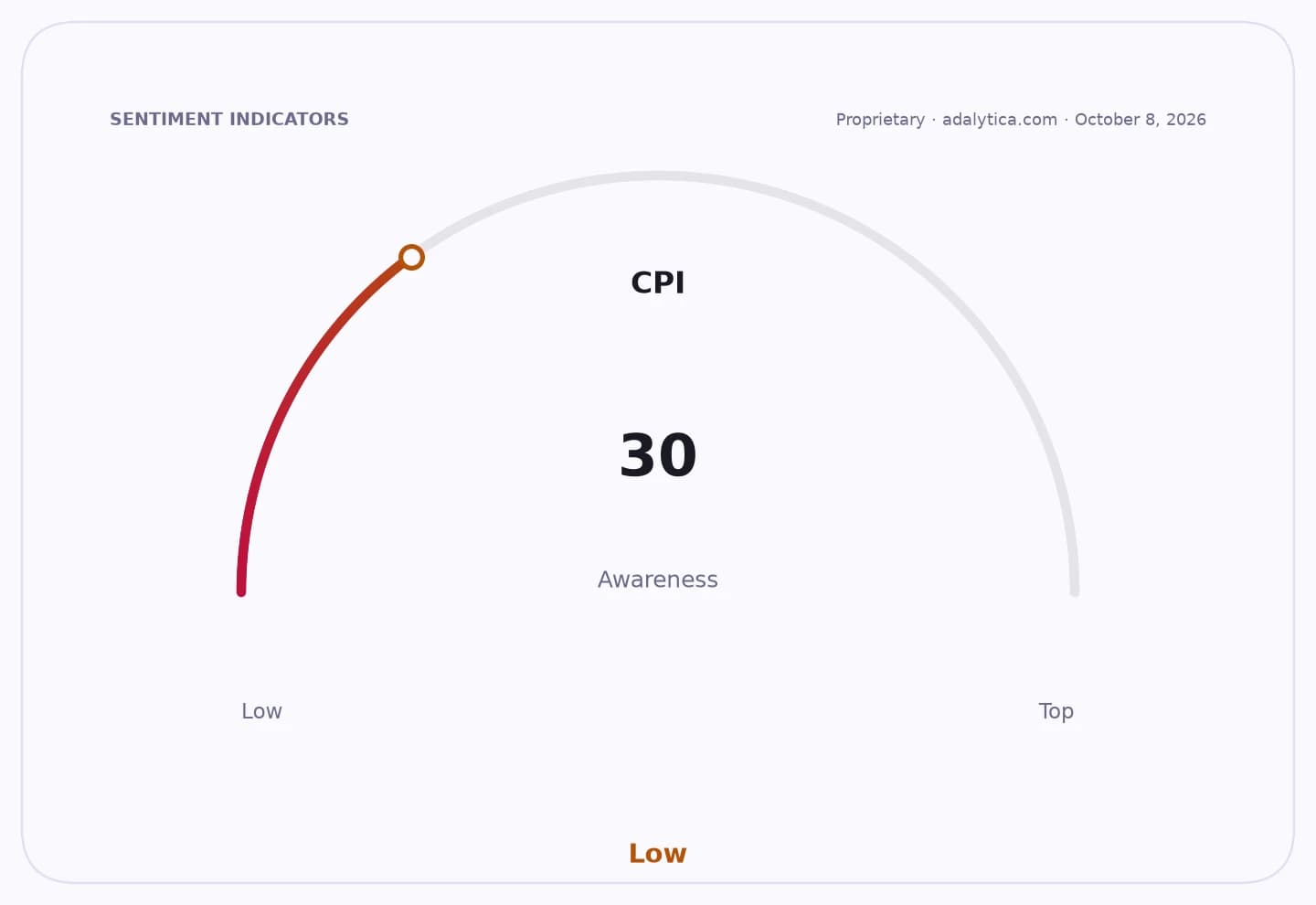
Sentiment IndicatorsⓘProprietary · adalytica.com · October 8, 2026
This is a snapshot — live sentiment, awareness and momentum for 130+ markets update continuously in the dashboard.Open AlphaPulse
BBVA now expects Spain’s economy to grow 2.6% this year, but to slow to 2.1% in 2027. It sees inflation at 3.6% in 2026 and 3.2% in 2027, underscoring how energy can keep price pressures sticky even as broader demand cools. The economists also estimate that the shift in the interest-rate outlook could subtract 0.3 point from average GDP growth in 2026 and 2027, assuming another 25-basis-point increase in December.
That combination matters because it hits Spain’s most important engines from both sides. Private consumption is still expected to expand, but at a slower pace as higher prices and borrowing costs bite. BBVA sees consumer spending rising 3.1% in 2026 and 2.2% in 2027, supported by employment growth, lower household savings and housing wealth. Yet the longer the energy shock lasts, the less families can cushion it by dipping into savings or credit.
CPIAUCSL vs DCOILWTICO — macro contextadalytica.com
Explore this data interactively — full history, time series and cross-market comparisons.Open AlphaPulse
The broader story is that Spain’s recovery remains intact, but more fragile than the headline growth rate suggests. BBVA expects exports of goods to fall 0.6% in 2026 on higher costs and sluggish Europe, while services exports continue to outperform. Investment is uneven, with machinery and equipment holding up better than construction. Fiscal policy is still mildly expansionary, with the deficit seen at 2.7% of GDP in 2026 and 2.4% in 2027, but that support looks increasingly constrained if inflation stays elevated.
For investors, the message is not simply that Spain faces more inflation. It is that the country’s growth mix is shifting toward the sectors best able to pass through costs and away from those exposed to compressed demand. Energy, utilities, select exporters and companies tied to electrification and infrastructure may gain relative strength, while consumer-facing businesses, rate-sensitive names and highly leveraged borrowers face a tougher backdrop.
The market should also pay attention to the second-order effects. BBVA warned that tighter central bank responses to higher inflation can rattle sovereign and corporate debt markets, while grid congestion from faster electrification could become a bottleneck for future investment. In other words, the inflation shock is not just a near-term macro problem; it is a catalyst for capital allocation across energy, utilities, housing, credit and infrastructure.
Our thesis is straightforward: Spain’s next big market opportunity will come from owning the winners of the cost-of-capital era, not the firms most exposed to consumer strain. If energy prices stay firm, inflation risk rises, rate cuts get delayed, and investors will be rewarded for leaning into assets with pricing power, regulated returns and exposure to the capex cycle around electrification and AI-driven productivity. The market underestimates how quickly an energy shock can reshape the investable landscape.
| Entity | Gains | Losses |
|---|---|---|
| Energy producers | ▲Higher selling prices | ▼Volatile demand |
| Utilities and grid builders | ▲Electrification capex | ▼Congestion risk |
| Consumers and retailers | ▲Passing through costs | ▼Softer real spending |
| Spain’s government | ▲Temporary fiscal support levers | ▼Slower deficit improvement |