Nvidia and Advanced Micro Devices are being pulled higher by a simple but powerful message from the AI industry: demand for compute is still outrunning supply, even as the cost of running large models climbs.
Nvidia, AMD Gain as AI Compute Demand Stays Tight

That matters because the AI buildout is no longer just a story about model breakthroughs; it is increasingly a story about capacity, pricing power and who controls the scarce hardware underneath the boom. When GPU rental rates jump 22% in a month, as market commentary in the data showed for Nvidia H100s, it suggests the bottleneck is not enthusiasm but access to chips, power and data-center infrastructure. For investors, that keeps the earnings backdrop constructive for Nvidia and, increasingly, for AMD — but it also raises the risk that today’s scarcity economics invite faster competition, heavier capital spending and eventual normalization.
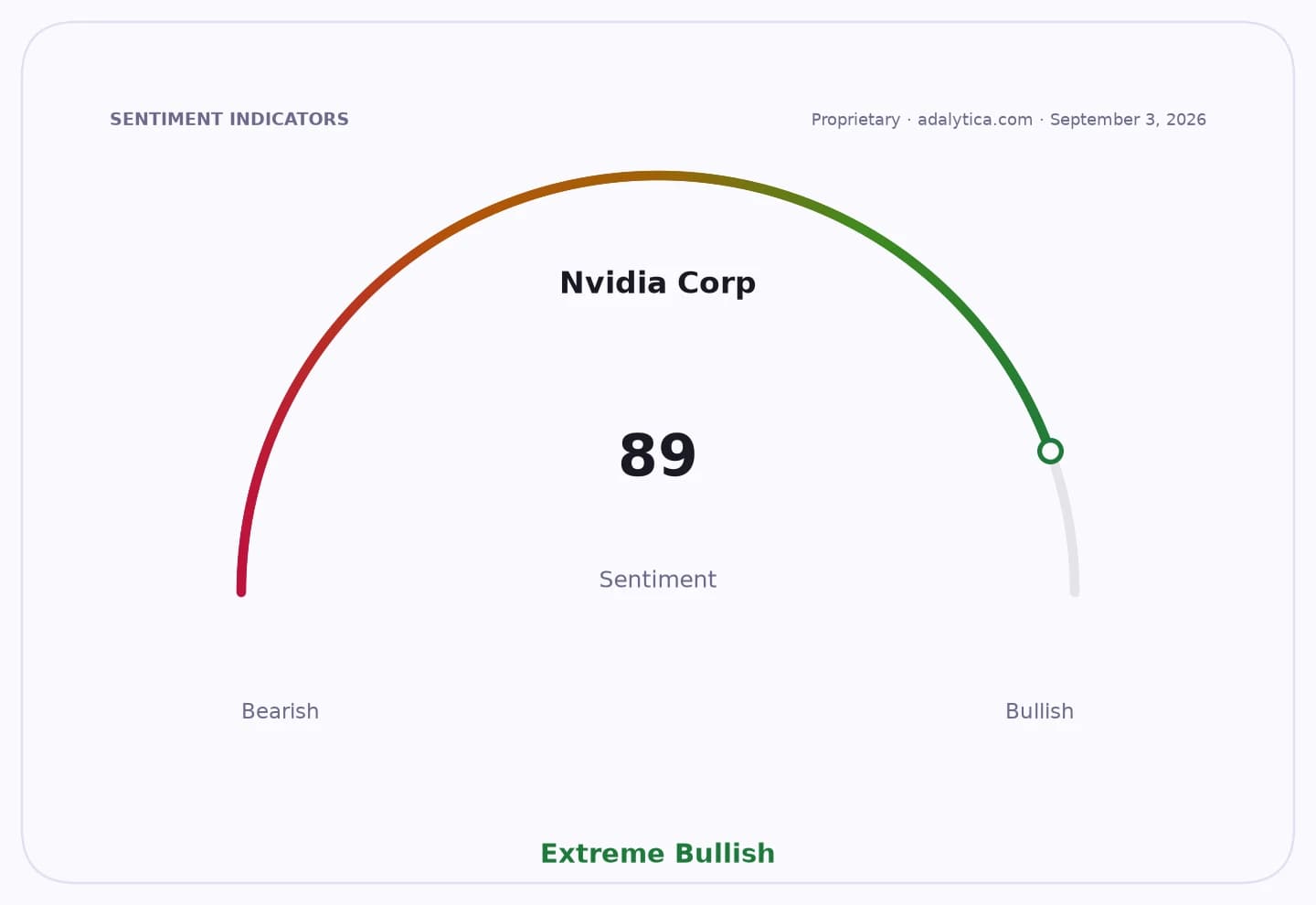
Sentiment IndicatorsⓘProprietary · adalytica.com · September 13, 2026
This is a snapshot — live sentiment, awareness and momentum for 130+ markets update continuously in the dashboard.Open AlphaPulse
The market is treating the shortage as a feature, not a bug. Nvidia shares were last around $218.29, above the 50-day moving average of $212.36 and well above the 200-day average of $197.11, while AMD traded at $516.13, also above its 50-day and 200-day moving averages. Those levels matter because they show the sector’s strongest names are still attracting capital despite volatility. The VanEck Semiconductor ETF, meanwhile, was steady near $568.53, highlighting that the broader chip complex has stabilized after a summer surge and pullback.
What is driving the move is the economics of AI adoption. The source material described “unprecedented demand” for newer model capabilities and cited a case where AI-agent tooling could solve a problem for about $20 that would previously have carried a token cost of roughly $300,000. Whether that comparison proves durable or not, it captures the central investment thesis: if compute is becoming materially more productive, customers will keep spending even when unit prices remain elevated. That is the bull case for Nvidia and AMD — a market in which the payoff from each incremental GPU remains high enough to justify aggressive buying.
For Nvidia, the setup is especially favorable. The company remains the dominant supplier to the data-center AI stack, and its stock’s recovery above key technical levels suggests investors are again willing to pay for that scarcity premium. Adalytica’s proprietary Nvidia earnings sentiment gauge showed a snapshot reading of 78, or “Greed,” even as its short-term awareness score dropped sharply, signaling that attention around the name is cooling even while conviction remains high. That combination often appears when a stock is strong but crowded: the fundamental story is still dominant, but expectations are elevated.
AMD’s move is more nuanced. The company is gaining credibility as an alternative supplier into AI infrastructure, and its share price has been far more explosive than Nvidia’s over the past year. But AMD’s valuation now depends on execution catching up with narrative. Its latest 10-Q makes clear that supply commitments, customer demand and the pace of AI adoption are all key variables. In other words, AMD can benefit from the same compute shortage, but it must convert that opportunity into sustained gross-margin expansion and repeatable data-center revenue to justify the re-rating.
The bigger backdrop is that the AI infrastructure cycle is spreading beyond chipmakers. Microsoft’s filings warn of power constraints and unpredictable AI demand, underscoring that the bottleneck is increasingly system-wide: chips, electricity, networking and data-center capacity all need to scale together. That is good news for suppliers of semiconductors and related infrastructure in the near term. It is also a reminder that margins can shift quickly if supply catches up, hyperscalers negotiate harder or internal chip design reduces reliance on merchant GPUs.
There are risks. If GPU prices keep rising too fast, buyers could delay deployments or accelerate custom silicon efforts. If model efficiency improves faster than expected, the demand curve could steepen temporarily and then flatten. And if competition intensifies, the current scarcity premium embedded in Nvidia and AMD valuations could compress. Still, the near-term narrative remains intact: the AI economy is consuming compute faster than the industry can build it.
For investors, that means the winners are still the chipmakers with the most exposed leverage to AI capex, while the losers are buyers facing rising infrastructure costs and any rival suppliers without scale. The next test will be whether hyperscalers and enterprise customers keep absorbing higher compute prices without slowing deployment. If they do, Nvidia and AMD remain direct beneficiaries of one of the most powerful capital-spending cycles in the market.
| Entity | Gains | Losses |
|---|---|---|
| Nvidia | ▲GPU pricing power | ▼Buyers facing tighter supply |
| AMD | ▲AI data-center share gains | ▼Lagging rivals in scale |
| Hyperscalers | ▲Faster model training | ▼Higher infrastructure bills |
| Custom chip makers | ▲Longer-term substitution case | ▼Near-term merchant GPU buyers |