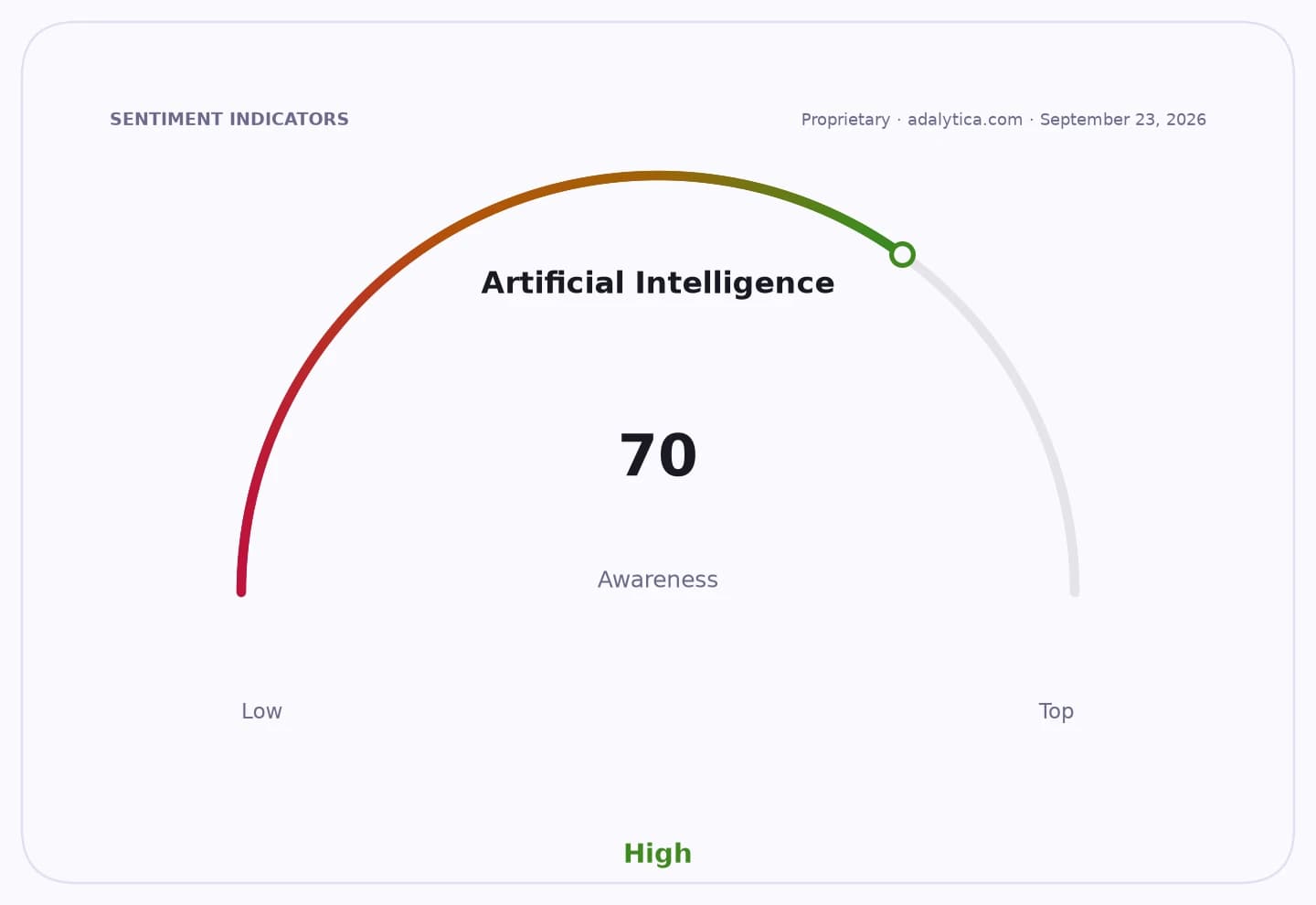
NVIDIA and Broadcom are still two of the cleanest ways for investors to own the artificial intelligence buildout, and the reason matters more than the latest noise around bubbles, Federal Reserve policy or data-center skepticism.
NVIDIA and Broadcom remain AI buildout winners

That’s the view from NewEdge Wealth portfolio manager Jay Peters, who said both chipmakers continue to stand out because they are growing fast, highly profitable and throwing off enough free cash flow to keep funding their expansion. For long-term investors, that combination is hard to ignore: in a market still trying to decide whether AI is overextended or just getting started, earnings and cash flow usually end up winning the argument.
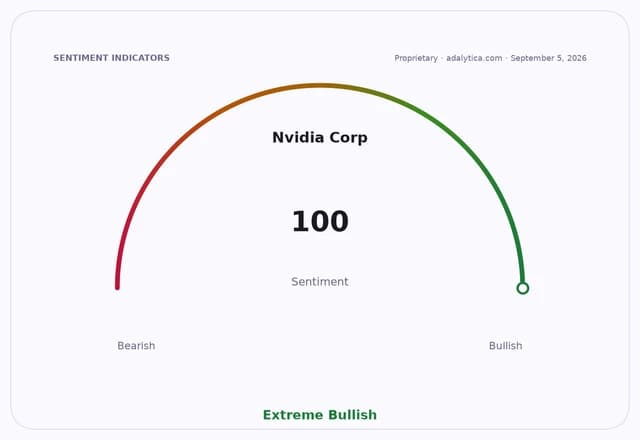
Sentiment IndicatorsⓘProprietary · adalytica.com · September 5, 2026
This is a snapshot — live sentiment, awareness and momentum for 130+ markets update continuously in the dashboard.Open AlphaPulse
Peters’ bullish case is built on a simple but powerful idea. AI adoption is still forcing hyperscalers and enterprise customers to spend heavily on compute, networking and related infrastructure, and he expects hyperscaler capital spending to rise about 30% next year. Even that may prove conservative if the buildout keeps broadening beyond the first wave of model training into inference, enterprise deployment and new AI services.
That backdrop helps explain why both NVIDIA and Broadcom continue to command premium valuations without looking wildly expensive. Peters said the stocks trade at roughly 19 to 20 times forward earnings, which is not a bargain-bin multiple, but it is also not outrageous for companies with this level of profitability and secular growth. NVIDIA shares were trading around $233.22, while Broadcom was near $355.47, showing how differently the market is treating two leaders in the same theme.
Nvidia Corp — 30-day sentimentadalytica.com
Explore this data interactively — full history, time series and cross-market comparisons.Open AlphaPulse
What makes the story more interesting is that investors are no longer just buying “AI” as a concept. They are increasingly buying the plumbing behind it. NVIDIA remains the central player in accelerated computing, while Broadcom has become one of the key suppliers of custom chips and networking gear that hyperscalers need to build out massive AI clusters. In other words, these are not one-product stories. They are infrastructure franchises.
There are, of course, reasons for caution. Peters acknowledged the growing debate over “circular financing” in AI, where big companies, suppliers and customers can end up reinforcing one another’s spending in ways that may not be fully sustainable. He also pointed to concerns about rising leverage across the ecosystem. That is worth watching. If the industry starts leaning too hard on debt or financially engineered dealmaking, investors could eventually demand a higher risk premium.
But that risk does not erase the bigger investment case. NVIDIA and Broadcom generate enough cash and operate with enough margin strength to absorb large investments better than most peers. That is the key distinction for investors thinking in years, not quarters. A lot of AI names can tell a good story. Far fewer can turn that story into durable free cash flow.
The market backdrop matters too. Risk appetite has faded from its second-quarter highs, seasonal weakness is a headwind, and uncertainty around Fed policy remains elevated. Yet the AI spending cycle still appears intact. Peters said “we’re still incredibly short compute in this country,” and that shortage is exactly what tends to sustain multi-year capital spending waves. When demand is structural, volatility often becomes opportunity.
That is why the current debate should not really be framed as AI exuberance versus AI bust. The more useful question for investors is which companies are converting the AI boom into lasting competitive advantages. On that score, NVIDIA and Broadcom still look like two of the best-positioned names in the market.
For patient investors, the right move may be to keep both on the watchlist, or continue building positions gradually rather than trying to time every swing in sentiment. AI spending can be lumpy, and the sector may stay volatile. But if the compute shortage persists and earnings keep compounding, these two chips giants could remain core long-term winners.
| Entity | Gains | Losses |
|---|---|---|
| NVIDIA | ▲AI platform expansion | ▼Bubble skeptics |
| Broadcom | ▲Hyperscaler spending boom | ▼Short-term volatility traders |
| Hyperscalers | ▲More compute capacity | ▼Higher capital spending |
| Investors with patience | ▲Long-term compounding | ▼Market-timers |