Nvidia’s refusal to give China access to its most advanced chips signals that the world’s most valuable semiconductor company is drawing a hard line in the expanding U.S.-China technology split, with implications that reach well beyond one customer market.
Nvidia China Limits Turn AI Story Into Policy Trade

The issue matters economically because Nvidia sits at the center of the AI infrastructure buildout, and China remains too large a market to ignore even as Washington tightens export controls. Blocking the newest chips preserves Nvidia’s access to U.S. regulators and the highest-margin end of the AI cycle, but it also leaves billions of dollars of potential demand vulnerable to policy decisions rather than product demand. That makes China less a growth engine than a geopolitical overhang, and it forces investors to think about Nvidia not just as a chip maker but as a company priced to navigate trade restrictions as much as technical leadership.
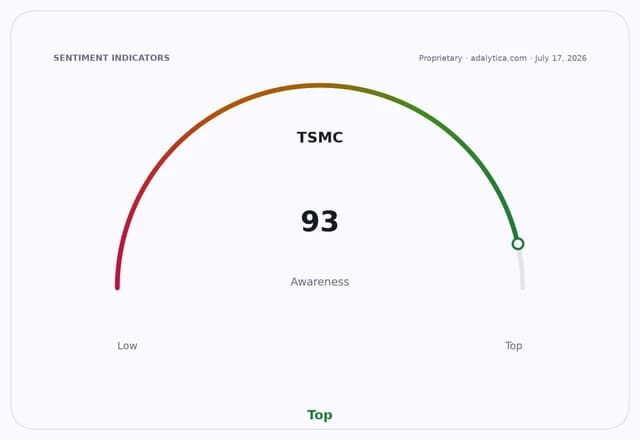
Sentiment IndicatorsⓘProprietary · adalytica.com · July 17, 2026
This is a snapshot — live sentiment, awareness and momentum for 130+ markets update continuously in the dashboard.Open AlphaPulse

The market has already been reflecting that tension. Nvidia shares closed at $207.40 on July 16, below their May peak near $235.47, but still comfortably above the 50-day moving average around $209.68 and well above the 200-day average near $192.09. The stock’s RSI near 60 suggests momentum has cooled from overbought levels without breaking the broader uptrend, while the MACD has turned back positive. In other words, investors have not abandoned the trade; they are recalibrating how much China exposure still belongs in the valuation.
That recalibration is unfolding against a broader semiconductor reshuffle. AMD, another major AI chip supplier, has seen its shares retreat to $500.94 from above $580 in late June, even as its long-term trend remains strong. Intel, meanwhile, has swung violently lower to $96.98 after a sharp run-up earlier this year, underscoring how quickly capital is being rerated across the chip complex as investors separate genuine AI beneficiaries from names caught in policy-driven volatility.
The China question is also no longer just about Nvidia’s sales. Reuters reporting that Nvidia has begun shipping H200 AI chips to China shows the company is still trying to preserve a foothold, but the latest stance on its most advanced products suggests that access is likely to remain partial and precarious. That creates a two-sided investment case: bulls can argue Nvidia protects its franchise by staying compliant and staying ahead technologically, even if it sacrifices some China upside. Bears will counter that every new restriction narrows the addressable market and increases the risk that Chinese customers accelerate substitution efforts or that domestic rivals move faster to close the gap.
Those substitution pressures are increasingly real. China is pushing its own chip technology, with Huawei and others working on alternatives that reduce dependence on leading-edge U.S. GPUs and memory. If that effort gains traction, Nvidia’s long-term China opportunity could shrink even as AI demand elsewhere remains strong. At the same time, the Adalytica U.S.-China relations gauge has turned more active, with sentiment still neutral but awareness elevated, reflecting how quickly trade and technology headlines now move the market.
For investors, the key takeaway is that Nvidia’s valuation will likely remain tethered to three variables: AI demand outside China, the scope of U.S. export controls, and whether China’s domestic chip ecosystem can absorb more of the demand Nvidia can no longer serve. As long as those forces remain in tension, Nvidia can still be the dominant AI infrastructure name — but it will no longer be a pure growth story. It is now also a policy trade.
| Entity | Gains | Losses |
|---|---|---|
| Nvidia | ▲U.S. compliance, premium margins | ▼China revenue upside |
| U.S. regulators | ▲Export-control leverage | ▼Faster Chinese self-sufficiency |
| Chinese AI buyers | ▲Short-term supply visibility | ▼Access to cutting-edge chips |
| AMD and domestic rivals | ▲Incremental opportunity | ▼If Nvidia retains technical lead |