NVIDIA is deepening its push to make artificial intelligence central to gaming and personal computing, unveiling DLSS 5, new RTX Spark Windows PCs and broader local-AI support as the company tries to keep its graphics franchise at the center of the next hardware cycle.
NVIDIA Unveils DLSS 5 and RTX Spark PCs
The launches matter because they widen NVIDIA’s addressable market beyond data centers and into consumer PCs, a segment where faster rendering, AI-assisted workflows and premium gaming features can help support pricing and demand. For investors, that gives NVIDIA another way to defend margins and reinforce its ecosystem at a time when the stock is already trading near the top of its recent range.
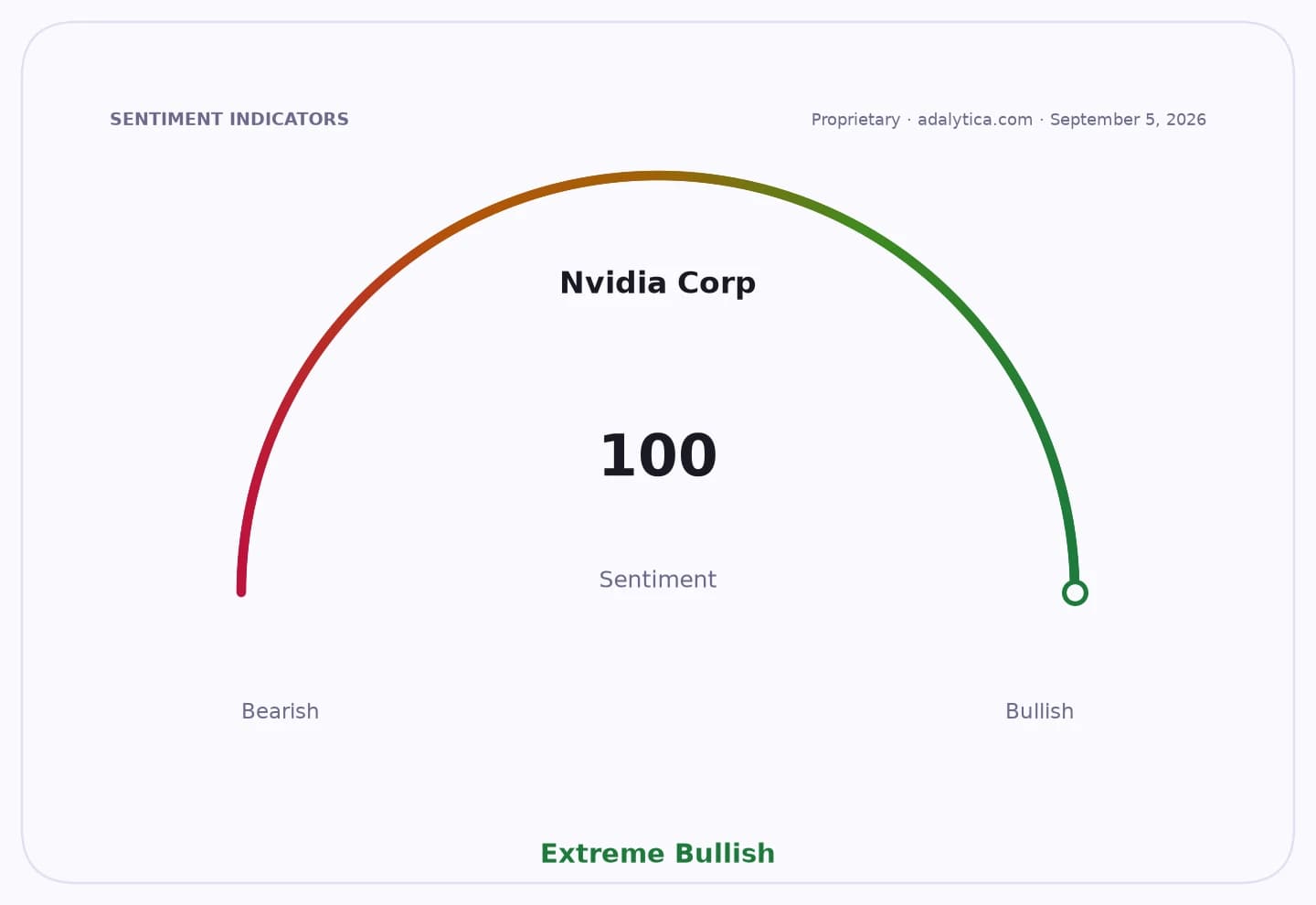
Sentiment IndicatorsⓘProprietary · adalytica.com · September 5, 2026
This is a snapshot — live sentiment, awareness and momentum for 130+ markets update continuously in the dashboard.Open AlphaPulse
DLSS 5 introduces 3D-guided neural rendering, which NVIDIA says uses AI to add more realistic lighting and material detail while preserving the underlying character design. The feature debuts with NBA 2K27 and is available on GeForce RTX 50-series GPUs, laptops and GeForce NOW, extending NVIDIA’s software advantage across hardware categories that matter for upgrade demand.
The company also said RTX Spark Windows PCs will launch in October, targeting local AI workloads, gaming and creative tasks with a 1 petaflop RTX Blackwell GPU, up to 128GB of unified memory and a 20-core Grace CPU. Lenovo and Acer have already shown systems based on the platform, underscoring that NVIDIA wants the PC market to absorb more AI compute rather than leave it solely to cloud providers.
NVIDIA shares closed at $230.36 on Sept. 4, up from $224.41 two sessions earlier, while the 50-day moving average sat near $210.57 and the 200-day average near $196.53, keeping the stock above both key technical levels. Adalytica’s NVIDIA earnings sentiment snapshot also showed “Extreme Greed,” reflecting elevated investor enthusiasm around the company’s AI roadmap.
The broader backdrop is a technology sector still racing to turn AI features into consumer products, from smartphones to design software. TECNO’s concept phone with a near borderless 0mm bezel illustrates how handset makers are chasing visual differentiation, while NVIDIA is using AI to make graphics and local computing more capable rather than merely faster.
The key test now is whether developers, game publishers and PC makers build enough real use cases around DLSS 5 and RTX Spark to turn product demos into sustained shipments. NVIDIA’s next earnings update and early demand indicators for RTX Blackwell-based systems will show whether this AI hardware push translates into another revenue leg.
| Entity | Gains | Losses |
|---|---|---|
| NVIDIA | ▲More AI-enabled product demand | ▼Slower upgrade cycles |
| PC makers using RTX Spark | ▲Access to premium AI PCs | ▼Commodity pricing pressure |
| Gamers and creators | ▲Better graphics and local AI tools | ▼Higher-end hardware costs |
| Rival chipmakers | ▲— | ▼Pressure to match NVIDIA features |