Wall Street’s rebound was led by artificial-intelligence stocks even as European markets fell after protests unsettled sentiment, underscoring how a narrow group of U.S. megacaps continues to drive global equity leadership while political risk hits regional indices more directly.
Nvidia, Microsoft Lead Wall Street AI Rebound
The split matters because AI-linked shares now account for a disproportionate share of the market’s directional moves. When the biggest names in the sector firm, they can offset broader weakness in cyclicals and keep the U.S. benchmarks afloat even when risk appetite elsewhere fades. That leaves investors focused less on the breadth of the rally than on whether capital spending, earnings and valuation can keep supporting the trade.
Sentiment IndicatorsⓘProprietary · adalytica.com · October 24, 2026
This is a snapshot — live sentiment, awareness and momentum for 130+ markets update continuously in the dashboard.Open AlphaPulse
Nvidia, the clearest bellwether for the theme, ended the latest stretch at $210.96 on Oct. 23 after swinging between $177.65 and $235.20 in recent months. Its 50-day moving average stood at $222.39, while the 200-day average was $203.36, showing the stock still trading above its longer-term trend but below recent highs. The RSI had fallen to 22.0, a level that typically suggests the shares were technically oversold after the recent selloff. The semiconductor ETF SMH showed a similar pattern, closing at $527.20 after dropping from $556.70 two days earlier, with RSI at 15.0 and the stock below its 50-day average of $575.09.
Microsoft also held up better than the broader market, closing at $524.51 on Oct. 23 after a modest pullback from $532.95 the day before. The stock remained above its 200-day moving average of $435.37, reflecting the market’s willingness to keep paying for exposure to AI infrastructure and cloud demand even as near-term volatility persists. But its RSI at 49.6 and a MACD below its signal line point to a pause rather than a clean breakout.
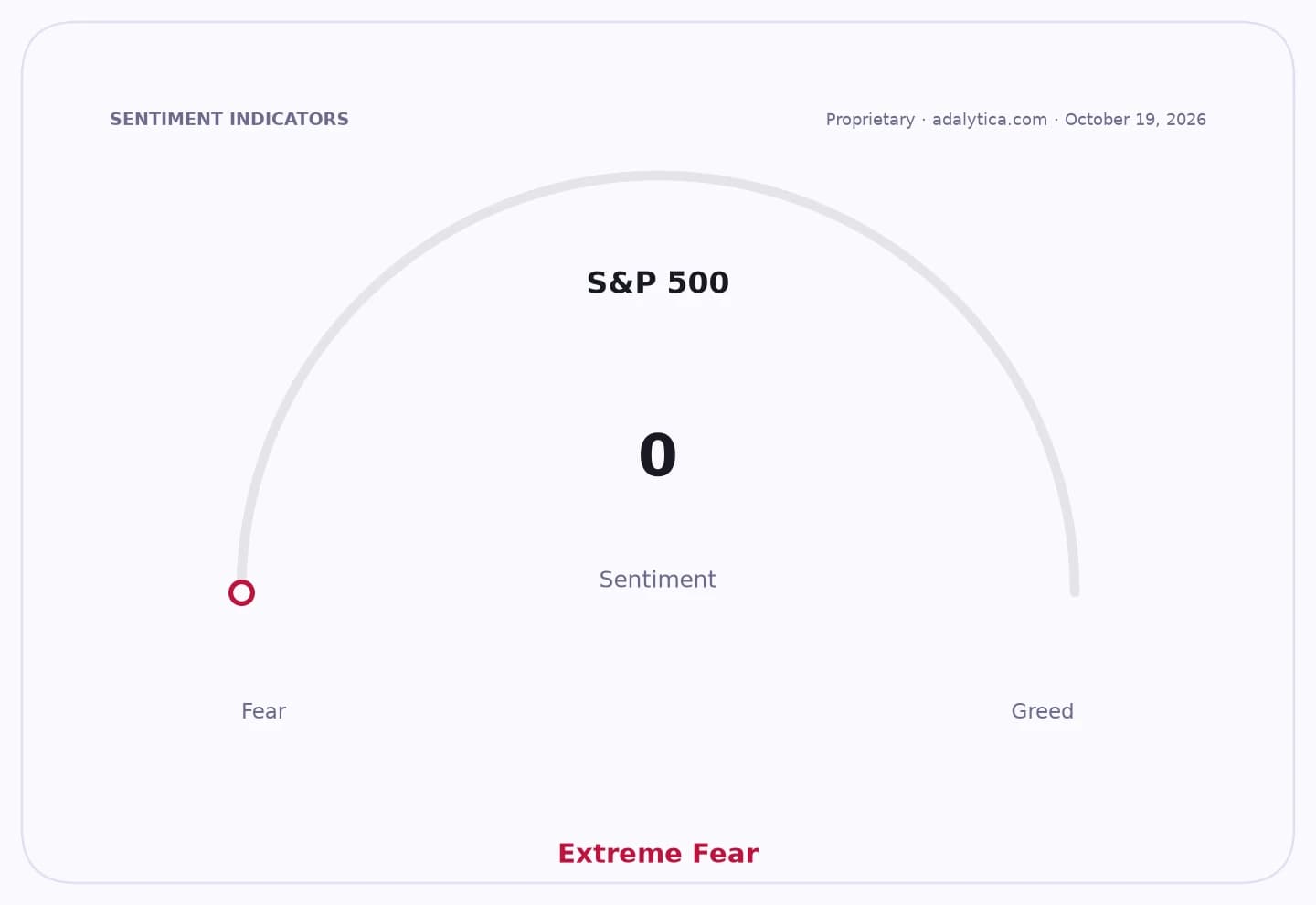
The market backdrop remains fragile. Adalytica’s S&P 500 trade signals put sentiment at 0.0, labeled “Extreme Fear,” even as awareness stayed neutral, a sign that investors are alert to abrupt swings but not yet positioned for a full capitulation. The U.S. dollar gauge showed weakening momentum too, with awareness at 5.0 and a one-day change of -14.0, suggesting the macro backdrop is not providing a strong tailwind to risk assets.
For investors, the key question is whether the AI rally is broadening into a sustainable earnings story or narrowing into a momentum trade dependent on a handful of large-cap names. The bull case is that AI demand continues to support capital spending and revenue growth across chips, cloud and software. The bear case is that valuations and technical damage leave the group vulnerable if earnings fail to keep pace or if broader political and macro shocks drag down risk appetite again.
European markets, by contrast, remain more exposed to local event risk and weaker sector leadership, so protests can have a larger immediate impact on sentiment there than in the U.S. But if the AI complex loses traction, the spillover would likely be felt globally, given how much of the current equity uptrend still hinges on the same few U.S. technology names.
| Entity | Gains | Losses |
|---|---|---|
| Nvidia and AI chipmakers | ▲Rebound leadership | ▼Valuation-sensitive shorts |
| Microsoft and mega-cap tech | ▲Index support | ▼Broad market breadth |
| Wall Street indices | ▲Stabilized gains | ▼Defensive sectors trailing |
| European equities | ▲— | ▼Protest-hit sentiment |