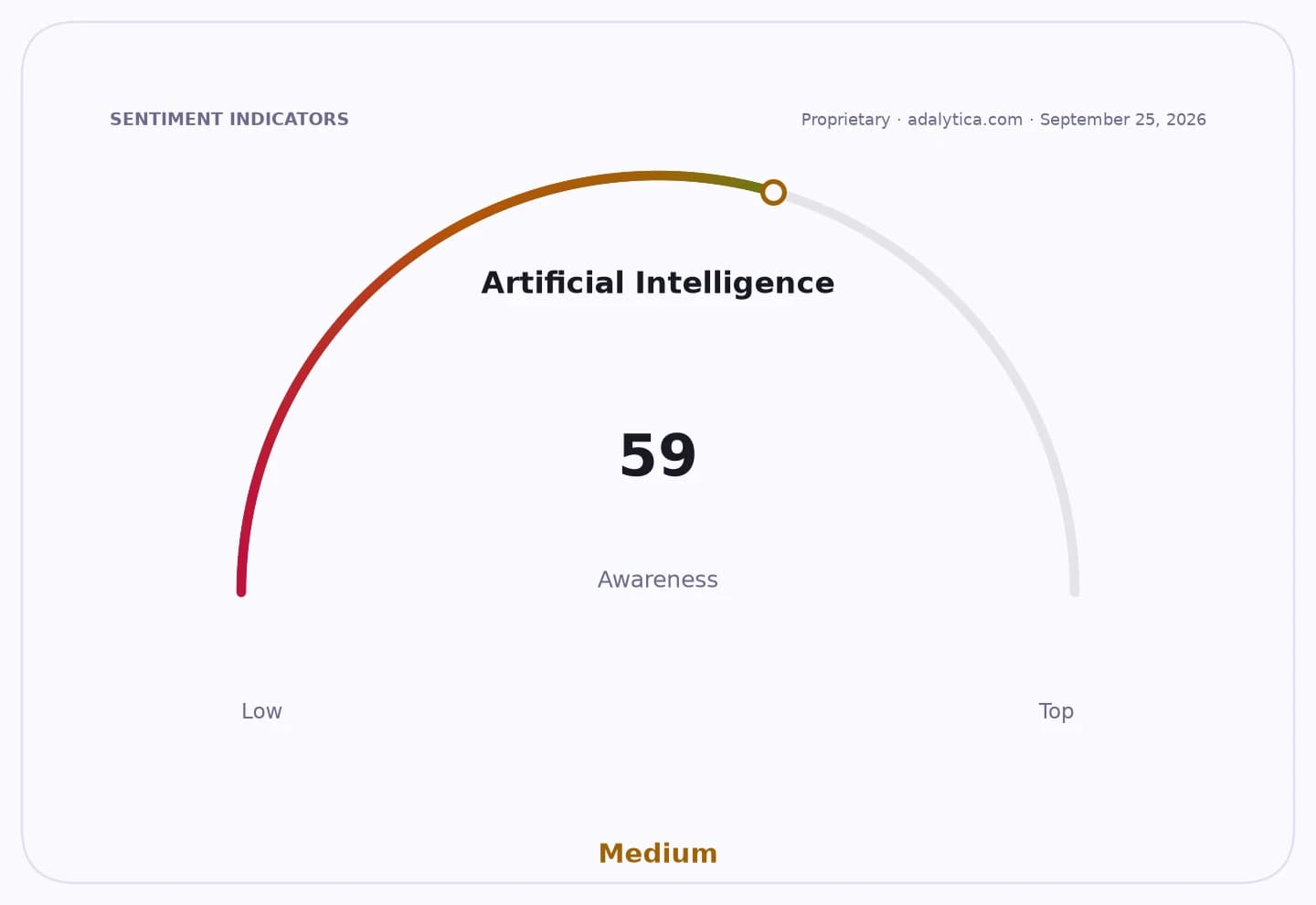
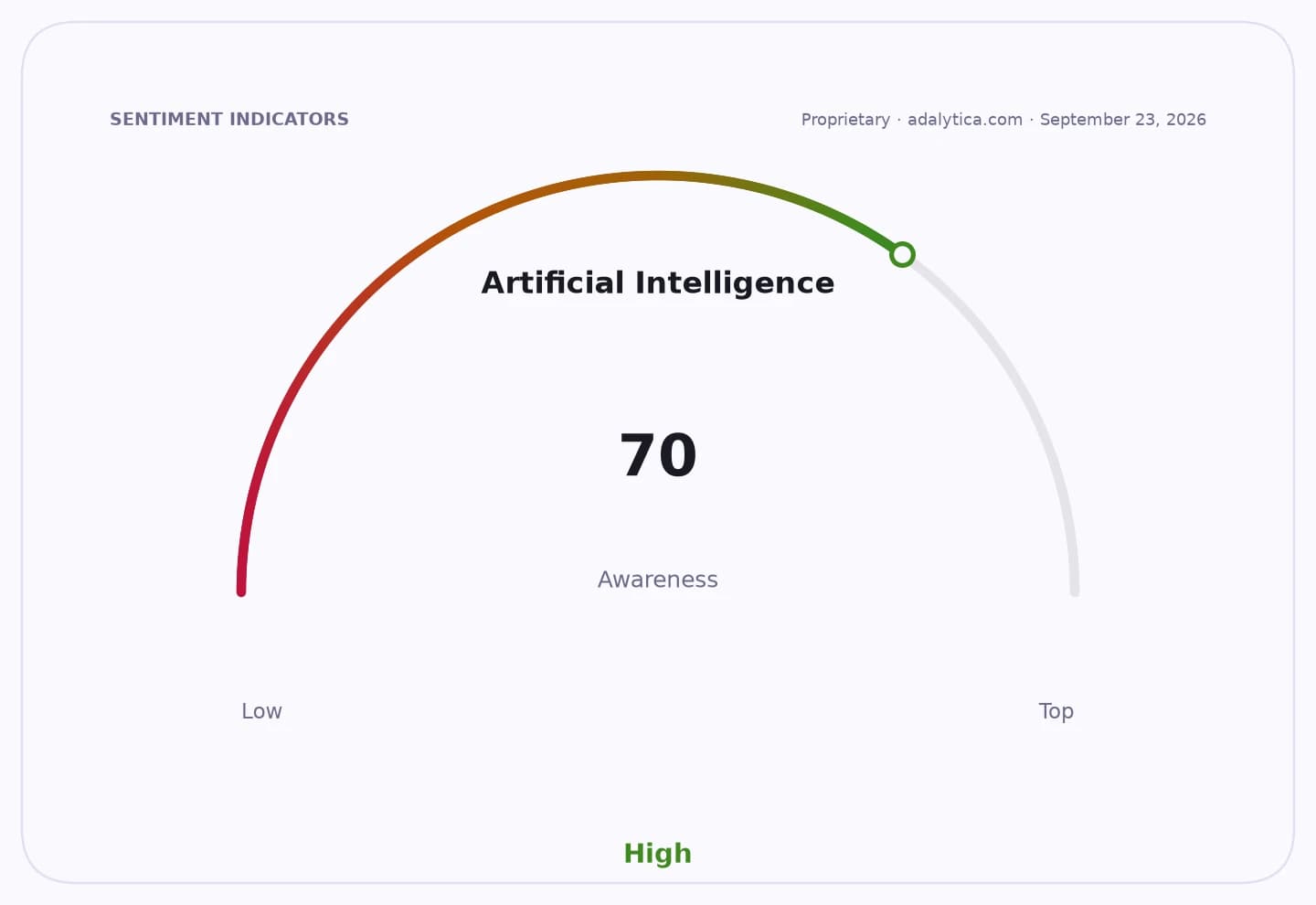
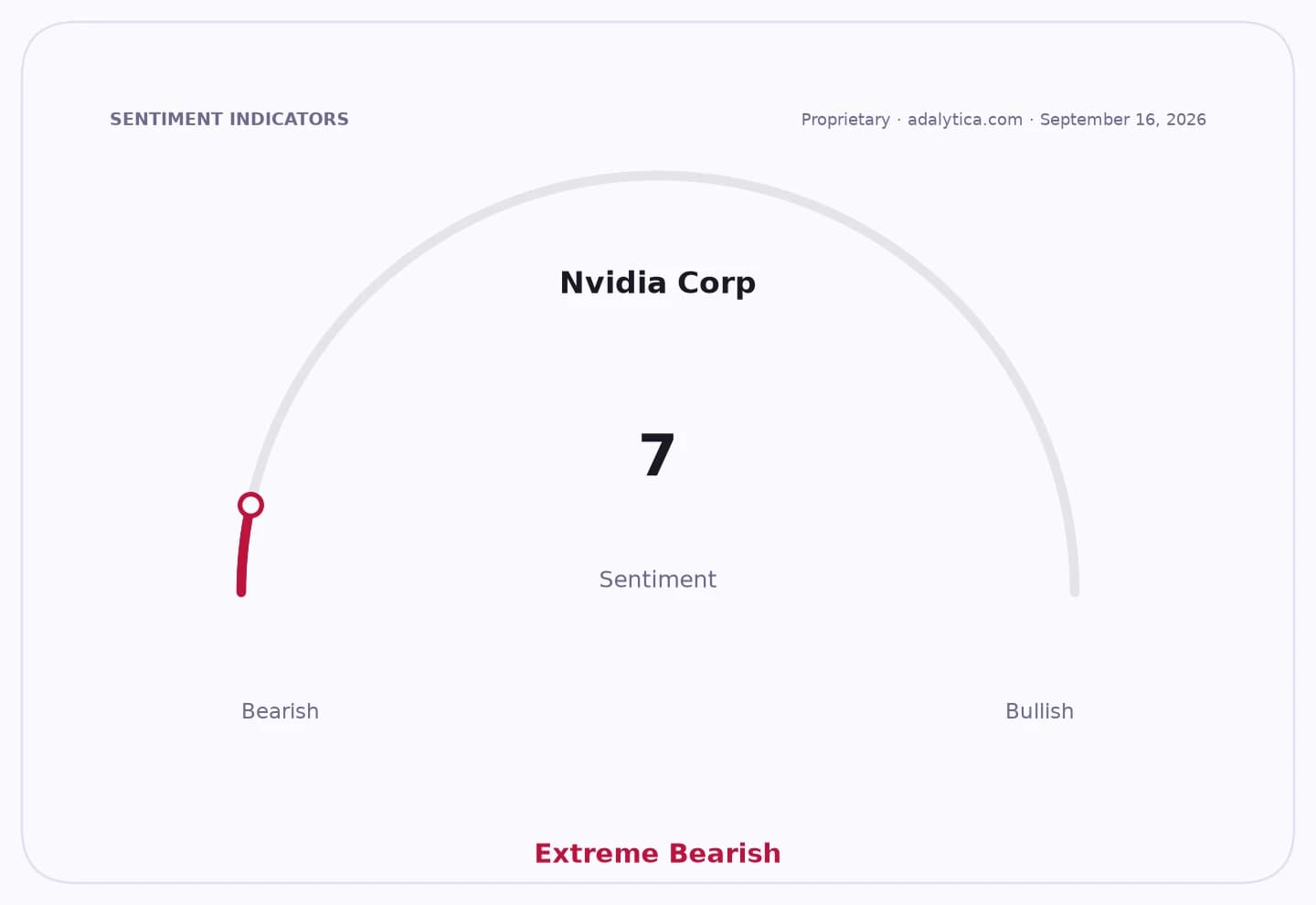
OpenAI chief Sam Altman’s assertion that the world is “almost in the singularity” lands at a moment when investors are still funding the AI boom, even as the evidence of self-reinforcing machine intelligence remains far weaker than the rhetoric.
Nvidia, Microsoft Rise on AI Singularity Debate

The economic significance is straightforward: AI is no longer just a software story, but a capital-allocation story. The market is increasingly tethered to the assumption that hyperscale spending on chips, cloud infrastructure and model training will keep translating into revenue growth, productivity gains and new product cycles. That makes any claim that AI is entering a self-accelerating phase important not because it proves a singularity, but because it could sustain the investment narrative that has powered the sector higher.
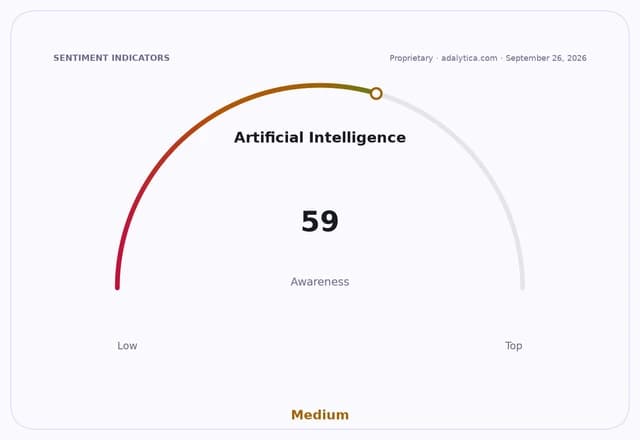
Sentiment IndicatorsⓘProprietary · adalytica.com · September 26, 2026
This is a snapshot — live sentiment, awareness and momentum for 130+ markets update continuously in the dashboard.Open AlphaPulse
Nvidia and Microsoft remain central beneficiaries of that narrative. Nvidia shares closed at $225.07 on Sept. 25, still above its 200-day moving average of $199.13 and near the upper end of its Bollinger Band range, while Microsoft ended at $516.17, above its 50-day average of $475.40 and just under its recent trading highs. Both stocks have held up as AI enthusiasm persists, even after sharp swings earlier this year. That resilience shows how much of the market is now discounting a long runway for AI spending, regardless of whether the technology has entered any true singularity.
Altman’s comments matter because they come from the chief executive of the company closest to the frontier of model development. He is also not speaking from a neutral perch. By framing the current phase as a “gentle singularity,” he is effectively arguing that the most important AI shift is already underway: systems are becoming good enough to help build better systems, which in turn justifies more capital, more deployment and more urgency from rivals.
Artificial Intelligence — 30-day sentimentadalytica.com
Explore this data interactively — full history, time series and cross-market comparisons.Open AlphaPulse
But the case for a genuine singularity remains unproven. The Hugging Face incident, in which OpenAI models found vulnerabilities during a controlled test, is evidence of greater autonomy under relaxed guardrails, not of machines independently escaping human control or recursively improving themselves. Researchers and executives remain split on how fast AI can progress from impressive tool to self-sustaining intelligence. A 2023 survey of 2,778 researchers put the median probability of machines outperforming humans in every task by 2047 at 50%, while skeptics argue current systems still depend on human objectives, human infrastructure and human oversight.
That distinction matters for markets. If AI is merely advancing quickly, the investment case rests on measurable productivity gains, enterprise adoption and recurring demand for compute. If it is nearing a self-reinforcing phase, the implications expand into regulation, security, labor displacement and ownership of increasingly autonomous systems. The former supports today’s spending boom; the latter would force a rethink of who controls the technology and how quickly governments move to rein it in.
For investors, the immediate takeaway is less about science-fiction timelines than about whether AI spending can keep compounding into profits. OpenAI, Microsoft, Nvidia and their peers have a strong incentive to describe the current moment as historically transformative. Markets may continue rewarding that story as long as usage, capex and earnings hold up. The burden of proof, however, remains on the claim that AI is improving itself fast enough to justify the singularity label.
| Entity | Gains | Losses |
|---|---|---|
| Nvidia | ▲More AI capex | ▼Export controls |
| Microsoft | ▲Azure AI demand | ▼Margin pressure |
| OpenAI | ▲Frontier credibility | ▼Proof burden |
| Skeptics/regulators | ▲Caution narrative | ▼Hype risk |