Nvidia’s pullback looks less like a busted growth story and more like a market searching for a cleaner way to own artificial intelligence, which is exactly why the stock is starting to attract “safe haven” comparisons inside a jittery semiconductor sector.
Nvidia Pullback Attracts Safe-Haven Buying
That matters because investors are no longer rewarding every AI-linked company the same way. The latest selloff in chips shows Wall Street shifting from blind enthusiasm to a focus on balance sheets, cash generation and whether AI spending is actually turning into profits. In that kind of market, Nvidia still stands apart. Even after slipping to $213.66 on Oct. 29 from a recent high near $235, the shares remain well above the 200-day moving average of about $204 and above the 50-day average near $222, suggesting the long-term uptrend is intact even as momentum cools. The stock’s RSI near 35 also points to a weaker short-term setup, not a broken business thesis.
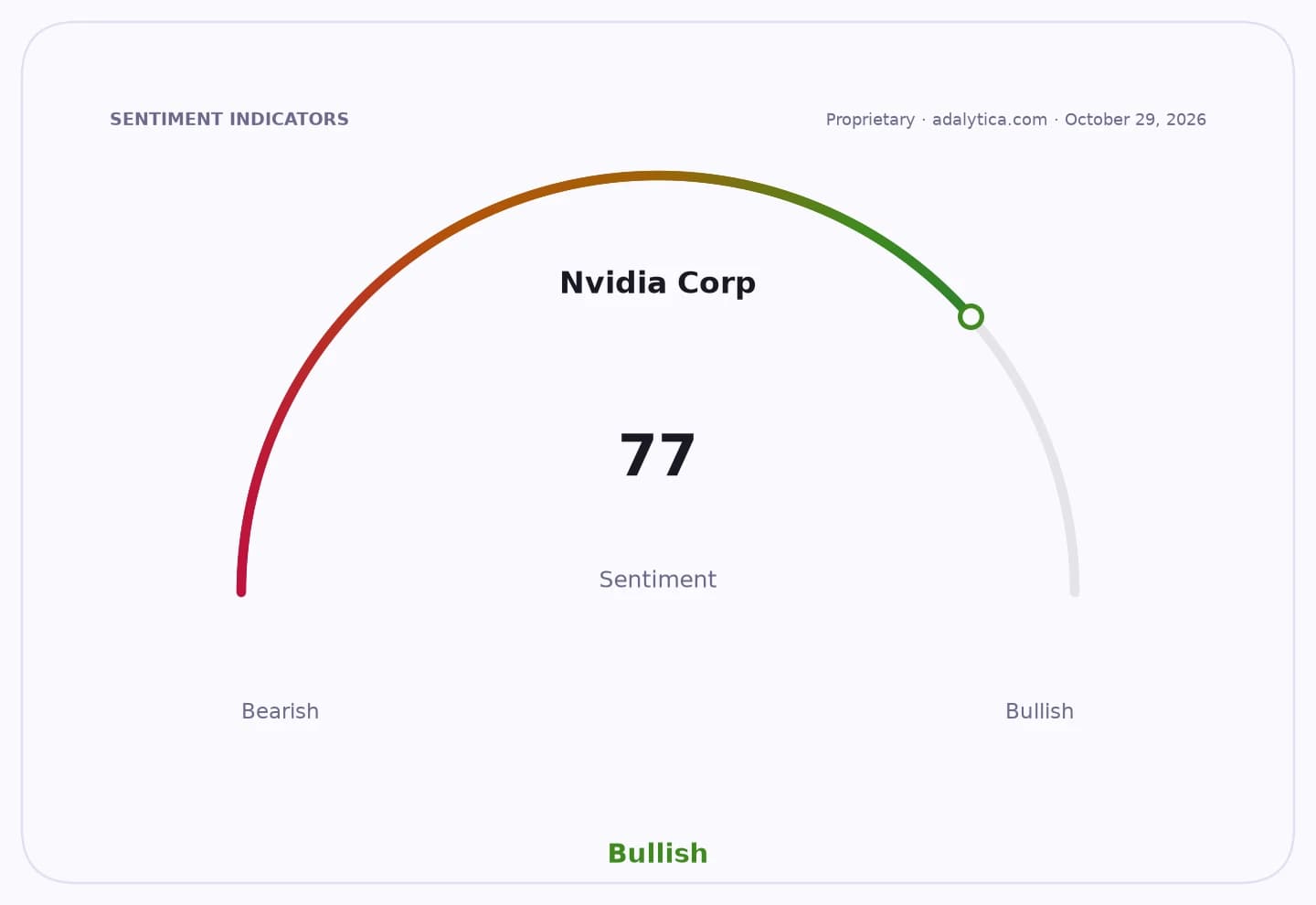
Sentiment Indicators

That distinction is important for investors because the broader semiconductor gauges have been far rougher. The Philadelphia Semiconductor Index, tracked by the SOXX ETF, has fallen to about $513.86 from $567.67 on Oct. 28 and is trading below its 50-day average around $530. The data suggest traders are de-risking the whole AI complex, not just Nvidia. When that happens, companies with the clearest earnings power and the strongest competitive moat often become the relative winners. Nvidia’s scale in data center chips, software and platform-level AI infrastructure keeps it at the center of the spending cycle even when investors question the pace of that spending.
The reason this story matters economically is that AI capital expenditure has become a major driver of the technology sector and, increasingly, the market itself. If companies slow their AI buildouts, the pressure ripples through chipmakers, foundries, equipment suppliers and cloud providers. If, instead, investors decide to concentrate capital in the few firms most likely to convert AI demand into durable free cash flow, Nvidia could absorb money leaving weaker names. That is the essence of a safe-haven trade: not that the stock becomes risk-free, but that it becomes the first place investors want to hide inside a risky theme.
There is also a broader market backdrop supporting that shift. Adalytica’s S&P 500 trade signals show awareness at an extreme level, while sentiment is neutral, a combination that often appears when investors are fully engaged but not fully convinced. The U.S. dollar’s awareness reading is also elevated, underscoring a market environment where macro caution has not disappeared. In that setting, the market tends to favor the highest-quality names over the most speculative ones.
For long-term investors, that is the real takeaway. Nvidia may not be immune to valuation swings, and it is not unusual for a stock this dominant to pause after a huge run. But the longer-term case still rests on the same thing that made it a market leader in the first place: a rare combination of technological leadership, ecosystem lock-in and exposure to one of the most powerful secular growth trends in global markets. If AI spending keeps expanding, Nvidia is still the cleanest way to own it. If the trade narrows, Nvidia may be one of the few names investors keep buying anyway.
| Entity | Gains | Losses |
|---|---|---|
| Nvidia | ▲Flight to quality | ▼Valuation-sensitive traders |
| SOXX and chip peers | ▲Select leaders only | ▼Broad semiconductor basket |
| AI spenders with weak returns | ▲Cost scrutiny | ▼Easy funding and hype premium |
| Long-term NVDA holders | ▲Relative resilience | ▼Short-term momentum traders |