Asian equities slipped on Tuesday as traders braced for a new round of results from the biggest names in artificial intelligence, while oil extended gains on geopolitical tensions, sharpening the market’s focus on inflation, margins and the durability of the global growth trade.
Nvidia, Microsoft, Alphabet Fall Ahead of AI Earnings
The selloff reflects a simple but important recalibration: investors want proof that the billions pouring into AI infrastructure are translating into earnings, not just higher capital expenditure. Goldman Sachs estimates the five largest hyperscalers could lift total capital spending to about $1.2 trillion next year, a scale that has turned quarterly updates from Meta, Tesla, Netflix and other megacap technology groups into a broader test of whether the AI buildout can justify its cost.
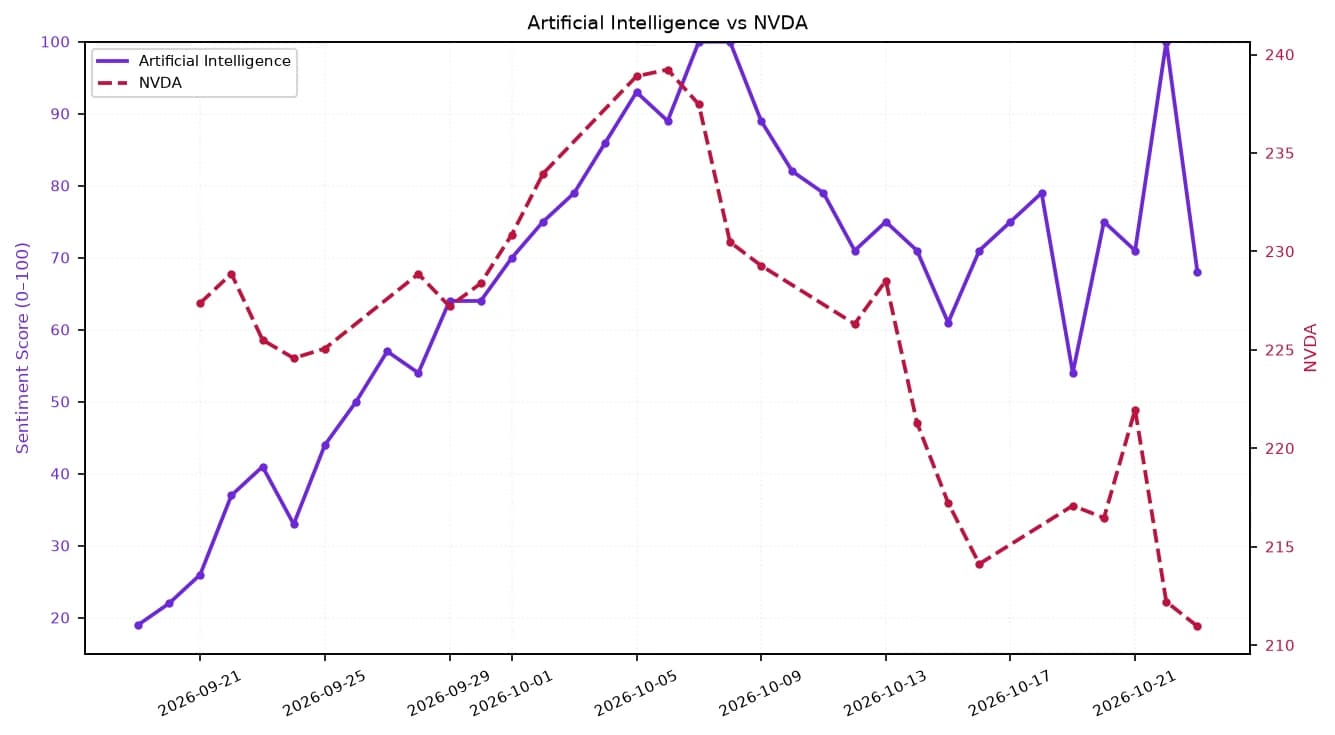
Sentiment IndicatorsⓘProprietary · adalytica.com · October 24, 2026
This is a snapshot — live sentiment, awareness and momentum for 130+ markets update continuously in the dashboard.Open AlphaPulse
That question matters well beyond Silicon Valley. If the earnings season confirms that AI demand is still strong, it should support the case for continued heavy investment across chips, cloud and data-center supply chains, even after a turbulent stretch for the sector. If, however, investors see evidence that spending is outrunning monetization, valuations of the most exposed names could come under pressure, especially after recent swings in Nvidia, Microsoft and Alphabet.
Nvidia closed at $210.96 on Friday, below its 50-day moving average of $222.39 and with an RSI reading of 22.0, a technical setup that points to oversold conditions but also lingering downward momentum. Microsoft ended at $524.51 versus a 50-day average of $508.35, while Alphabet fell to $320.21, below both its 50-day and 200-day averages, as traders continued to reassess how quickly AI can convert into cash flow.

The market’s caution is reinforced by the broader tone across equities. Adalytica’s S&P 500 Trade Signals snapshot shows sentiment at 3, labeled “Extreme Fear,” even as awareness remains neutral, suggesting investors are still watching rather than capitulating. That backdrop leaves little room for disappointment in earnings from firms carrying the heaviest AI expectations.
Oil is adding a second source of stress. U.S. crude was quoted at $103.85 a barrel and Brent at $109.64, buoyed by uncertainty around U.S. sanctions policy toward Russia and heightened tensions in the Middle East. Higher energy prices complicate the inflation outlook at a time when central banks are already reluctant to ease policy aggressively, and they threaten to squeeze margins for airlines, manufacturers and other energy-sensitive sectors.
That combination — softer Asian stocks, firmer oil and a heavy calendar of AI results — leaves markets caught between two competing narratives. One is that AI remains the strongest structural growth theme in global equities; the other is that the cost of funding it, alongside a renewed energy shock, may keep pressure on profits and delay any broad relief rally. The next batch of results will help determine which story dominates.
| Entity | Gains | Losses |
|---|---|---|
| AI hyperscalers | ▲Credibility if monetization holds | ▼Valuation if spending outruns revenue |
| Oil producers | ▲Higher realized prices | ▼— |
| Energy-intensive sectors | ▲— | ▼Input-cost pressure |
| Asian equities | ▲— | ▼Risk-off flows and earnings caution |