Jensen Huang is trying to reframe Nvidia’s slide in valuation as a buying opportunity, arguing the chipmaker is not just a growth stock but “the world’s first and only growth value stock” at a moment when Apple has become the market’s clearest example of premium scale and predictability.
Nvidia Valuation Slides as Apple Hits $5 Trillion
That contrast matters because it captures one of the defining tensions in the artificial intelligence trade: investors are rewarding companies with durable cash generation and visible returns, while increasingly questioning whether the biggest AI spenders can keep funding Nvidia’s runaway growth at the same pace. Apple’s rise to a $5 trillion market capitalization underscores that preference. Nvidia, by contrast, has fallen to what traders and analysts describe as valuation levels not seen in years even as earnings and sales continue to expand rapidly.
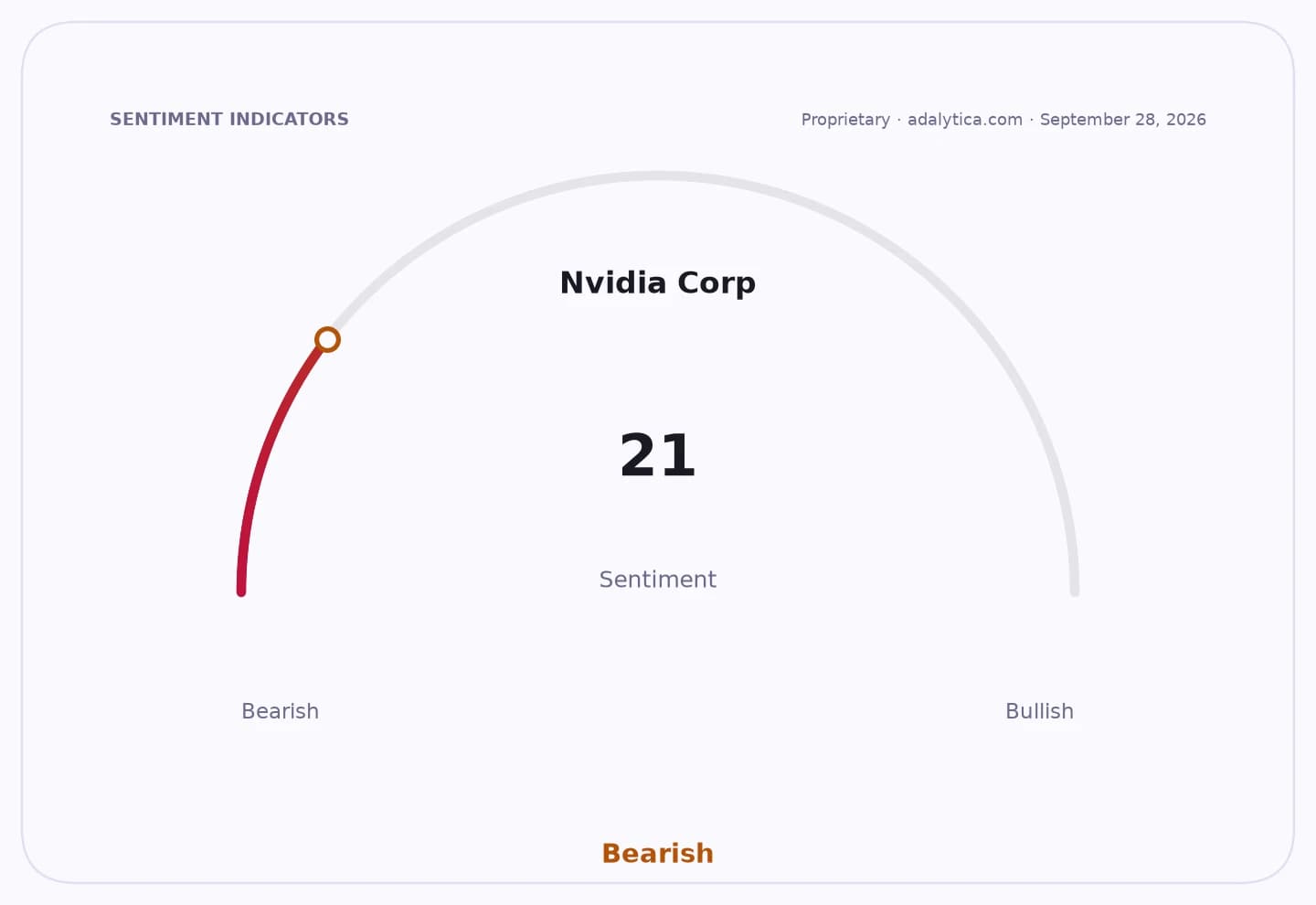
Sentiment IndicatorsⓘProprietary · adalytica.com · September 28, 2026
This is a snapshot — live sentiment, awareness and momentum for 130+ markets update continuously in the dashboard.Open AlphaPulse
The market’s split reflects more than a simple style rotation. Apple’s appeal rests on recurring revenue from the iPhone ecosystem, app fees and a balance sheet that does not require enormous capital outlays to stay competitive. Nvidia’s business, while still dominant in AI accelerators, depends on a concentrated group of hyperscale customers that are also building their own custom chips to reduce dependence on outside suppliers. That trend raises the risk that Nvidia’s pricing power and gross margins will gradually narrow.
Analysts cited in the source context say that concern is already visible in the stock. Nvidia’s valuation has compressed even as fiscal 2027 sales are still projected at about $410 billion, a scale that would normally support a far richer multiple. Technical indicators suggest the stock has recovered from a weaker stretch but remains well below the more exuberant peaks of the year: shares closed at $225.07 on Sept. 25, above both the 50-day and 200-day moving averages, while the relative strength index near 44 points to neither an overbought nor deeply oversold setup. The conventional indicators show a stock that is stabilizing, not euphoric.
That backdrop helps explain why Huang is leaning into a valuation argument rather than a pure growth pitch. If Nvidia can sustain earnings expansion while margins only modestly compress, the shares could look cheap relative to the company’s long-term profit trajectory. If, however, in-house chips at Meta, Alphabet and other large customers take hold faster than expected, the market may be right to assign Nvidia a lower multiple even after years of exceptional growth.
Apple’s $5 trillion milestone reinforces the bear case on Nvidia in one important respect: the market is willing to pay up for certainty and to discount companies whose spending-heavy business models leave more room for disappointment. Yet Nvidia still has a clear bull case. It remains the core supplier to the AI buildout, demand for advanced compute is still running ahead of supply in several segments, and analysts continue to see substantial upside from current levels if the company converts revenue growth into sustained earnings power.
For investors, the next phase will hinge on whether AI infrastructure spending broadens enough to offset competitive pressure from in-house silicon and rising memory costs. Nvidia’s margin profile, customer concentration and the pace of hyperscaler capital expenditure will determine whether Huang’s “growth value” label proves prescient or simply a defense of a stock that the market has started to re-rate.
| Entity | Gains | Losses |
|---|---|---|
| Apple | ▲Premium multiple | ▼Growth-stock rivals |
| Nvidia | ▲Upside if valuation rerates | ▼Lower margin expectations |
| Hyperscalers | ▲Custom-chip leverage | ▼Vendor dependence |
| Investors in cash-rich megacaps | ▲Visible earnings | ▼Pure AI capex plays |