Nvidia’s blowout earnings outlook is not translating into a stock-market payoff, with the chipmaker’s valuation sinking to a 10-year low as investors question how long its extraordinary profit growth can last.
Nvidia valuation falls as earnings growth stays strong
The disconnect is stark: analysts expect Nvidia’s revenue to jump 90% in fiscal 2027 and net income to rise 99%, yet the shares are up only about 20% this year, far behind the Philadelphia Semiconductor Index’s roughly 78% gain. Nvidia’s forward price-to-earnings ratio has fallen below 17 times, about half its level in 2025 and well below more than 25 times seen in May.
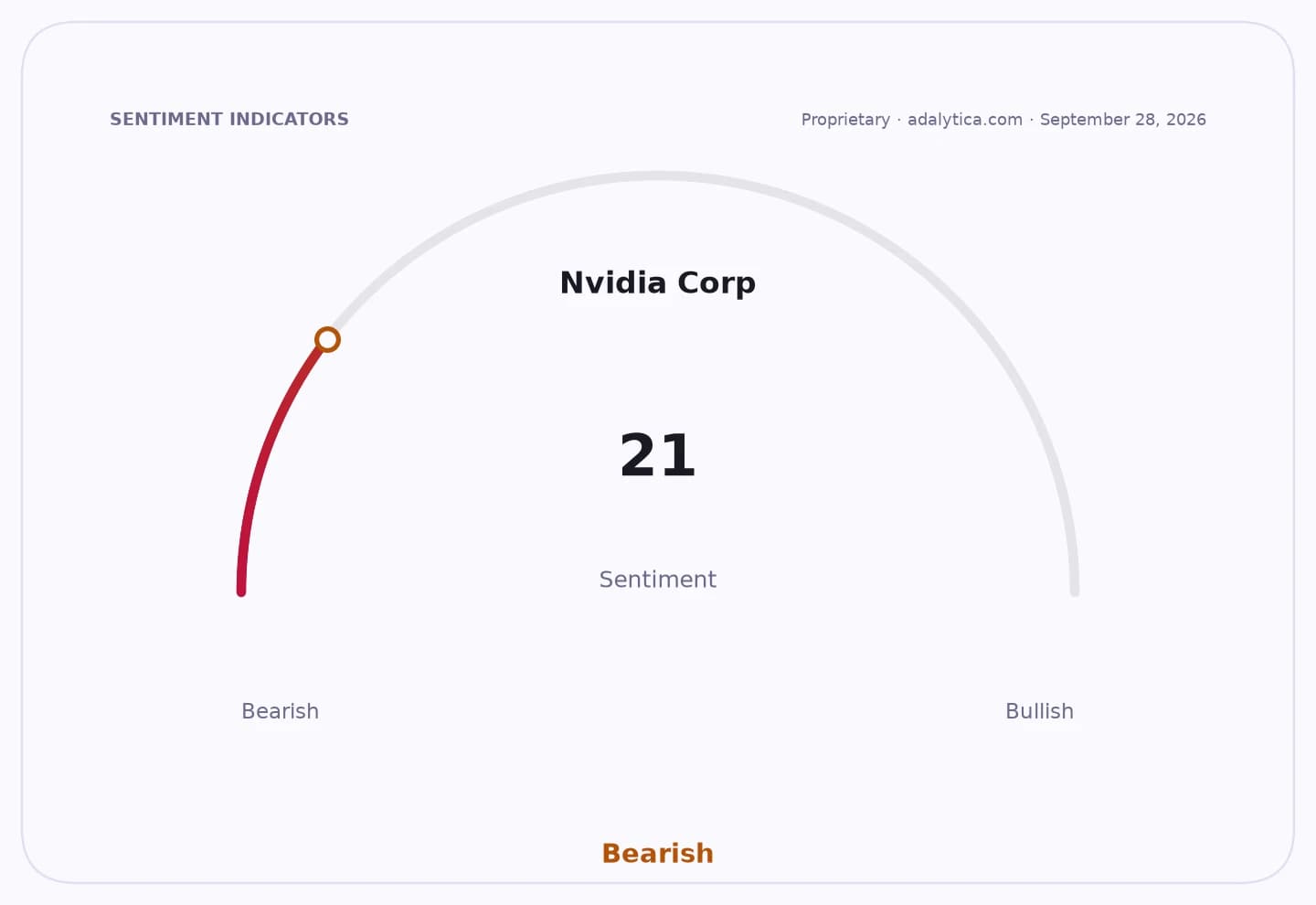
Sentiment IndicatorsⓘProprietary · adalytica.com · September 28, 2026
This is a snapshot — live sentiment, awareness and momentum for 130+ markets update continuously in the dashboard.Open AlphaPulse
That reset matters because Nvidia is still the market’s bellwether for the AI trade. When a company with this pace of growth loses multiple expansion, it usually means investors are no longer paying up for the next leg of earnings unless they see a clearer path to sustaining margins, demand and capacity discipline.
Some of that caution is showing up in the stock itself. Nvidia closed at $225.07 on Sept. 25, up modestly from its late-July lows, while the broader semiconductor complex has outperformed on the AI buildout. The VanEck Semiconductor ETF has climbed to $572.68, and the Philadelphia index has pushed to 2026 highs, underscoring that investors are rotating toward chips more selectively rather than broadly rewarding every AI name.
The market’s concern is not growth, but durability. Eli Horton, senior portfolio manager at TCW, said the drop in Nvidia’s valuation reflects skepticism about the sustainability of its current earnings power, even as the company posts “stunning” fundamentals.
Nvidia chief executive Jensen Huang has pushed back on that view, telling a Goldman Sachs technology conference the company is the world’s first and only growth value stock and arguing it is “seriously misunderstood.” Investors, however, are still focused on whether the company can keep converting AI demand into profit at the same pace.
Margin pressure is one reason for the hesitation. Analysts see Nvidia’s gross margin around 75% in the second quarter, narrowing to below 72% by year-end before improving later, as higher costs for memory chips and other key components weigh on profitability.
Adalytica’s NVIDIA Earnings Sentiment snapshot also shows “Fear,” with sentiment at 21 and awareness at 18, while the stock’s recent technical backdrop remains mixed rather than euphoric: the shares sit above the 50-day moving average and the 200-day moving average, but momentum indicators have cooled from earlier highs.
For investors, the setup leaves Nvidia in a familiar but more demanding position. The company can still justify a premium if earnings keep compounding near current forecasts, but the market is signaling that future upside now depends less on AI enthusiasm and more on evidence that margins, supply costs and demand can stay elevated into 2027 and beyond.
| Entity | Gains | Losses |
|---|---|---|
| Nvidia long-term holders | ▲Strong earnings growth | ▼Lower valuation multiple |
| Nvidia shorts | ▲Slower multiple expansion | ▼Risk of profit surprises |
| AI chip rivals | ▲Sector-wide demand lift | ▼Nvidia’s dominance narrative |
| Semiconductor ETFs | ▲Broad AI enthusiasm | ▼Concentration risk in Nvidia |