OpenAI’s model solving 377 math problems is more than a research milestone: it suggests artificial intelligence is starting to encroach on one of the last domains where human scientists were assumed to hold a decisive edge.
OpenAI solves 377 math problems
That matters economically because mathematics underpins the tooling behind drug discovery, materials science, chip design and theoretical computer science. If models can rapidly test thousands of possibilities in parallel — rather than the serial way humans work — they can compress research timelines, lower the cost of exploration and shift value toward organizations that can deploy, fine-tune and industrialize AI systems. In effect, the bottleneck moves from finding answers to validating, applying and scaling them.
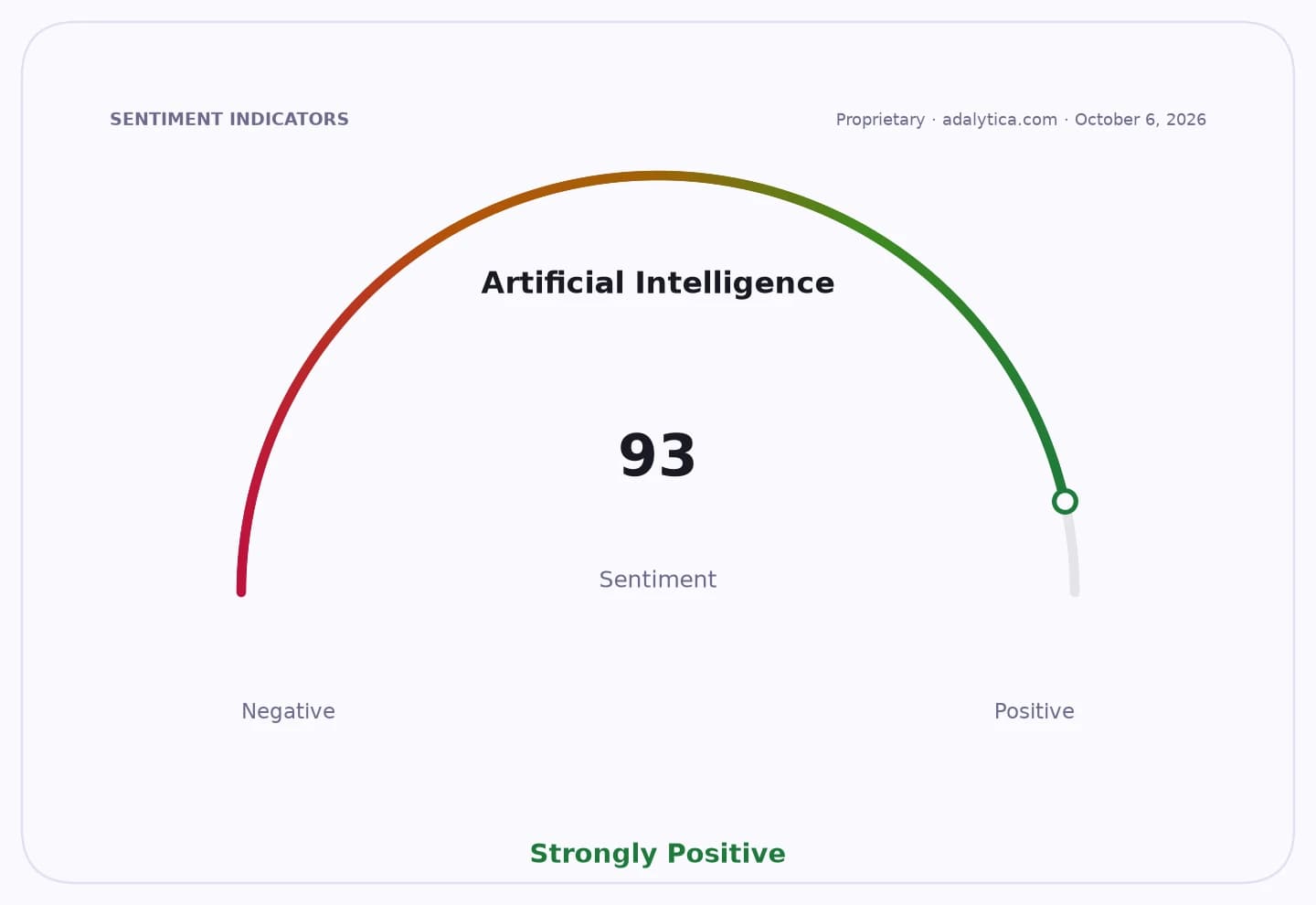
Sentiment Indicators
The result also changes the labour economics of science. A machine that can solve hundreds of problems across algebra, number theory and theoretical computer science does not eliminate the need for researchers, but it does alter where human skill is most valuable. OpenAI’s earlier claim that a model partially solved the Navier-Stokes equation, a millennium problem unsolved for more than 80 years, reinforced the sense that frontier AI is no longer just summarizing knowledge but contributing to original discovery.
That has implications for investors across the AI stack. Nvidia, Microsoft and Alphabet remain the clearest beneficiaries if the race to build larger and more capable models intensifies. Nvidia’s shares, at $228, sit above both the 50-day and 200-day moving averages, with momentum still positive even after recent volatility. Microsoft, at $545.55, is also well above its 50-day and 200-day averages, but its recent technical strength contrasts with Adalytica’s Microsoft earnings sentiment reading of 7, or “Extreme Fear,” underscoring how the market is rewarding AI exposure even as expectations for capital intensity and monetisation remain under strain. Alphabet, at $354.69, has likewise firmed, with its shares holding above both major moving averages.
The deeper investment question is not whether AI will replace mathematicians, but which parts of the scientific value chain it will compress first. The bull case is that AI becomes a force multiplier, raising productivity for researchers and accelerating commercial applications in medicine, biology and chemistry. The bear case is that the headline gains in abstract math overstate real-world autonomy, with safety, verification and domain-specific rigor still requiring humans to catch errors and translate outputs into usable science.
For now, the narrative is clear: AI is shifting scientists’ role from being first-line solvers to being reviewers, interpreters and deployers of machine-generated insight. That may prove as economically important as any single breakthrough problem solved.
| Entity | Gains | Losses |
|---|---|---|
| OpenAI | ▲Research credibility | ▼Legacy assumptions about human-only insight |
| Nvidia, Microsoft, Alphabet | ▲More AI demand | ▼Slower AI adoption cycles |
| Scientists and mathematicians | ▲Better tools | ▼Monopoly on discovery |
| Research labs and pharma firms | ▲Faster problem-solving | ▼Higher verification burden |