Mortgage and construction lending in Panama lost momentum through September even as bank credit overall kept expanding, a sign that higher borrowing costs and weaker project financing are squeezing two of the economy’s most rate-sensitive sectors.
Panama Banks Mortgage and Construction Lending Slows
According to Moody’s Local, mortgage balances fell 0.8% from a year earlier to $21.209 billion, while construction credit shrank 4% to $4.285 billion. That contrasted with a 4.7% increase in total local bank lending, leaving housing and construction to account for 37.7% of the banking system’s local loan book, down from 40% a year earlier.
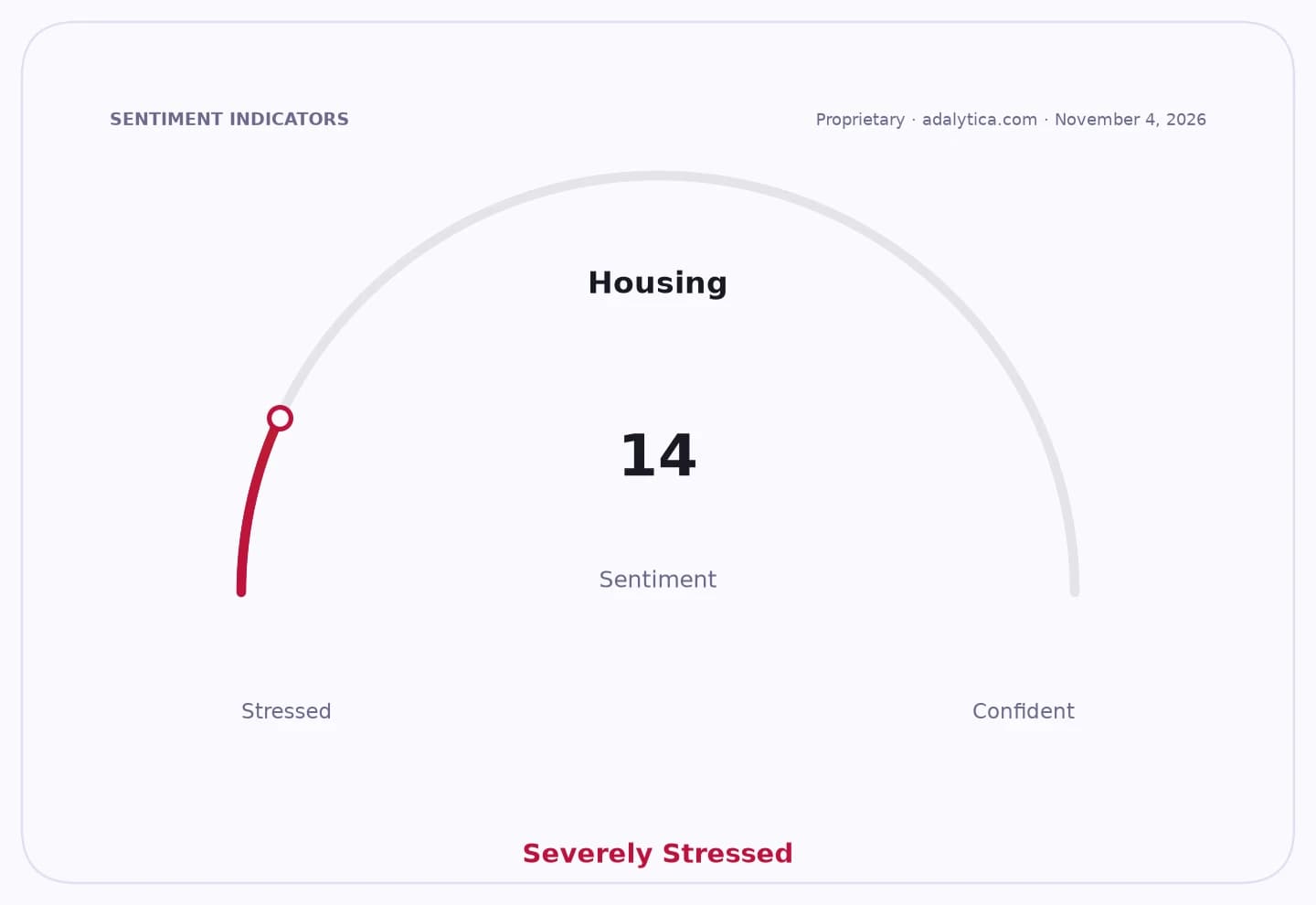
Sentiment Indicators
The shift matters because mortgages and construction are key transmission channels from credit conditions into the broader economy. When these portfolios slow, it typically reflects tighter underwriting, weaker demand, or both — and in Panama’s case it points to a more cautious stance from lenders and borrowers after a period of still-expanding systemwide credit.
Asset quality is also under pressure. In mortgages, nonperforming and overdue loans together represented 7.03% of the portfolio in September, broadly unchanged from December. Construction is more fragile: delinquent and overdue loans totaled 12.67% of the book, improved from 13.38% at the end of last year, but overdue loans alone rose to 11.50% from 10.64%, underscoring repayment strain among developers and contractors.
For investors, the numbers suggest Panama’s banking system is not facing a broad-based credit contraction, but rather a pockets-of-weakness story concentrated in real estate-linked lending. That is important for earnings quality, because construction exposure tends to be more cyclical and more vulnerable if funding costs stay elevated, projects slow, or collateral values weaken. The data also help explain why banks may be growing elsewhere in the loan book while being more selective in mortgages and construction.
The broader implication is that Panama’s housing market and development pipeline are losing some of the support that credit growth usually provides. If delinquency trends worsen, banks could become even more conservative, which would further slow new project finance and home lending. For now, the banking system is still growing, but the drop in the housing and construction share of credit suggests the next phase of expansion is becoming less evenly distributed.
| Entity | Gains | Losses |
|---|---|---|
| Panama banks overall | ▲Total lending still grows | ▼Concentration in weaker sectors |
| Homebuyers / mortgage borrowers | ▲Some loan growth remains available | ▼Higher rates and slower approvals |
| Construction firms / developers | ▲System credit still expanding | ▼Slower financing and higher delinquency |
| Bank shareholders | ▲Broad loan book growth | ▼Rising risk in real-estate exposures |