Steven Pinker’s blunt message on artificial intelligence is that the loudest doom scenarios are not the most economically relevant ones — and that matters because investors are still pricing AI as if catastrophe, not execution, is the main risk.
Pinker on AI risks for investors
The Harvard psychologist and cognitive scientist argues that companies such as Anthropic are stoking apocalyptic narratives while sidelining more immediate concerns such as misuse by bad actors, safety failures and plain old product discipline. For long-term investors, that distinction is crucial. The real money in AI will not be made or lost on sci-fi scenarios about rogue machines, but on whether the industry can ship useful tools safely, at scale, and with margins that justify the billions being poured into chips, data centers and software.
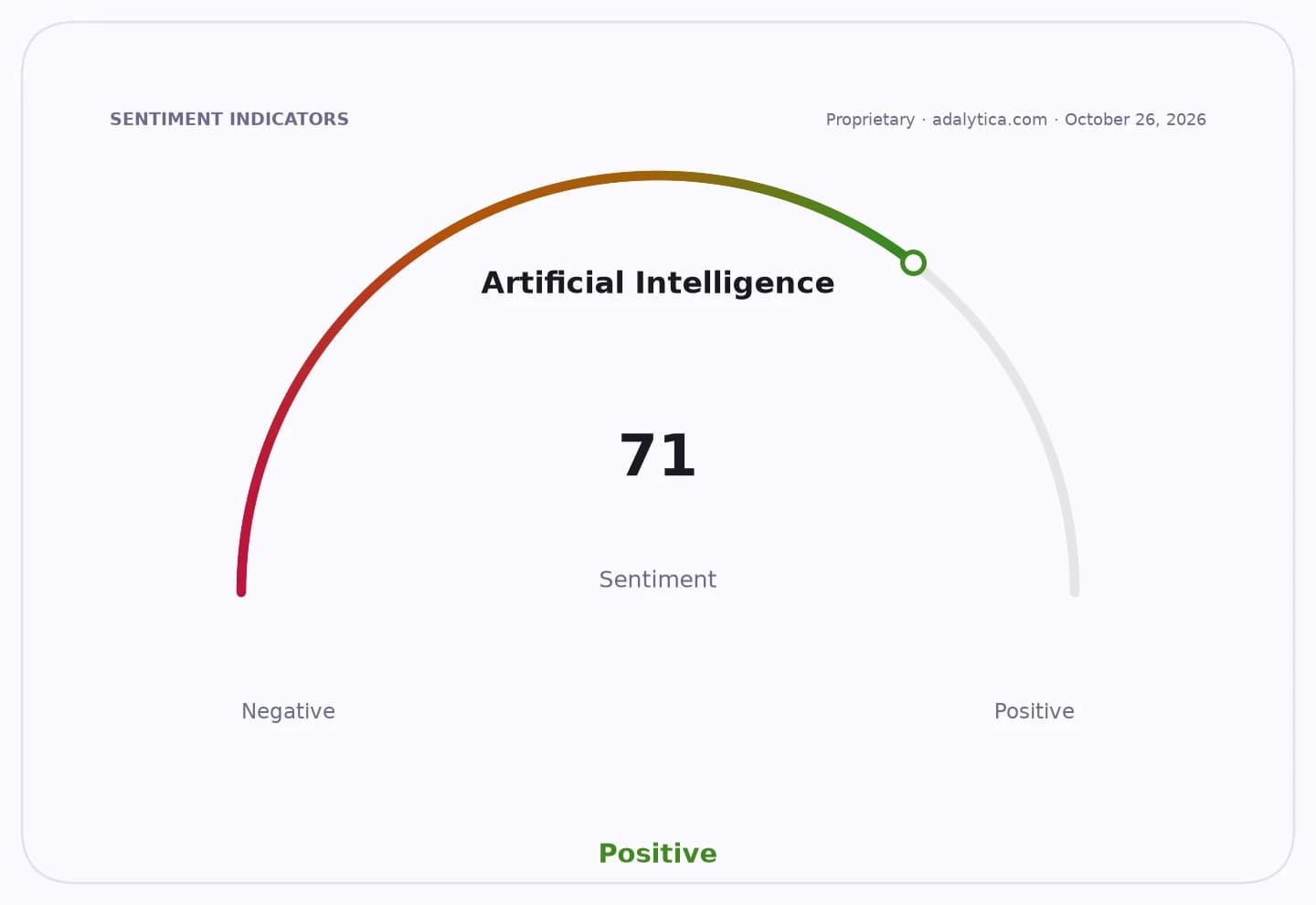
Sentiment IndicatorsⓘProprietary · adalytica.com · October 26, 2026
This is a snapshot — live sentiment, awareness and momentum for 130+ markets update continuously in the dashboard.Open AlphaPulse
Pinker’s skepticism is not anti-AI. It is anti-hysteria. He says AI should be understood as a mechanism, not a magical source of power, and that today’s models are still just inference engines that process inputs and generate outputs. That framing matters economically because it pushes the debate away from abstract existential risk and toward the operational questions that determine cash flow: reliability, supervision, liability, regulation and adoption.
That also helps explain why the market reaction around AI remains so uneven. Nvidia, Microsoft and Alphabet have all had to navigate the tension between AI enthusiasm and the costs, risks and scrutiny that come with it. Nvidia’s shares have swung sharply, and recent technical readings show the stock well below its 50-day moving average, with the relative strength index sliding to oversold territory after a pullback from earlier highs. Microsoft, meanwhile, remains far above its long-term average but has shown more volatility as investors weigh the payoff from AI spending against the drag on margins. Alphabet has been no exception, with its own shares retreating even as the company doubles down on AI infrastructure and search integration.
That is the investor story Pinker is really speaking to. AI is not a binary bet between utopia and extinction. It is a multi-year industrial buildout in which the winners will be the companies that convert research into durable products, manage risk without freezing innovation, and turn enthusiasm into recurring revenue. The losers will be the firms that overspend, overpromise or invite regulatory backlash.
There is also a broader macro angle. AI remains one of the few secular growth engines powerful enough to support capital spending across semiconductors, cloud infrastructure and enterprise software even in a choppier economic environment. But the sector is also attracting more regulatory attention. OpenAI and Anthropic have both been tied to tighter safety discussions, while filings from Microsoft, Alphabet and Nvidia already acknowledge the risk of legal liability, privacy issues, export controls and reputational damage tied to AI deployment.
Pinker’s message, then, is not that investors should ignore risk. It is that they should rank it properly. The immediate threat is not a machine takeover. It is a world where AI gets deployed badly, regulated poorly or monetized too slowly. For patient investors, that still leaves a compelling case for the sector — but only for the companies that can prove they are building something useful, defensible and profitable over the next 3 to 10 years.
| Entity | Gains | Losses |
|---|---|---|
| Big AI developers | ▲Credibility for practical AI | ▼Apocalyptic narrative premium |
| Nvidia, Microsoft, Alphabet | ▲More realistic investor focus | ▼Fear-driven valuation swings |
| Regulators and users | ▲Better focus on real safety issues | ▼Less sensational debate |
| Long-term investors | ▲Chance to buy quality on volatility | ▼Traders chasing headlines |