AI stocks are losing altitude fast, and the biggest message for investors is that the market is finally questioning how much borrowed money it will take to build the next wave of artificial intelligence infrastructure.
Nvidia, AMD, Micron Fall as AI Sell-Off Widens

Nvidia, AMD and Micron fell in premarket trading Thursday as a global rout in semiconductors and related hardware stocks gathered force, with more than $1 trillion wiped from the market value of 20 of the world’s most valuable AI and chip names this week alone. That kind of drawdown matters because it is no longer just a valuation reset in a handful of expensive stocks — it is a broad repricing of the AI buildout itself, from chips to memory to the data-center “neoclouds” trying to rent out the capacity.
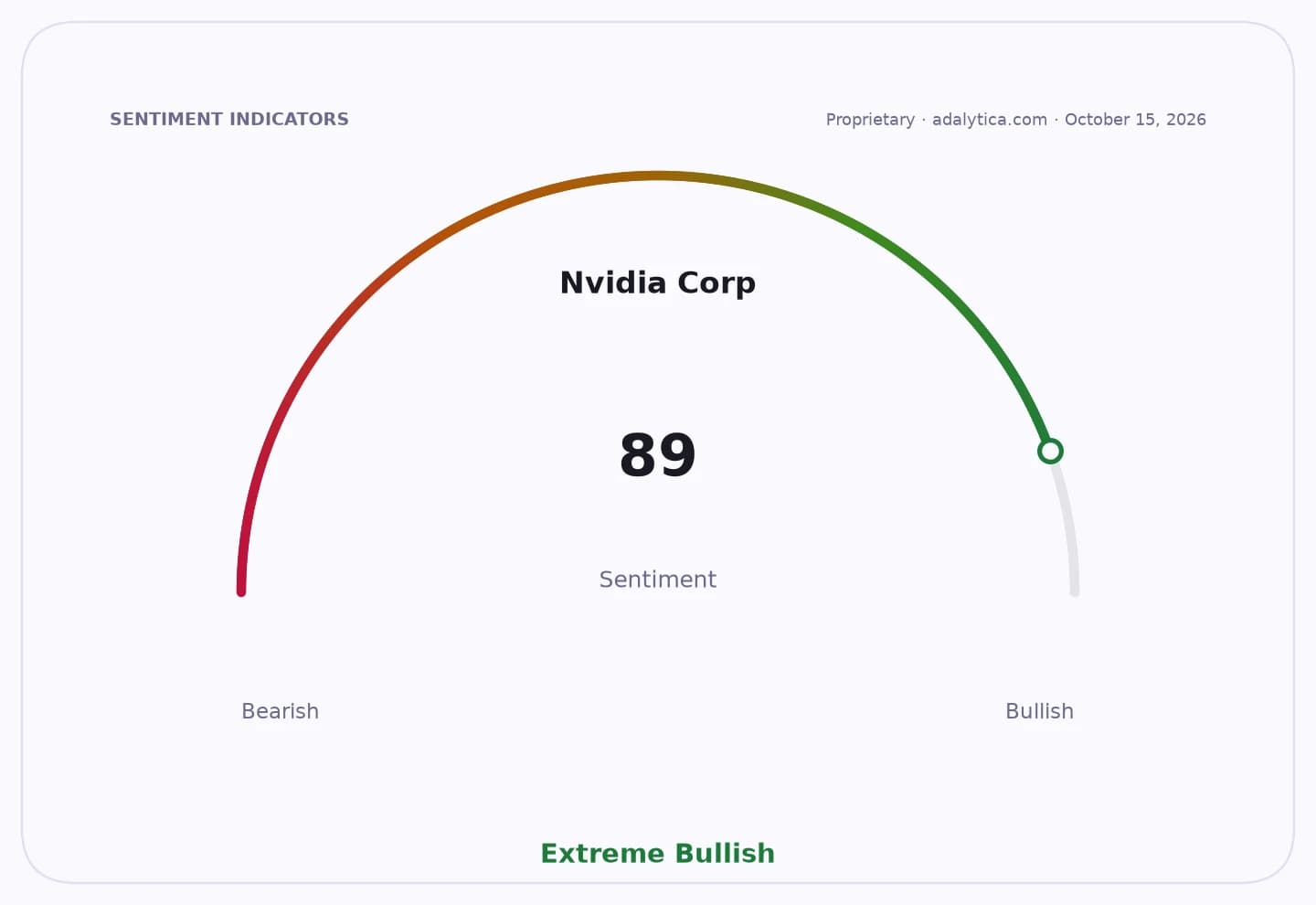
Sentiment IndicatorsⓘProprietary · adalytica.com · October 17, 2026
This is a snapshot — live sentiment, awareness and momentum for 130+ markets update continuously in the dashboard.Open AlphaPulse

The immediate pressure point is financing. Higher U.S. Treasury yields and the prospect of further Federal Reserve tightening are making investors much less comfortable with the huge capital outlays needed to construct AI infrastructure. As borrowing costs rise, the economics of multibillion-dollar data centers, GPU clusters and memory expansion look less effortless than they did when money was cheap and enthusiasm was unlimited. That’s why Oracle, CoreWeave and Nebius were also lower, and why the weakness spilled from Wall Street into Asia and Europe.
This is an important shift for long-term investors because the AI trade has not been built only on current earnings. It has also been built on expectations that demand for computing power will justify enormous spending for years. If financing becomes more expensive, the winners will be the companies with the strongest balance sheets, the clearest customer commitments and the most pricing power. The losers are the firms depending on constant access to capital, fast asset turnover and perfectly smooth demand growth.
The market is also starting to worry about supply catching up with demand. Memory-chip oversupply could emerge as early as 2029 as producers race to add capacity, while China’s CXMT is signaling fresh competition in memory technology. In other words, investors are now being asked to price not just today’s AI boom, but tomorrow’s competition and the possibility that profits get squeezed when too many companies chase the same opportunity.
That helps explain why the sell-off has become so brutal in the chip complex. SK Hynix, Samsung Electronics, Advantest, Tokyo Electron, ASML and Infineon all came under heavy pressure in overseas trading, showing this is a global revaluation rather than a single-stock problem. When the world’s chipmakers fall together, it is usually because investors are reassessing the cycle, not just one quarter.
Still, this is where patient investors should keep their perspective. The AI demand story has not disappeared. Analysts such as Dan Ives argue that higher rates are a financing problem, not a demand problem, and that the real warning signs would be canceled contracts, slower hyperscaler spending or falling GPU rental prices. Those are the numbers to watch, because they would tell you whether the AI buildout is merely pausing or truly faltering.
For now, the better read is that the market has moved from euphoria to skepticism. That often hurts in the short term, but for investors with a multiyear horizon it can create better entry points in the best businesses. Nvidia, AMD and Micron remain central to the AI supply chain; the question is not whether AI matters, but how much discipline the industry can bring to financing and capacity growth.
In that sense, this sell-off is less a verdict on AI than a stress test for the companies trying to monetize it. If demand keeps growing and balance sheets hold up, the long-term story stays intact. If capital costs keep rising and spending plans get pulled back, the market will keep punishing the most crowded names. Either way, this is a moment to stay selective, think in years, and keep the strongest AI names on your watchlist.
| Entity | Gains | Losses |
|---|---|---|
| Long-term value investors | ▲Better entry prices | ▼Short-term paper losses |
| Cash-rich chip leaders | ▲Relative resilience | ▼Valuation multiple compression |
| Highly leveraged AI builders | ▲— | ▼Higher financing costs |
| AI skeptics / shorts | ▲Lower prices | ▼— |