The race to build artificial intelligence infrastructure is increasingly being decided by who can finance it, not just who can design the fastest chips, as Nvidia, Broadcom and AMD deepen ties with customers through debt, equity and other funding structures that could lock in demand and reshape the economics of the boom.
Nvidia, Broadcom, AMD use financing to sell AI chips

That matters because the AI buildout is no longer just a story about semiconductors or model quality. It is becoming a capital-allocation contest, with suppliers effectively helping customers pay for the products they are trying to sell. In a market where datacenters, power and GPUs require tens of billions of dollars up front, financing can determine which vendors win orders, who bears the risk if revenue disappoints, and how much pricing power remains once customers start shopping around.
Broadcom has reportedly discussed raising about $30 billion in debt to help OpenAI buy chips it is developing with the startup, following a $35 billion Anthropic deal and another $60 billion package said to be in the works for Anthropic and others. Nvidia has partnered with six finance firms to mobilize more than $500 billion of third-party capital for customers’ AI infrastructure, while also holding direct stakes in AI companies valued at almost $100 billion. AMD has gone further on alignment, offering OpenAI and Meta warrants for up to 320 million shares at a penny each, effectively giving big customers an incentive to keep buying.
The playbook is familiar from industrial history. General Motors and General Electric long helped customers finance purchases and infrastructure. What is different now is the scale, the speed and the uncertainty around the underlying product. The AI market is still being priced off explosive revenue growth assumptions, yet the financing structures themselves increasingly depend on those same assumptions holding up.

That is where the investor debate gets sharper. The bull case is straightforward: financing accelerates adoption, lowers the cost of entry for customers and cements long-term demand for chipmakers and cloud providers. In that version of the story, vendor-backed funding becomes a competitive moat, especially when supply is tight and hyperscalers need guaranteed access to compute.
The bear case is that financing can mask fragility. If customers are being subsidized to buy capacity before the revenue is proven, suppliers may be taking on credit, valuation and concentration risk at the very moment the market is rewarding them for growth. The more these deals resemble quasi-balance-sheet extensions of sales strategy, the harder it becomes to tell whether demand is organic or financed.
OpenAI’s updated financials, reported by the Financial Times, add urgency to that question. The company told investors annualized revenue approached $50 billion at the end of September, about $20 billion below what had circulated last month. Anthropic’s numbers are also less clear-cut: its reported $60 billion annualized revenue through the end of July may be roughly a third lower once revenue booked by cloud partners is stripped out. For backers and lenders, those gaps matter because the financing model is only as solid as the cash flow supporting it.
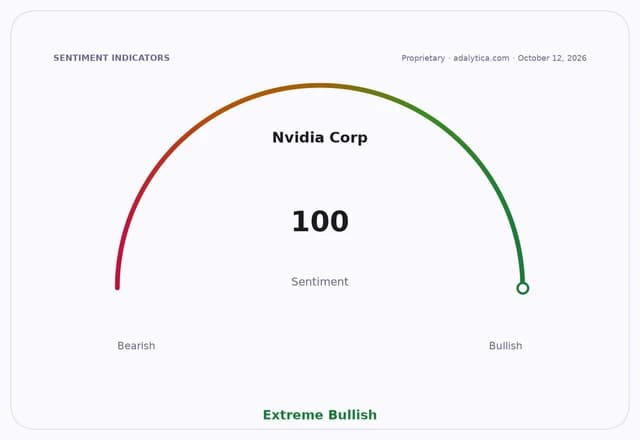
Investors are already treating the AI trade as increasingly sensitive to financing and disclosure. Nvidia’s shares have been volatile even as its earnings sentiment remains extremely bullish in Adalytica’s gauge, while Microsoft’s sentiment has swung to extreme fear despite a strong share price, underscoring how quickly expectations can reprice when capital intensity and returns come into question. Broadly, the sector is still benefiting from abundant cash, but the cost of capital is not trivial: the US 10-year Treasury is around 5.23%, while high-yield credit spreads remain above 3 percentage points, leaving debt-funded expansion exposed if margins or demand cool.
For the biggest AI players, that means the next phase of competition may be less about raw model performance than about who can structure the most resilient financing stack. For investors, the key questions are now who is on the hook, how much leverage is being hidden inside customer-supplier relationships, and whether the next wave of AI growth is being built on durable demand or on financial engineering that only works while the capital markets stay open.
| Entity | Gains | Losses |
|---|---|---|
| Nvidia, Broadcom, AMD | ▲Lock in customer demand | ▼Higher credit and concentration risk |
| OpenAI, Anthropic, Meta | ▲Easier access to chips and compute | ▼Greater dependence on suppliers |
| Investors in AI stocks | ▲Faster near-term growth narrative | ▼Lower visibility on true demand |
| Lenders and finance firms | ▲Fee income from AI funding | ▼Exposure if AI revenues disappoint |