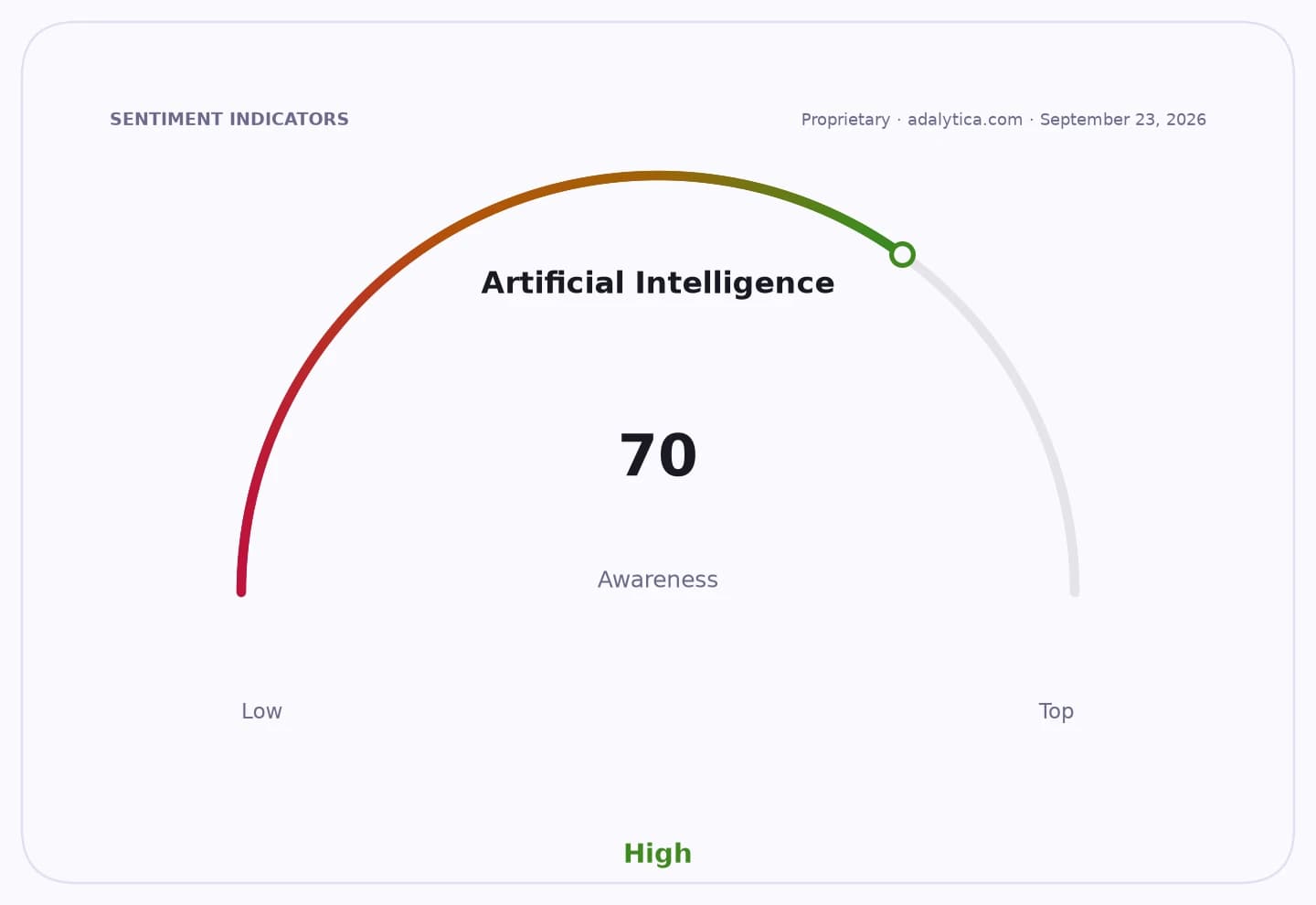
Artificial intelligence is no longer just a stock-market story — it has become one of the main engines of the U.S. economy, and the financing behind that boom is starting to reshape markets, corporate balance sheets and politics.
AI Spending Drives U.S. Growth, Debt Issuance

That is the key takeaway from a growing body of estimates showing AI-related investment accounted for an outsized share of American growth in recent quarters. ING said that under its broadest definition, information technology, software and data centers made up 50.2% of year-over-year real GDP growth in the second quarter of 2026. Even after stripping out imported equipment, the share still came in at 36%. The U.S. Treasury has said AI-linked investment represented almost 30% of GDP growth in 2025, while JPMorgan has put the figure at about 20% over the past 12 months.
Sentiment IndicatorsⓘProprietary · adalytica.com · September 28, 2026
This is a snapshot — live sentiment, awareness and momentum for 130+ markets update continuously in the dashboard.Open AlphaPulse

For investors, that concentration matters because it means the U.S. expansion is increasingly tied to a single capex cycle. Big Tech’s spending surge is no longer a light-asset, high-margin story. Microsoft, Alphabet, Amazon, Meta and Oracle are now pouring hundreds of billions into servers, chips, data centers and power infrastructure, turning AI into a capital-intensive race where access to financing may matter as much as product adoption.
Reuters reported in July that the five giants’ combined capital spending estimates for 2026 rose to about $730 billion from roughly $485 billion. Reuters, using LSEG data, also estimated that between 2025 and 2027 the companies will invest about $1.57 for every $1 of operating cash flow they generate. At the current pace, the hyperscalers’ capex is on track to exceed their combined free cash flow in 2027. That does not mean the balance sheets are under immediate stress — Microsoft, Alphabet and Meta still generate enough cash to support dividends and buybacks — but it does show why debt markets are becoming central to the AI trade.
Oracle is the clearest example of the strain. Its capital expenditures in the latest fiscal year amounted to 174% of operating cash flow, a reminder that even the most promising AI infrastructure buildout can become cash hungry fast. Goldman Sachs expects gross bond issuance from the tech giants to hit a record $420 billion in 2027, up 60% from its estimate for 2026. That is good news for bond investors looking for supply, but it also means credit markets must absorb a far larger share of the AI boom.
The deeper question for equity investors is not whether AI is generating demand — it clearly is — but whether the returns will justify the mountain of capital being deployed. OpenAI, according to documents reported by the Financial Times and Reuters, expects negative free cash flow of $278 billion between 2026 and 2030 even as revenue rises from $36 billion to $350 billion. Its spending on computing power and infrastructure is projected to reach $856 billion by the end of the decade. Anthropic’s latest Claude Opus 5.5 model, meanwhile, cut token pricing by 20% and is said to lower operating costs by 40%, underscoring how quickly competition can push down margins even as usage grows.
That tension is why the AI story is bigger than Nvidia, Microsoft or Oracle. It reaches into chipmakers, data-center builders, utilities, networking firms and the credit market itself. If spending slows sharply, the hit would extend beyond semiconductors to construction, power demand, corporate earnings and household wealth through equities. Investors should also note that bondholders are worried less about default today than about the sheer scale of new borrowing and whether future cash flows will be large enough to service it.
Politics is now part of the backdrop too. The 2026 U.S. midterm elections are approaching, and voters are far more focused on living costs than on AI. In a Reuters/Ipsos poll completed Sept. 20, only 17% approved of President Donald Trump’s handling of the cost-of-living issue. AI is not yet a top campaign theme, but if the boom lifts growth while also deepening corporate leverage and keeping prices sticky, it will inevitably become one.
For long-term investors, the right conclusion is not to fear the AI buildout, but to respect its scale. AI is creating real revenue, real infrastructure and real economic growth. It is also pulling the stock market, corporate debt and the U.S. economy into the same trade. The winners will be the companies with durable demand, strong cash generation and pricing power. The losers will be the businesses that need endless capital but cannot earn an adequate return on it.
| Entity | Gains | Losses |
|---|---|---|
| Microsoft, Alphabet, Amazon, Meta, Oracle | ▲AI revenue growth | ▼Higher capex and debt |
| Chipmakers and data-center suppliers | ▲Surging demand | ▼Margin pressure if spending cools |
| Bond investors | ▲More issuance and yield | ▼Greater credit supply risk |
| Equity investors | ▲AI-led growth | ▼Return risk if profits lag spending |