Peer-to-peer financial learning is emerging as a key driver of household money management in Piura, Peru, where high informality makes formal financial advice scarce and everyday decisions more dependent on social networks.
Piura Peer Learning and Household Money Management
Consumer Spending
That matters because in economies with large informal labor markets, the difference between stable consumption and financial stress often comes down to whether households can borrow, budget and save using trusted local knowledge rather than formal institutions. A covariate-adjusted mediation analysis suggests peer learning is not just correlated with better perceived financial management — it may be the channel through which households improve their ability to cope with irregular income, lumpy expenses and limited access to credit.
Sentiment Indicators
The policy relevance is straightforward. In high-informality settings, financial inclusion efforts that focus only on bank accounts or digital payments may miss the mechanism that changes behavior: information diffusion inside communities. If people learn from relatives, neighbors or co-workers how to stretch income, manage debt or use credit products, then financial education programs built around peer influence could be more effective than top-down outreach alone.
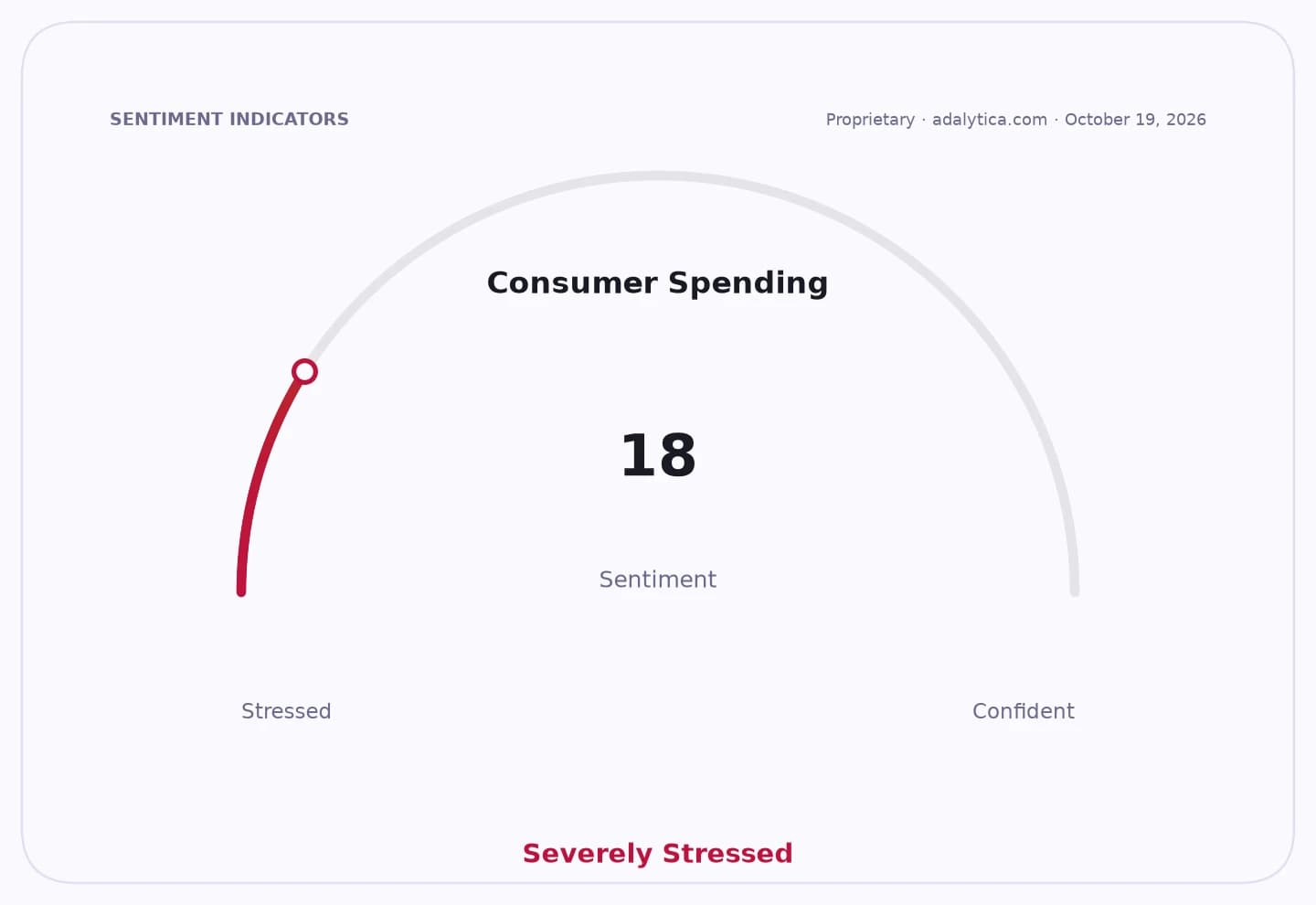
The market relevance is narrower but still important for lenders, payment providers and consumer-finance firms. Households that feel more in control of their finances are more likely to use formal credit channels and less likely to default on short-term borrowing. But the same peer channels can also amplify risk if misinformation spreads, particularly around high-cost credit cards and informal lending. That tension is visible in the data snapshot: consumer spending sentiment is in fear at 21, with awareness at an extreme fear reading of 4, while credit card usage sentiment sits at 93, indicating strong appetite for revolving credit even as spending confidence remains weak.
That divergence suggests a fragile household balance sheet dynamic rather than broad-based strength. Consumers may still be reaching for credit to smooth consumption, but the low spending sentiment implies caution around discretionary purchases and a heightened sensitivity to shocks. In that environment, peer learning can help households manage cash flow — but it can also normalize borrowing behavior before incomes have stabilized.
For investors, the story is less about Peru specifically than about the broader commercial case for behaviorally informed financial services in emerging markets. Lenders, fintechs and insurers that can embed peer-based education, community trust and simple product design may gain share in informal economies. The risk is that adoption outpaces resilience: credit growth without adequate household understanding can lift usage metrics in the short term while worsening delinquency later.
The wider takeaway is that financial capability in informal economies is social as much as it is individual. In Piura, the most important financial infrastructure may not be a branch or an app, but the peer networks through which households learn how to survive volatility.
| Entity | Gains | Losses |
|---|---|---|
| Peer networks | ▲Faster financial learning | ▼Weak guidance can spread |
| Households in Piura | ▲Better money management | ▼Higher exposure to peer bias |
| Lenders and fintechs | ▲More product uptake | ▼Higher default risk |
| Formal financial inclusion programs | ▲Clearer behavioral target | ▼Less impact if top-down only |