Poland’s Civic Coalition has widened its lead in the latest poll, yet the result still points to another fragmented parliament, underscoring how unstable the country’s governing arithmetic remains even as support shifts away from Law and Justice.
Poland poll widens Civic Coalition lead
A survey by IBRiS for Rzeczpospolita put Civic Coalition on 30.9% support, up 2.8 percentage points from August, while Law and Justice fell to 17.3%, down 0.8 point. The bigger political shift is on the right: Confederation rose to 15.3%, and Confederation of the Polish Crown gained further ground to 10%, together eroding PiS’s base and complicating any path to a clean governing majority.
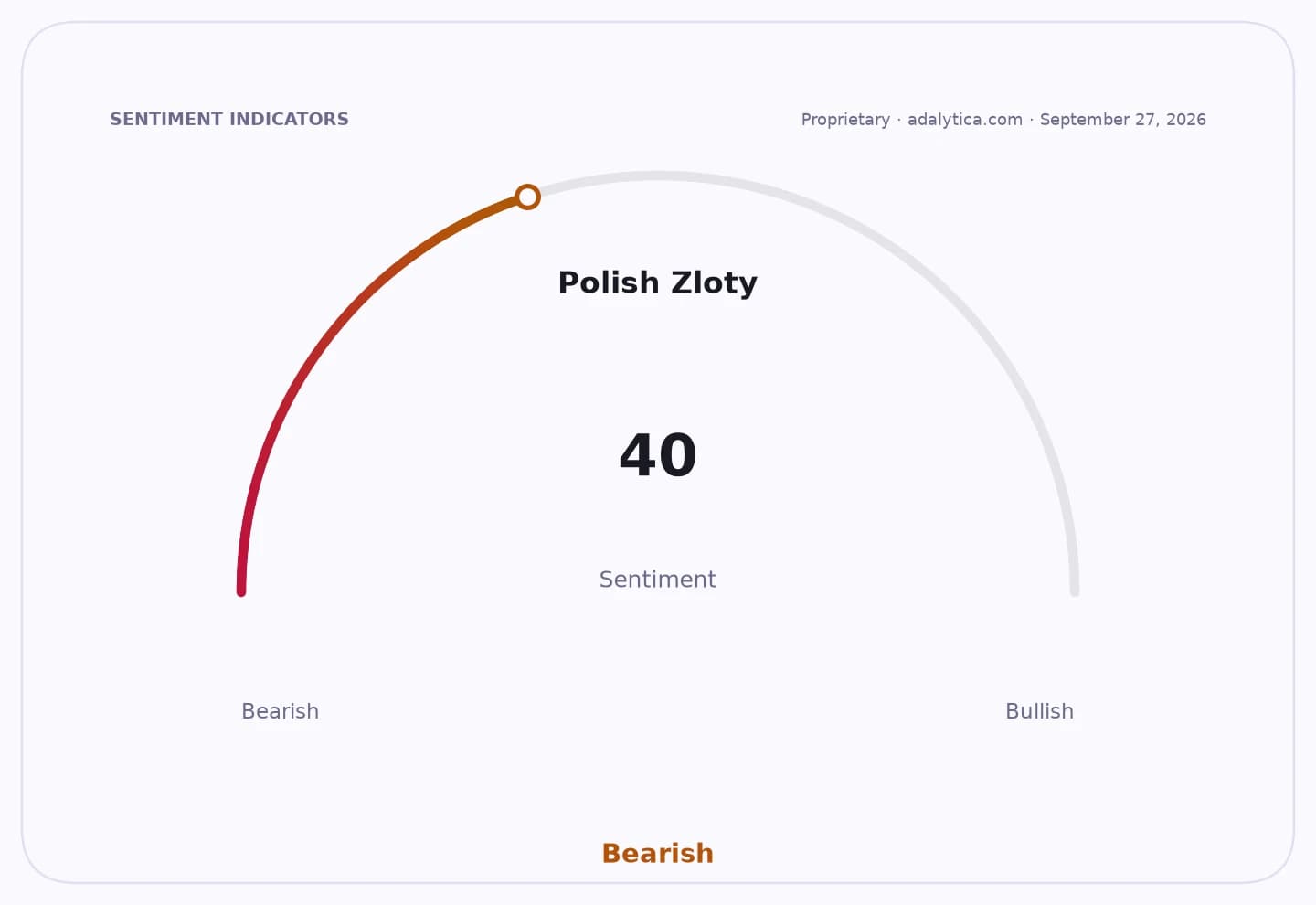
Sentiment IndicatorsⓘProprietary · adalytica.com · September 27, 2026
This is a snapshot — live sentiment, awareness and momentum for 130+ markets update continuously in the dashboard.Open AlphaPulse
That matters economically because Poland’s policy direction has become more sensitive to coalition math than to any single party’s lead. Even with Civic Coalition in first place, the poll suggests it would still fall short of majority control, meaning any future government would likely need to negotiate with smaller parties whose positions on taxation, spending, EU policy and institutional reform can be sharply different. For investors, that keeps a premium on policy clarity low and raises the risk of slower decision-making on budgets, state aid, regulation and judicial changes that matter for capital flows.
The numbers also show the right-wing vote fragmenting rather than consolidating behind PiS. That weakens the former ruling party’s ability to recover quickly, but it also makes it harder for Civic Coalition to translate popularity into control. On the left, the survey gives the Left 7.7%, while the bloc associated with former prime minister Mateusz Morawiecki is on 6.4%. Polish People’s Party slips below the threshold at 4.4%, Razem is on 3.1%, and Poland 2050 has nearly disappeared at 0.2%.
Polish Zloty — 30-day sentimentadalytica.com
Explore this data interactively — full history, time series and cross-market comparisons.Open AlphaPulse
For markets, the immediate implication is less about a direct reaction in zloty trading than about the policy backdrop investors will price into Polish assets over time. The currency has been broadly neutral in Adalytica’s Polish zloty trade signals, while the euro is showing extreme fear, reflecting a wider risk-off tone in European sentiment rather than a Poland-specific shock. But domestic political fragmentation can still feed into bond risk premia and equity sector valuations if it prolongs uncertainty around fiscal discipline, public investment and relations with Brussels.
The broader narrative is that Poland’s center-left bloc is gaining relative strength, but the country’s politics remain too divided to deliver a stable governing mandate. Unless one camp breaks sharply higher, investors should expect coalition bargaining to remain the defining feature of Polish policymaking and a source of recurring uncertainty for markets.
| Entity | Gains | Losses |
|---|---|---|
| Civic Coalition | ▲First-place lead | ▼Still no majority |
| Law and Justice (PiS) | ▲— | ▼Support erosion |
| Confederation / right-wing rivals | ▲Stronger vote share | ▼Fragmented opposition camp |
| Polish assets and policymakers | ▲Potential policy continuity if coalition holds | ▼Prolonged uncertainty |