Poland’s move to sharply restrict Colombian workers is the clearest sign yet that Europe’s labor-market openness is giving way to political backlash, a shift that could ripple through food processing, staffing and other industries already leaning on foreign labor.
Poland Tightens Work Rules for Colombian Workers
The government in Warsaw has barred Colombians from taking jobs under visa-free travel and now requires them to obtain a work visa as well as a permit, after similar curbs on Georgians and Venezuelans at the end of August. The change comes as the number of Colombians working in Poland jumped from just 108 in 2015 to 5,200 in 2023 and then to 16,389 two years later, with more than 3,000 permanent and temporary residence approvals issued in 2024 alone.
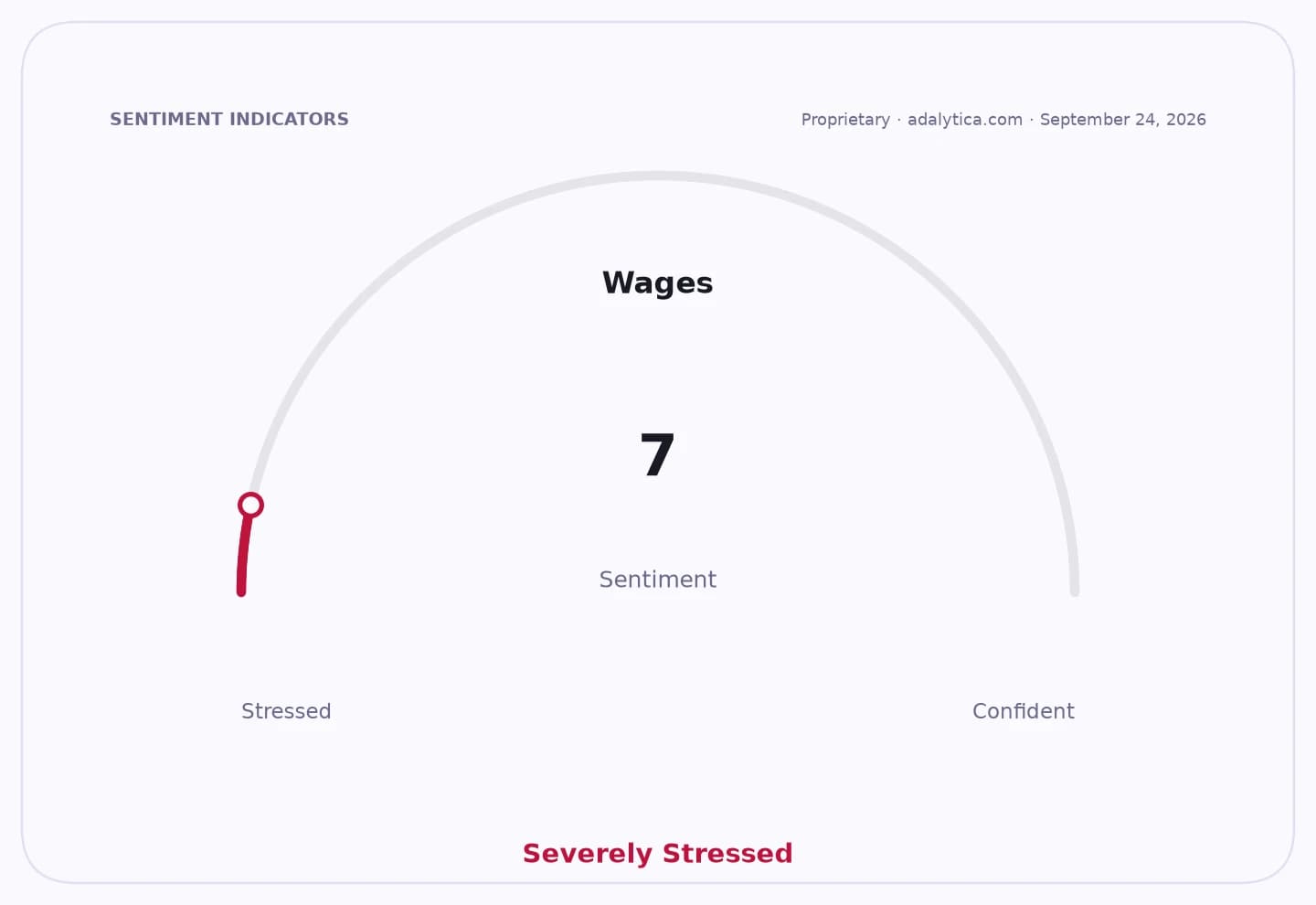
Sentiment IndicatorsⓘProprietary · adalytica.com · September 10, 2026
This is a snapshot — live sentiment, awareness and momentum for 130+ markets update continuously in the dashboard.Open AlphaPulse
Economically, the timing is awkward. Poland’s labor market still depends on foreign workers, with 1.15 million legally employed non-citizens at the end of the first quarter. Colombians are concentrated in food-related industries — fruit and vegetable processing, fish, dairy, meat, ice cream and confectionery — where employers have been struggling to fill shifts. A sudden tightening of access risks pushing up recruitment costs, slowing production and worsening labor shortages in segments that are not easily automated overnight.
For investors, this is a second-order story with first-order consequences. The market has tended to view migration policy as a domestic political issue, but in Poland it is now becoming a supply-side constraint on growth. That matters for consumer goods manufacturers, food processors, staffing firms and industrial employers that rely on imported labor to keep margins intact. It also matters for Polish assets more broadly because labor scarcity can feed wage pressure, reduce output and complicate the inflation path at a time when the country can least afford another cost shock.
The reaction in Bogotá has been notably calm, with Colombia’s foreign ministry saying bilateral ties remain positive and constructive. That lowers the risk of an immediate diplomatic tit-for-tat. But the bigger issue is precedent. If Warsaw extends similar restrictions to other countries, Poland could be the early test case for a broader European retreat from easy labor mobility — a development the market is underestimating.
That is why this matters now: the policy may be framed as a security response, but the real investment question is whether Poland is beginning to tax its own growth model. If the trend spreads, the winners are firms able to automate, raise prices or source labor locally; the losers are labor-intensive businesses that built their expansion on cross-border hiring. For investors, the message is to own the companies selling the tools of substitution — automation, logistics, productivity software and industrial efficiency — and be cautious on the most labor-dependent end of the Polish economy.
| Entity | Gains | Losses |
|---|---|---|
| Automation and productivity firms | ▲Higher demand | ▼None |
| Polish food processors | ▲Short-term labor protection | ▼Higher labor costs |
| Foreign workers from Colombia, Georgia, Venezuela | ▲None | ▼Job access in Poland |
| Polish employers reliant on migrant labor | ▲None | ▼Staff shortages, margin pressure |