Economists say the risk that higher energy costs are feeding broadly into Polish prices remains limited for now, giving the National Bank of Poland room to keep interest rates unchanged even as headline inflation stays above target.
Poland core inflation stays low as energy costs rise
Core inflation in Poland was running at 2.5%-2.7% year on year in November-March, the lowest in six years, according to the data cited by local economists. That suggests the recent jump in fuel and energy prices has so far been contained to a narrow set of categories rather than spreading through the wider economy, a key distinction for policymakers weighing whether to tighten monetary policy again.
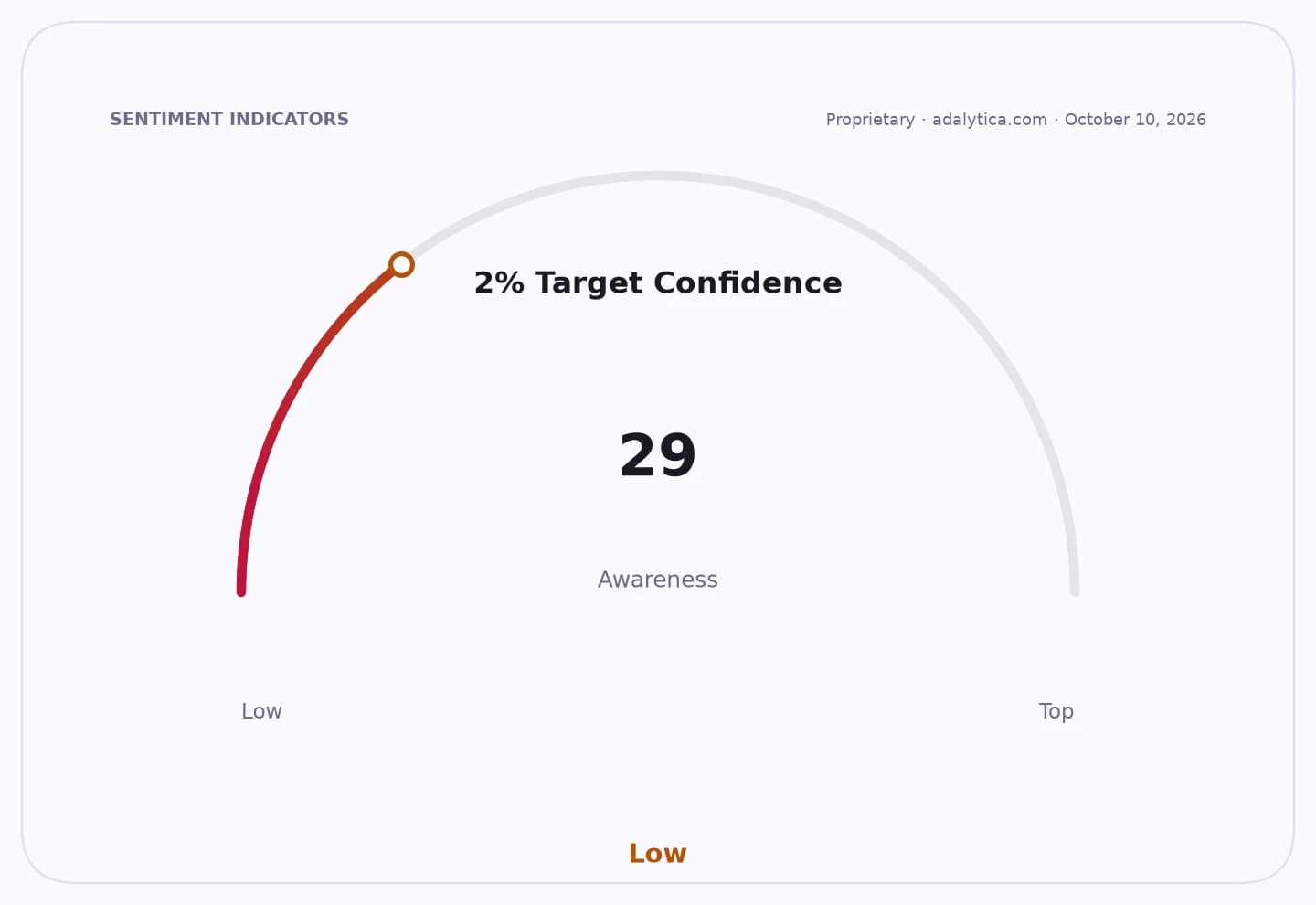
Sentiment IndicatorsⓘProprietary · adalytica.com · October 19, 2026
This is a snapshot — live sentiment, awareness and momentum for 130+ markets update continuously in the dashboard.Open AlphaPulse
The backdrop matters because headline inflation remains elevated at 4.1% in September, above the central bank’s 3.75% policy rate. But economists say the core measure strips out food and energy and better captures domestically generated price pressure, which is what the NBP can influence most directly. For now, that gauge points to a more benign picture than the headline number implies.
Analysts at Pekao said the September downside surprise in core inflation was driven mainly by lower-than-expected prices in organized tourism, after earlier increases, while PKO BP pointed to clothing, internet fees and cloud services as additional drags. Credit Agricole said the drop in core inflation supports the view that the energy shock linked to the Middle East conflict has not yet filtered broadly through the economy.
That said, the picture is not risk-free. Governor Adam Glapiński has warned that the central bank must still watch for signs of second-round effects from higher fuel and gas prices, especially with domestic demand still relatively strong, the economic backdrop in Poland and Europe improving, and next year’s budget not implying meaningful fiscal tightening. He also pointed to rising producer prices as a possible sign of building cost pressure.
Some economists see those risks as manageable. Piotr Dmitrowski at BGK said weak wage growth and still-muted labour-market pressure should help keep core inflation low and support an unchanged policy rate, even if that means the bank tolerates temporarily negative real rates. BOŚ Bank’s Aleksandra Świątkowska said higher energy costs will feed into core inflation through costs, but limited bargaining power for workers should keep labour-cost inflation contained.
The main upside risk is external. Erste Bank Polska expects pressure to rise in durable goods as higher Chinese producer prices and a weaker zloty reduce the disinflationary effect of imports that has helped cap prices of clothing, footwear and household goods. If that trend deepens, the NBP could face a harder choice between supporting growth and preserving credibility on inflation.
For investors, the message is that Poland’s rate path still looks data-dependent rather than inflation-driven. With core price pressures subdued and wages not yet accelerating enough to force a policy response, fixed-income markets can continue to price a patient central bank. The key catalysts are whether producer-price inflation broadens, whether the labour market tightens, and whether energy costs keep leaking into household and business prices in the months ahead.
| Entity | Gains | Losses |
|---|---|---|
| NBP/RPP | ▲Policy flexibility | ▼Urgency to hike rates |
| Polish consumers | ▲Slower core-price erosion | ▼None if shocks stay contained |
| Borrowers | ▲Stable financing costs | ▼Higher real rates if inflation eases faster |
| Importers/durable-goods sellers | ▲Cheaper demand conditions | ▼Weaker zloty and China cost pass-through |