The Portuguese PSI fell 0.44% on Thursday as hotter-than-expected US producer prices sharpened concerns that the Federal Reserve may have to keep rates restrictive for longer, while European equity markets remained split between defensive sectors and rate-sensitive ones.
PSI falls as US PPI fuels inflation concerns
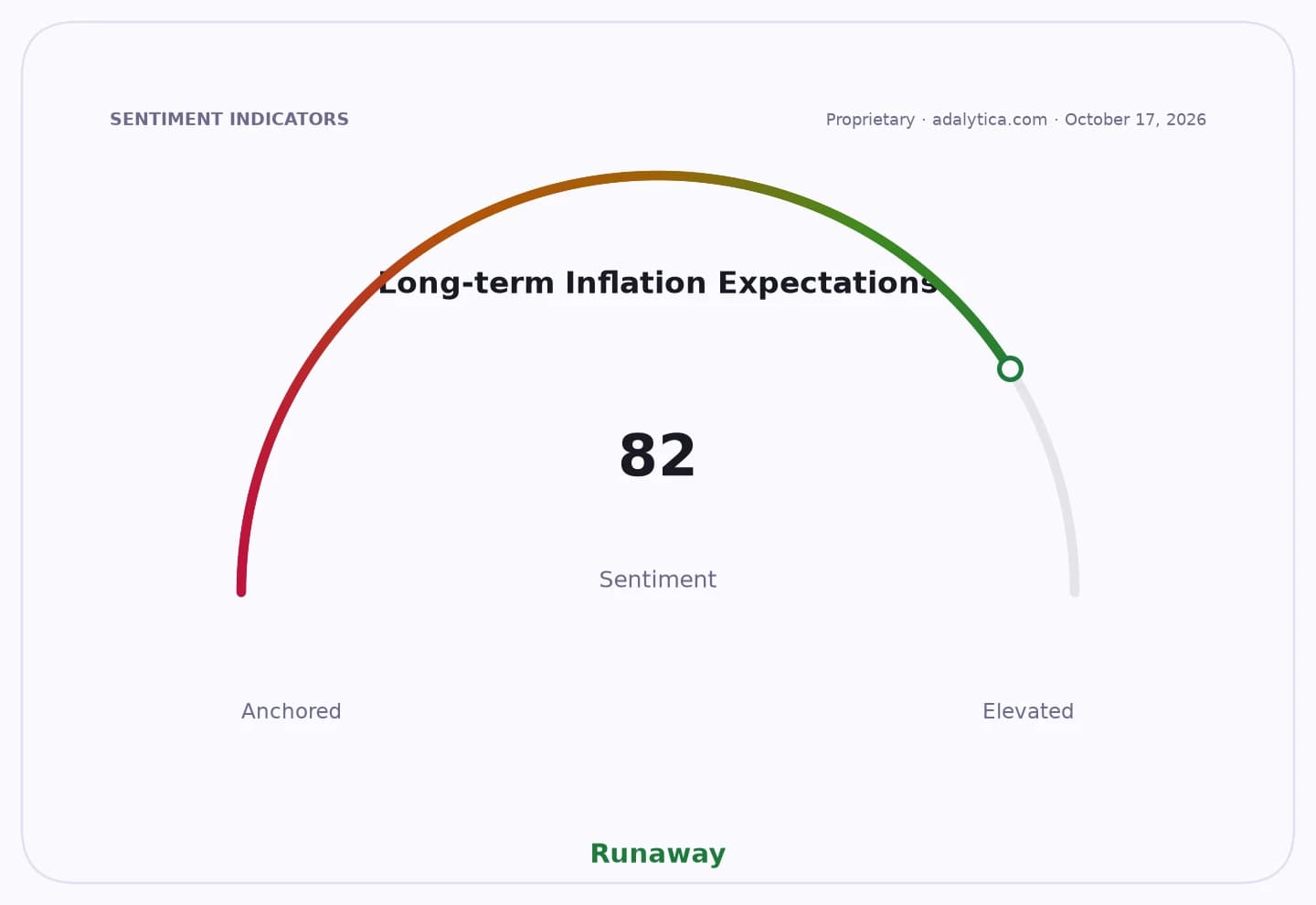
The PSI closed at 9,373.82 points, with the day’s tone shaped less by domestic news than by the global macro backdrop. US producer prices accelerated to 6.3% in September, well above the 5.4% forecast and the fastest pace in four years, while core producer prices rose 5%. That re-ignited the inflation debate across markets and, even if bond traders quickly bought duration, it reinforced the view that central banks are still not done with inflation.
Sentiment IndicatorsⓘProprietary · adalytica.com · October 17, 2026
This is a snapshot — live sentiment, awareness and momentum for 130+ markets update continuously in the dashboard.Open AlphaPulse
In Lisbon, the decline was led by EDP Renováveis, down 2.32% to 12.21 euros, Mota-Engil, which lost 2.08% to 4.710 euros, and Teixeira Duarte, off 2.00% to 0.4410 euros. Jerónimo Martins was the strongest contributor, climbing 2.59% to 17.83 euros after Kepler Cheuvreux cut its target price to 19.60 euros from 20.40 euros but maintained a buy recommendation, underscoring the appeal of defensive retail names when investors are wary of inflation and policy risk. CTT rose 0.91% and NOS added 0.86%.
The broader European picture was mixed. The EuroStoxx 50 slipped 0.36%, even as the Stoxx 600 edged up 0.38%. The FTSE 100 gained 1.08%, helped by softer sovereign yields and energy stocks, while Paris and Frankfurt rose modestly. Southern Europe lagged, with Italy’s FTSE MIB down 0.72% and Spain’s IBEX 35 off 0.28%, a pattern that fits a market still preferring cash-generative, defensive and oil-linked exposures over more cyclical or rate-sensitive areas.
2% Target Confidence — 30-day sentimentadalytica.com
Explore this data interactively — full history, time series and cross-market comparisons.Open AlphaPulse
Millennium Investment Banking said European bourses finished divided, with Iberian losses offset by gains in London, and noted that the day’s US producer-price surprise was met with relative calm. That calm was visible in sovereign debt, where 10-year yields fell broadly: the US benchmark dropped 9.62 basis points to 5.09%, Germany’s fell to 3.41% and Portugal’s to 3.88%. The move suggests investors were willing to buy duration despite the inflation data, perhaps on expectations that tighter financial conditions will eventually slow growth.
Commodity markets told a different story. WTI rose 3.35% to $98.28 a barrel and Brent added 0.16% to $106.23, reflecting lingering geopolitical tensions, while gold gained 1.55% to $4,171.40, showing that safe-haven demand has not disappeared. The euro strengthened 0.42% against the dollar to $1.1204, even as higher US inflation normally supports the greenback, highlighting how mixed positioning has become across currencies and rates.
For investors, the key message is that inflation is once again the dominant global variable. In equities, that favours defensives such as Jerónimo Martins over higher-beta names and companies exposed to funding costs. In bonds, falling yields offer near-term relief, but if US inflation stays sticky, the path for central bank policy remains uncertain and valuation support for risk assets may prove fragile. The next test will be whether incoming Fed communication confirms that the latest price data is a one-off or the start of a more persistent inflation problem.
| Entity | Gains | Losses |
|---|---|---|
| Jerónimo Martins | ▲defensive demand bid | ▼valuation upside limited |
| PSI / Iberian cyclicals | ▲selective support for defensives | ▼broader index weakness |
| US bond buyers | ▲lower yields, price gains | ▼inflation persistence risk |
| Oil and gold | ▲geopolitical and safe-haven flows | ▼rate-sensitive assets |