Australia’s central bank is preparing markets for a move to 4.85% as soon as November, after minutes showed the Reserve Bank of Australia is increasingly willing to accept a rise in unemployment if inflation does not cool fast enough.
RBA Eyes 4.85% as Inflation Stays Sticky

That shift matters because it marks a harder line from policymakers who now see the inflation fight as outweighing the near-term cost to growth and jobs. The minutes point to a central bank frustrated by sticky domestic price pressures and weak productivity, even as borrowers, retailers and construction firms are still digesting the lagged effect of prior tightening.
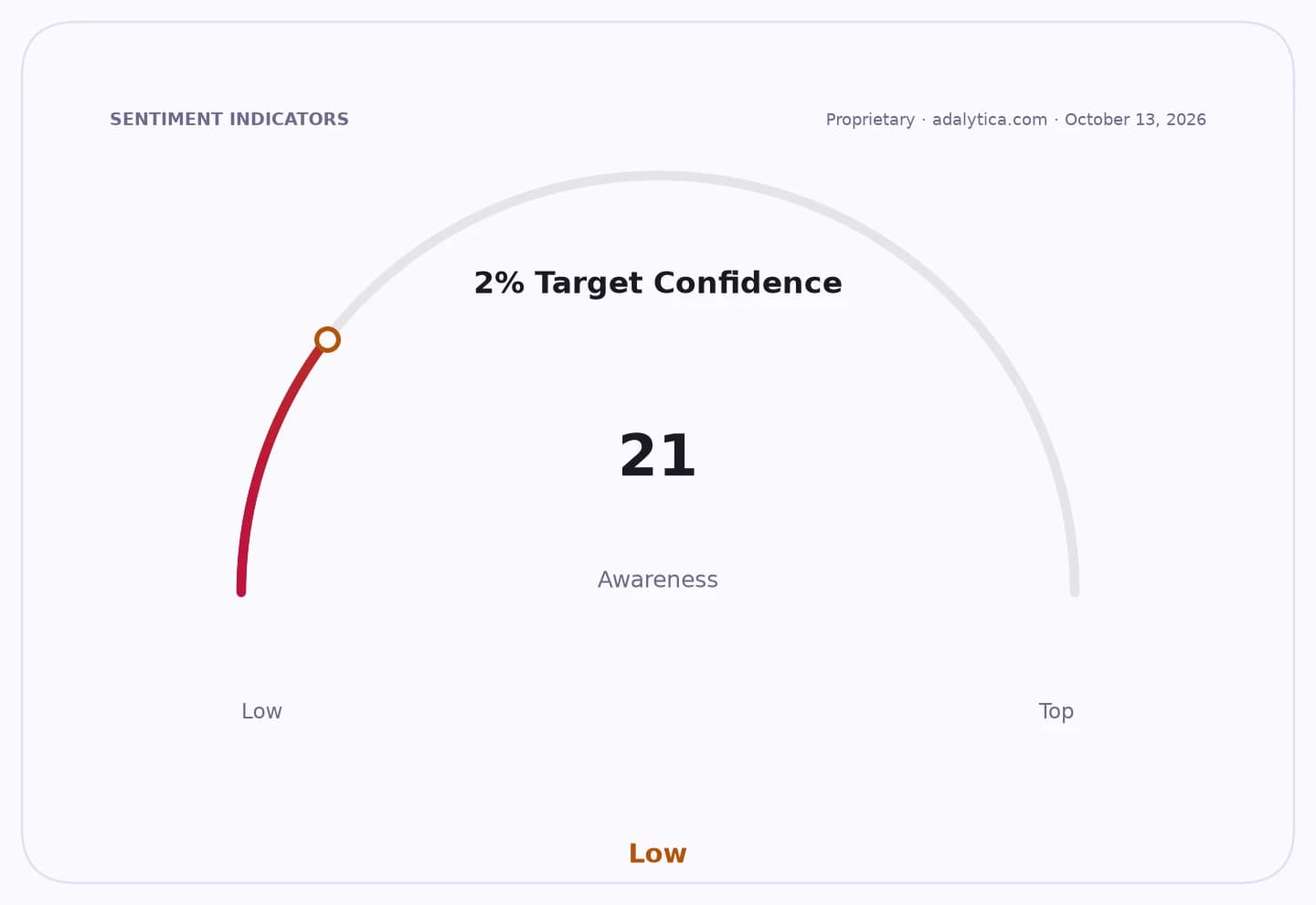
Sentiment IndicatorsⓘProprietary · adalytica.com · October 14, 2026
This is a snapshot — live sentiment, awareness and momentum for 130+ markets update continuously in the dashboard.Open AlphaPulse
The warning lands at a sensitive moment for the Australian economy. Inflation has not fallen decisively enough to convince the RBA that policy is restrictive enough, while unemployment remains low by historical standards at 4.2% in September and only modestly above the 4.09% forecast for October. That gives the bank room to tighten further, but also raises the risk that a small deterioration in labour conditions becomes a sharper downturn if households and small businesses absorb another rate increase.
For investors, the main implication is that Australian assets may need to price a longer period of elevated borrowing costs. Rate-sensitive sectors such as housing, discretionary retail and small-cap cyclicals are the most exposed, while banks face the familiar trade-off between higher lending margins and rising credit stress. The Australian dollar has been confined near 0.70 against the US dollar, with technical indicators suggesting a weak backdrop rather than a convincing breakout, underscoring how little room there is for complacency in fixed income or FX markets.
The broader policy message is that the RBA is increasingly focused on supply-side dysfunction as well as demand pressure. It has effectively argued that weak productivity is making inflation harder to defeat, which means monetary policy alone may have to do more of the work unless wages and pricing behaviour cool materially. That is a difficult backdrop for Treasurer Jim Chalmers, whose fiscal stance is now being judged through the lens of whether government policy is helping or complicating disinflation.
The near-term catalyst is the next inflation print and the RBA’s November meeting. If price pressures remain sticky, the bank may follow through with the fifth hike it has been signalling, putting households under more strain and increasing the chance of the small-business failures it has warned about in construction, hospitality and retail. If inflation softens more quickly than expected, the central bank may still pause — but the minutes suggest it will need convincing.
| Entity | Gains | Losses |
|---|---|---|
| RBA | ▲Credibility on inflation | ▼Growth tolerance |
| Borrowers | ▲Lower rates if hike avoided | ▼Higher debt servicing |
| Banks | ▲Wider lending margins | ▼Credit deterioration |
| Small businesses | ▲Possible relief if policy pauses | ▼Failure risk from tighter policy |