India’s central bank rejected all bids at a Rs 23,000-crore treasury bill auction, a rare move that signals the Reserve Bank of India is unwilling to validate the recent jump in short-term borrowing costs.
RBI Rejects All Bids at Treasury Bill Auction
The cancellation matters because Treasury bill yields are a reference point for money-market pricing, banking system liquidity and the government’s near-term funding costs. By refusing to accept bids on the 91-day, 182-day and 364-day papers, the RBI is effectively telling the market that the level of rates on offer was too high, or at least too far above its comfort zone, after a sharp run-up in yields over the past five weeks.
Sentiment IndicatorsⓘProprietary · adalytica.com · October 26, 2026
This is a snapshot — live sentiment, awareness and momentum for 130+ markets update continuously in the dashboard.Open AlphaPulse
Traders said the cutoff levels likely came in above the central bank’s expectations. Last week, the RBI had sold 91-day notes at 5.73%, while the 182-day and 364-day bills cleared at 6.29% and 6.49%. A Reuters poll on Wednesday had projected 5.85%, 6.42% and 6.60%, respectively, already above the prior week’s levels. The refusal to clear the sale suggests the market had pushed rates even higher, reflecting caution around the policy path and tight supply-demand conditions in the front end of the curve.
That caution has intensified as investors price in more tightening. Avnish Jain, chief investment officer for fixed income at Canara Robeco Mutual Fund, said markets are expecting at least another 75 basis points of rate hikes and that investors are “now on the negative side,” leading to more restrained bidding for bills. In the five weeks to Oct. 14, cutoff yields on the three maturities rose by 64 basis points, 83 basis points and 69 basis points, respectively, while the spread between 364-day notes and the RBI’s policy rate climbed to 99 basis points last week, the widest in four years.
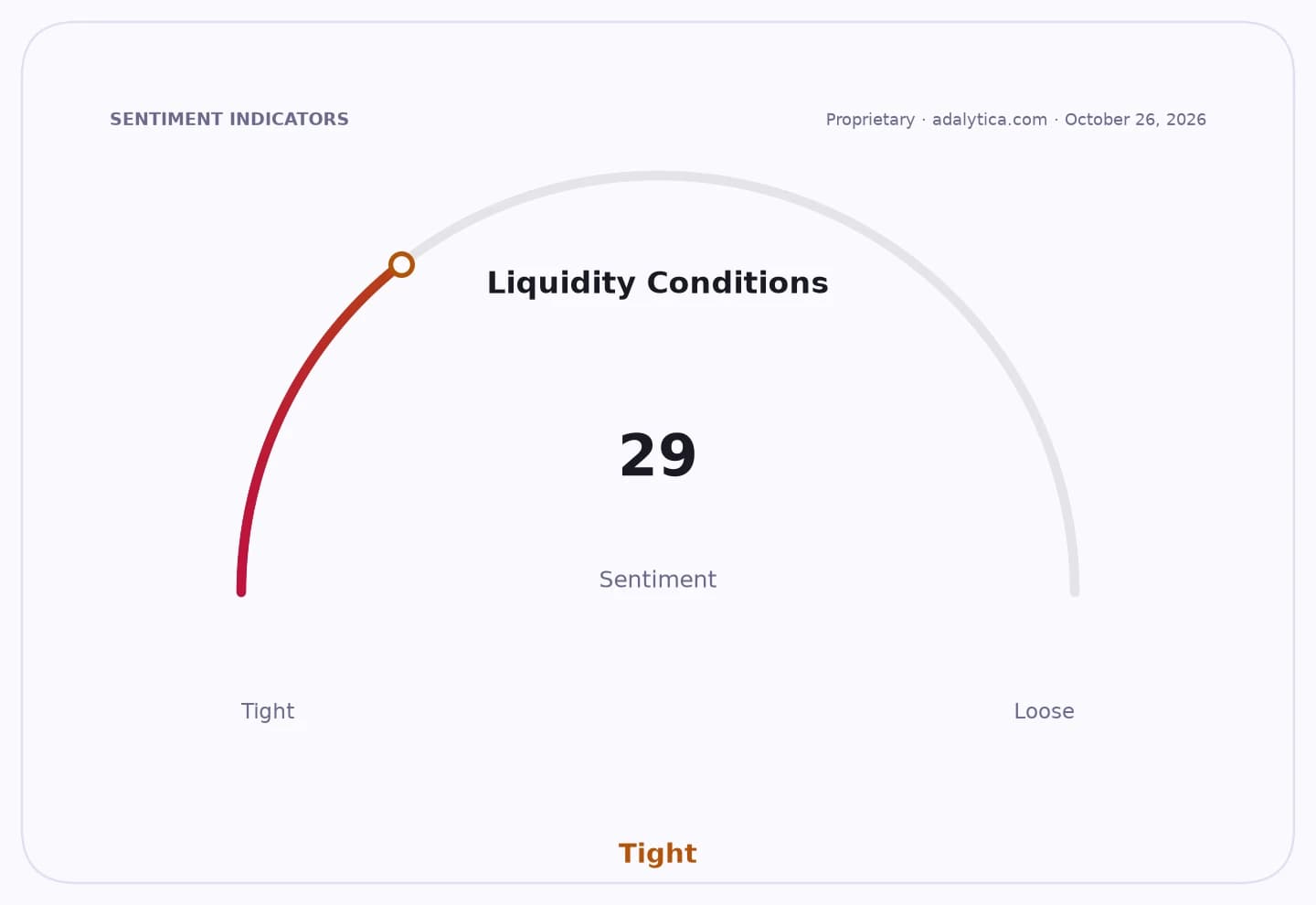
Liquidity Conditions — 30-day sentimentadalytica.com
Explore this data interactively — full history, time series and cross-market comparisons.Open AlphaPulse
For investors, the message is two-sided. On one hand, the RBI’s action may cap the pace at which money-market yields can reprice, especially if it follows up with liquidity support or a more calibrated auction strategy. On the other, repeated cancellations would reinforce the view that short-end rates remain vulnerable to further rises, pressuring bond funds, bank treasury books and borrowers that rely on rolling short-term paper.
The move also underscores how much the RBI is trying to manage market expectations without immediately changing policy. The government was seeking to raise Rs 230 billion through the sale, but officials can cancel or reschedule auctions when borrowing conditions become uncomfortable. The RBI has done so before, cancelling the 182-day and 364-day auctions in June and rejecting bids across all three tenors at the end of March.
The broader implication is that India’s short-end rates are moving into a more fragile zone. If the market keeps pricing a larger rate-hike cycle, the RBI may have to choose between tolerating higher funding costs or stepping in more forcefully to prevent a disorderly rise in yields. For investors, the next signals will come from whether the central bank allows future T-bill auctions to clear at higher levels or continues to push back against the repricing.
| Entity | Gains | Losses |
|---|---|---|
| RBI | ▲Retains rate control | ▼Faces market pressure |
| Government borrower | ▲Avoids locking in higher yields | ▼Delayed funding access |
| Bond investors | ▲Potential policy backstop | ▼Mark-to-market losses |
| Banks and mutual funds | ▲Possible later buying opportunity | ▼Short-end yield volatility |