A persistent 10-year Treasury yield above 5% is keeping pressure on income-oriented property stocks, but the divergence inside REITs is widening as investors favor landlords with stronger rent growth and balance-sheet flexibility over bond proxies that remain vulnerable to higher-for-longer financing costs.
Realty Income vs Simon Property on higher rates

That backdrop explains why the cleaner trade is to sell Realty Income, one of the sector’s most widely held net-lease names, and buy Simon Property Group, a smaller but more defensively positioned mall landlord whose shares have held up better despite the same rate environment. The message for investors is not that REITs are broken, but that valuation support now depends more on cash-flow durability and pricing power than on headline yield.
Sentiment IndicatorsⓘProprietary · adalytica.com · September 26, 2026
This is a snapshot — live sentiment, awareness and momentum for 130+ markets update continuously in the dashboard.Open AlphaPulse
The macro case is straightforward. The 10-year yield has climbed to about 5.19%, while the federal funds rate is still around 3.63%, leaving borrowing costs elevated across the property stack. For REITs, that matters twice: it raises the discount rate used to value long-duration cash flows and it lifts refinancing costs on debt maturing over the next several years. A higher risk-free rate also makes dividend yields less compelling relative to Treasuries, especially for names whose growth profile is modest.
Realty Income has been hit hard in that environment. The stock fell to $55.54 on Sept. 25 from as high as $64.52 in February, leaving it well below both its 50-day moving average of $61.45 and its 200-day moving average of $60.74. Its RSI reading of 4.8 points to deeply oversold conditions, but the technical damage reflects more than momentum selling. The market is effectively questioning whether a low-volatility, high-payout REIT can keep commanding a premium when bond yields are this high and the spread over Treasuries is narrowing.
Simon Property, by contrast, is showing the kind of relative resilience investors want when rates are restrictive. The stock closed at $204.82 on Sept. 25, far above its 200-day average of $199.38 and still only modestly below its 50-day average of $215.71. That is a much firmer technical profile than Realty Income’s, even after a recent pullback from above $220 in August. Simon’s business also has a more direct path to rent growth: premium malls and outlet centers tend to benefit when retailers are willing to pay for traffic and productivity, while occupancy and same-store sales can improve faster than in net-lease portfolios tied to long-dated leases.
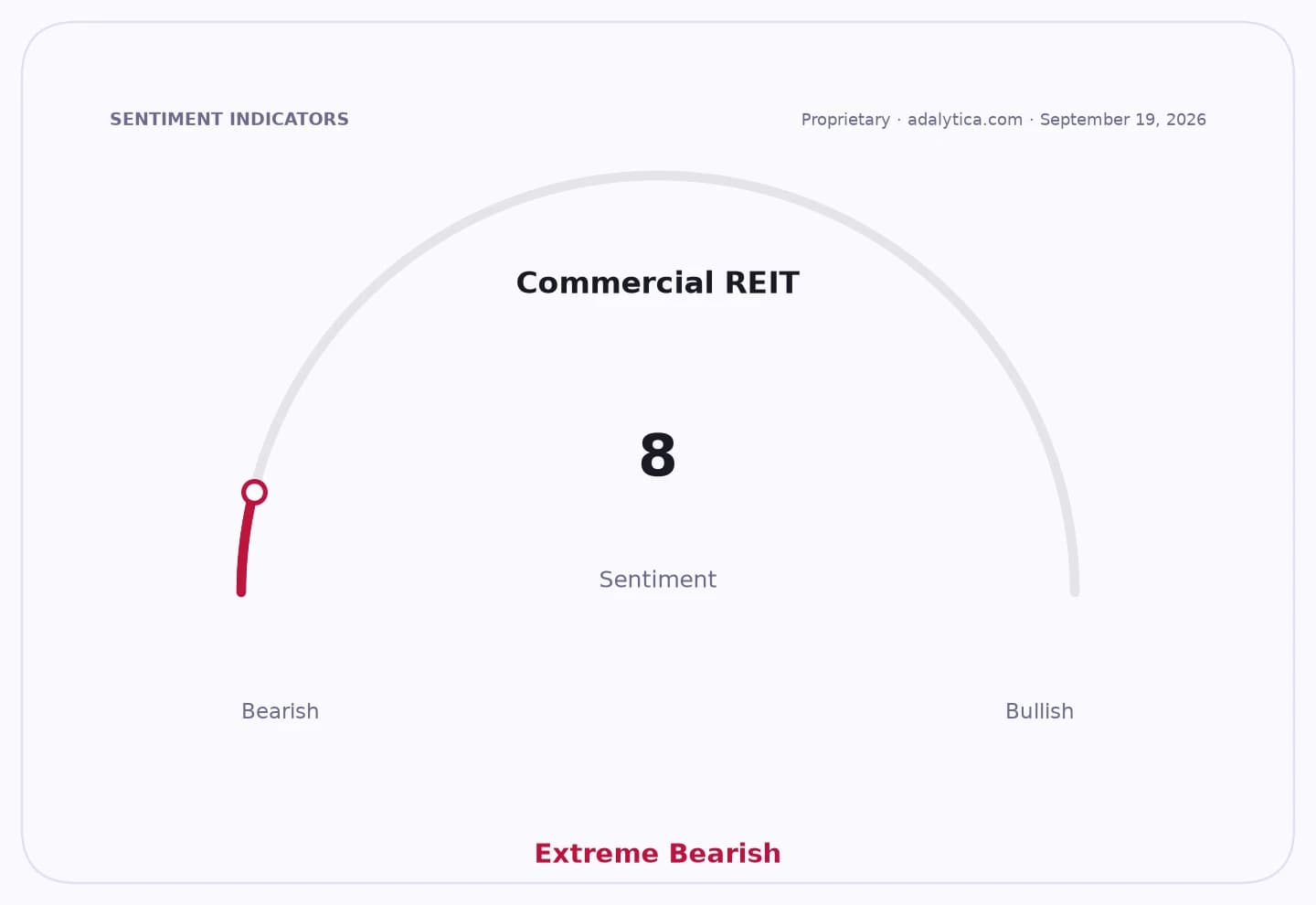
The trade also reflects a broader REIT rotation. Adalytica’s Commercial REIT sentiment gauge improved to neutral after a sharp swing over the past month, suggesting investors are no longer treating the whole sector as a single macro bet. But the distinction matters. Net-lease REITs such as Realty Income often behave like equity bond substitutes, which can underperform when Treasury yields remain elevated. Mall operators such as Simon are more cyclical, but they can outperform when consumer spending holds up and pricing power offsets financing pressure.
There is still a bull case for Realty Income. Its tenant base is diversified, its cash flows are predictable and its monthly dividend remains a draw for yield investors. If Treasury yields fall meaningfully, the stock could rerate quickly because the shares already trade with a defensive-income premium compressed by the rate shock. But that is a macro call, not a company-specific one, and it requires bond yields to stop competing so directly with REIT dividends.
The bear case is that elevated rates linger while housing and broader commercial property demand remain uneven. U.S. housing starts have cooled from recent levels and financing conditions are still tight, limiting the scope for a broad REIT multiple expansion. In that environment, capital should favor landlords with either stronger embedded growth or less sensitivity to refinancing costs. Simon fits that mold better than Realty Income right now.
For investors, the key takeaway is that the REIT trade is becoming more selective. If the 10-year stays near 5%, income alone will not be enough to carry valuations. The better setup is to own REITs with pricing power, asset quality and leverage flexibility, and to be cautious on high-yield names whose appeal depends on rates falling first.
| Entity | Gains | Losses |
|---|---|---|
| Simon Property Group | ▲Relative valuation support | ▼None if rates stay high |
| Realty Income | ▲Potential rebound if yields fall | ▼Yield competition from Treasuries |
| Treasury bonds | ▲Higher income appeal | ▼REIT multiples |
| Income investors | ▲Better selectivity | ▼Broad REIT beta |