Romania’s labor market is entering 2026 with a familiar contradiction: nominal wages are still rising, but workers are losing ground in real terms and the country remains far behind the European Union on both pay and employment.
Romania labor market wages rise as real pay falls

That matters because the story is no longer just about catch-up growth. The latest data show a labor market that is still relatively cheap by EU standards, but increasingly constrained by weak productivity, a low employment rate, a tiny pool of vacancies and a mismatch between the jobs firms need and the skills available. For investors and policymakers, that combination limits how far wages can rise without eroding competitiveness or squeezing household demand.
Sentiment IndicatorsⓘProprietary · adalytica.com · September 27, 2026
This is a snapshot — live sentiment, awareness and momentum for 130+ markets update continuously in the dashboard.Open AlphaPulse
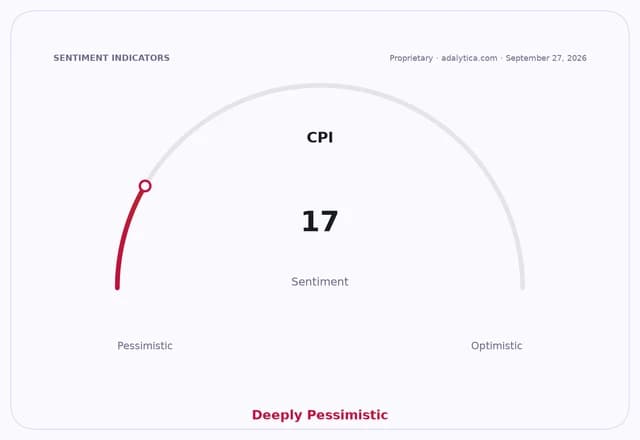
The average net wage reached 5,820 lei in July, up 5.5% from a year earlier, according to Romania’s statistics office. But the real wage index stood at 97.5% of its level a year ago, implying a roughly 2.5% drop in purchasing power after inflation. Consumer prices were still rising 8.16% annually in July, while inflation eased only later, to 6.17% in August. Services remained the most inflationary category at 11.28%, keeping pressure on household budgets even as pay packets got larger in nominal terms.
The gap between headline wages and living standards is central to the economic outlook. Rising pay has supported consumption and narrowed parts of the gap with richer EU economies, but the pace has slowed and is now being overtaken by prices. That leaves Romania in the awkward position of having higher labor costs than before, but not enough real income growth to generate a strong domestic demand impulse.
The structure of the labor market is just as important as the wage data. The average masks enormous sectoral differences: net pay reached 13,464 lei in IT programming and consulting and 13,140 lei in oil and gas extraction, but was below 3,000 lei in other services and just above that in fishing and aquaculture. The spread of more than 10,000 lei a month between the best- and worst-paid sectors underlines how uneven Romania’s growth model remains.
Monthly swings also show that the wage data are being driven by bonuses, seasonal payments and sector-specific adjustments rather than a broad, steady rise in pay. That makes the labor market more volatile for both employers and households, and it complicates any read-through to inflation or long-term wage trends.
Romania’s cost of labor remains low by EU standards, but the country is no longer racing to close the gap as quickly as it was. In 2025, the average hourly labor cost was 13.6 euros, versus 34.9 euros in the EU and 38.2 euros in the euro zone, according to Eurostat. That put Romania at about 39% of the EU average and second-lowest in the bloc, ahead only of Bulgaria. The cost gap has narrowed over time, helped by years of rapid minimum-wage increases, but the latest figures suggest the pace is cooling.
In the second quarter of 2026, the wage component of hourly labor costs rose only 1.8% from a year earlier, one of the weakest rates in the EU. By contrast, Bulgaria, Lithuania and Croatia posted increases close to or above 9%. For multinationals and domestic employers alike, that points to a labor market that is still inexpensive, but no longer expanding at the same breakneck pace.
The minimum wage adds another layer to the picture. Romania lifted the gross minimum to 4,325 lei from July 1, while the average gross wage in July was 9,709 lei, putting the minimum at about 45% of the average. Over the past decade, the minimum wage has grown at an average annual rate of 11.6%, among the fastest in the EU. Yet even after those gains, Romania remains in the group of member states with a minimum wage below 1,000 euros a month, which means low earners are still vulnerable to inflation shocks.
The deeper problem is not just low pay, but weak labor absorption. Romania’s vacancy rate was just 0.5% in the second quarter, the lowest in the EU and far below the bloc’s 2% average. That does not mean employers are fully staffed; it means the economy overall is generating relatively little churn and relatively few open positions.
| Entity | Gains | Losses |
|---|---|---|
| Low-cost employers | ▲Retain wage advantage | ▼Face tighter margins |
| Workers in high-pay sectors | ▲Benefit from nominal increases | ▼Still lose buying power |
| Workers in low-pay sectors | ▲Some wage floor support | ▼Lag inflation badly |
| Romanian households | ▲Higher nominal incomes | ▼Lower real purchasing power |