Ukraine’s military intelligence service says Russia’s Zircon hypersonic missile performs far below Moscow’s public claims, a development that matters less for the propaganda war than for the arms race it reinforces: governments are likely to buy more air defenses, interceptors and sensor networks, and defense contractors tied to that demand stand to benefit.
RTX, LMT and NOC gain on missile-defense spending

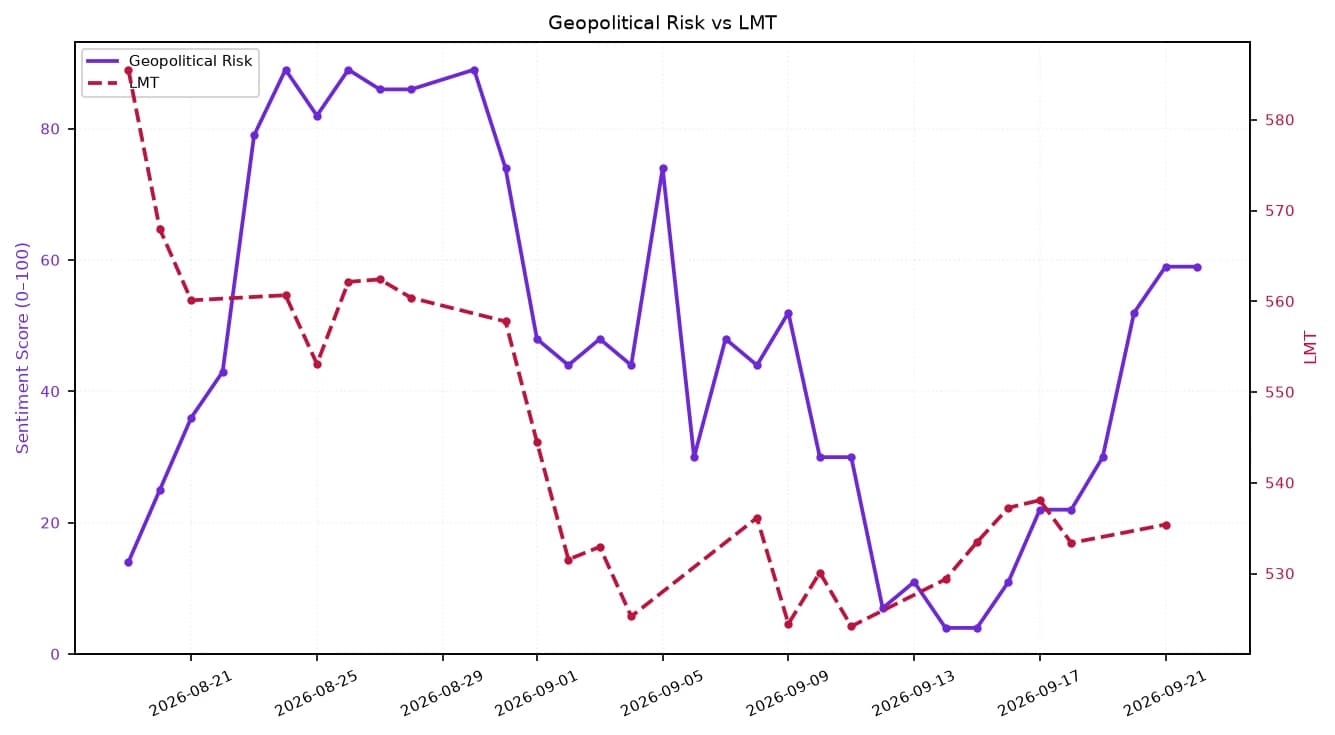
The report lands at a moment when the market is already rewarding the companies that sit closest to missile defense spending. Raytheon parent RTX has climbed sharply from the low $170s earlier this year to $207.73 on Aug. 31, even after a recent pullback from an Aug. 18 peak of $225.49, while Northrop Grumman has swung back and forth around the $540 level after a violent midyear selloff and recovery. Lockheed Martin, meanwhile, has given back part of a strong summer rally, slipping to $561.23 from a 2026 high above $670.

That matters because hypersonic missiles are one of the clearest budget drivers in modern defense. If a feared weapon proves less capable than advertised, it does not remove the threat — it usually forces militaries to spend more on layered defenses, early warning and counterstrike systems. The economic effect is straightforward: more procurement, more replenishment, more long-cycle contracts and more pressure on allied governments to accelerate defense budgets.
RTX is the most obvious beneficiary because missile defense and interceptors are already central to its bookings. In its latest 10-Q, the company said it booked $3.7 billion for Patriot GEM-T interceptors for Ukraine, alongside large missile orders for U.S. and international customers. That is exactly the kind of demand that grows when battlefield experience shows that defense systems must be upgraded faster than offensive weapons evolve. Northrop, with exposure to sensors, command systems and space-based warning, also fits the theme, while Lockheed remains a core play on F-35 modernization and missile and fire-control demand.
The bigger investor takeaway is that the market may still be underpricing the second-order effect of hypersonic proliferation: not just new weapons, but the multi-year infrastructure needed to defeat them. That includes interceptors, radars, command-and-control software and hardened logistics chains. Those are not flashy products, but they are the toll roads of defense spending — recurring, mission-critical and backed by sovereign buyers.
Technical indicators reinforce the setup. RTX’s 50-day moving average sits well below the current price, and the stock’s RSI has cooled from overbought levels, suggesting the recent pullback has not broken the broader uptrend. Northrop’s price is still below its 200-day moving average, but the rebound from spring lows shows capital is returning to defense names with credible exposure to missile warning and space systems. Lockheed’s share price remains above both its 50-day and 200-day averages, though momentum has eased after the summer run.
For investors, the message is not to chase every headline about hypersonics. It is to own the companies that get paid when those headlines force defense ministries to spend again. The market underestimates how quickly a credibility gap in a single Russian missile program can translate into orders for U.S. and allied contractors. If Zircon is weaker than claimed, the trade is still stronger defense budgets — and that keeps RTX, Lockheed and Northrop in the frame for the next leg higher.
| Entity | Gains | Losses |
|---|---|---|
| RTX | ▲Missile-defense bookings | ▼Hypersonic threat premium |
| LMT | ▲F-35 and missile systems demand | ▼Offensive-weapons hype |
| NOC | ▲Sensor and warning-system spend | ▼Near-term price momentum |
| Russia | ▲Propaganda leverage | ▼Weapon credibility |