Russia has overhauled its 30-year-old employment law, formally recognizing self-employment and platform work while tightening the conditions for registering as unemployed, a shift that raises the stakes for workers, employers and the state budget.
Russia overhauls employment law for gig work
The new law matters economically because it updates a labor market that has moved far beyond the assumptions of the 1990s, with more informal work, more gig-style jobs and sharper mismatches between vacancies and job seekers. By embedding newer forms of work into legislation and changing how unemployment benefits and job placement are handled, Moscow is trying to bring more people into the formal system while limiting passive receipt of state support.
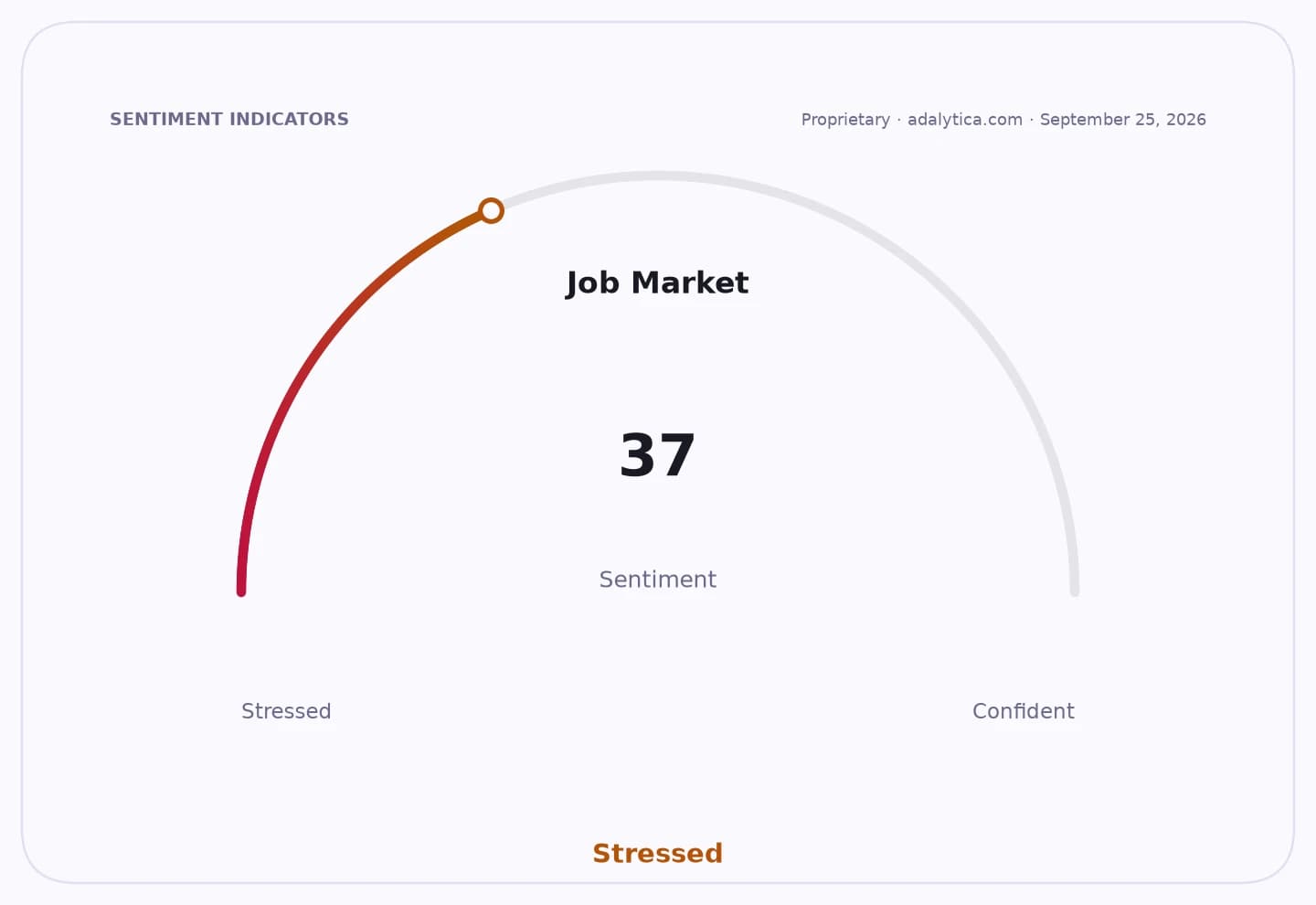
Sentiment IndicatorsⓘProprietary · adalytica.com · September 9, 2026
This is a snapshot — live sentiment, awareness and momentum for 130+ markets update continuously in the dashboard.Open AlphaPulse
Under the revised rules, employment offices will prepare an individual job-search plan that applicants must agree to, and failure to show up for that process means a person will not receive unemployed status. People can also lose that status if they refuse two suitable job offers within 10 days of registration. At the same time, vacancy matching will no longer be based only on pay, but also on experience, work format, distance from home, personal circumstances and health restrictions.
That creates a more interventionist model of labor-market management. For investors, the implications are mixed: it may improve labor supply matching and support sectors struggling to hire, but it also points to tighter state oversight of wage replacement, which can reduce the cushion for jobless households and keep pressure on consumption in weaker regions.
The law also sets unemployment benefits as a percentage of prior earnings in some cases, rather than only a flat minimum, while preserving a floor. In 2024, the maximum benefit is set at 13,751 rubles for the first three months and 5,375 rubles afterward, with a minimum of 1,613 rubles. The annual indexation of those amounts to consumer prices was added at the urging of trade unions.
The legislation further targets youth employment with subsidies for employers that hire young workers and support for students working outside study hours. It also introduces a more flexible quota system for hiring people with disabilities, letting regions set one target or several targets by industry, municipality or company size, and specifying cases where employers may be exempt.
For business, especially platform and service companies, the most important change is the legal codification of self-employment and platform work, even though the exact rules for those categories will be set out in a separate federal law. That keeps uncertainty alive for firms such as ride-hailing and delivery operators, where worker classification has been a recurring legal and financial risk.
Trade unions called the law a “second Labor Code,” while also pushing for stronger protection of the domestic labor market and social partnership. The broader message is that Russia is trying to formalize parts of an increasingly fragmented workforce without loosening pressure on people who can work but remain outside employment.
The next test is implementation: whether the tighter benefit rules, new quotas and recognition of platform work can lift formal employment without aggravating labor shortages or leaving more vulnerable workers with fewer safeguards.
| Entity | Gains | Losses |
|---|---|---|
| State employment agencies | ▲More control over job matching | ▼Higher administrative burden |
| Employers hiring youth or disabled workers | ▲Subsidies and clearer quotas | ▼Compliance costs |
| Unemployed job seekers | ▲Better matching criteria | ▼Stricter status rules |
| Platform and self-employed workers | ▲Legal recognition | ▼Regulatory uncertainty ahead |