Russia’s attack on a bridge over the Dnipro in Zaporizhia underscores how the war is increasingly targeting Ukraine’s transport arteries, with immediate implications for civilian movement, military logistics and the country’s already fragile regional economy.
Russia strikes Dnipro bridge in Zaporizhia
Ukraine’s regional governor said five people were injured in the strike, which damaged the bridge deck and briefly halted traffic. The attack comes after Russian forces last week hit bridges in Kyiv with drones, suggesting a widening campaign against critical crossings over the Dnipro, the river that divides the country from north to south and is central to sustaining supply lines across the front.
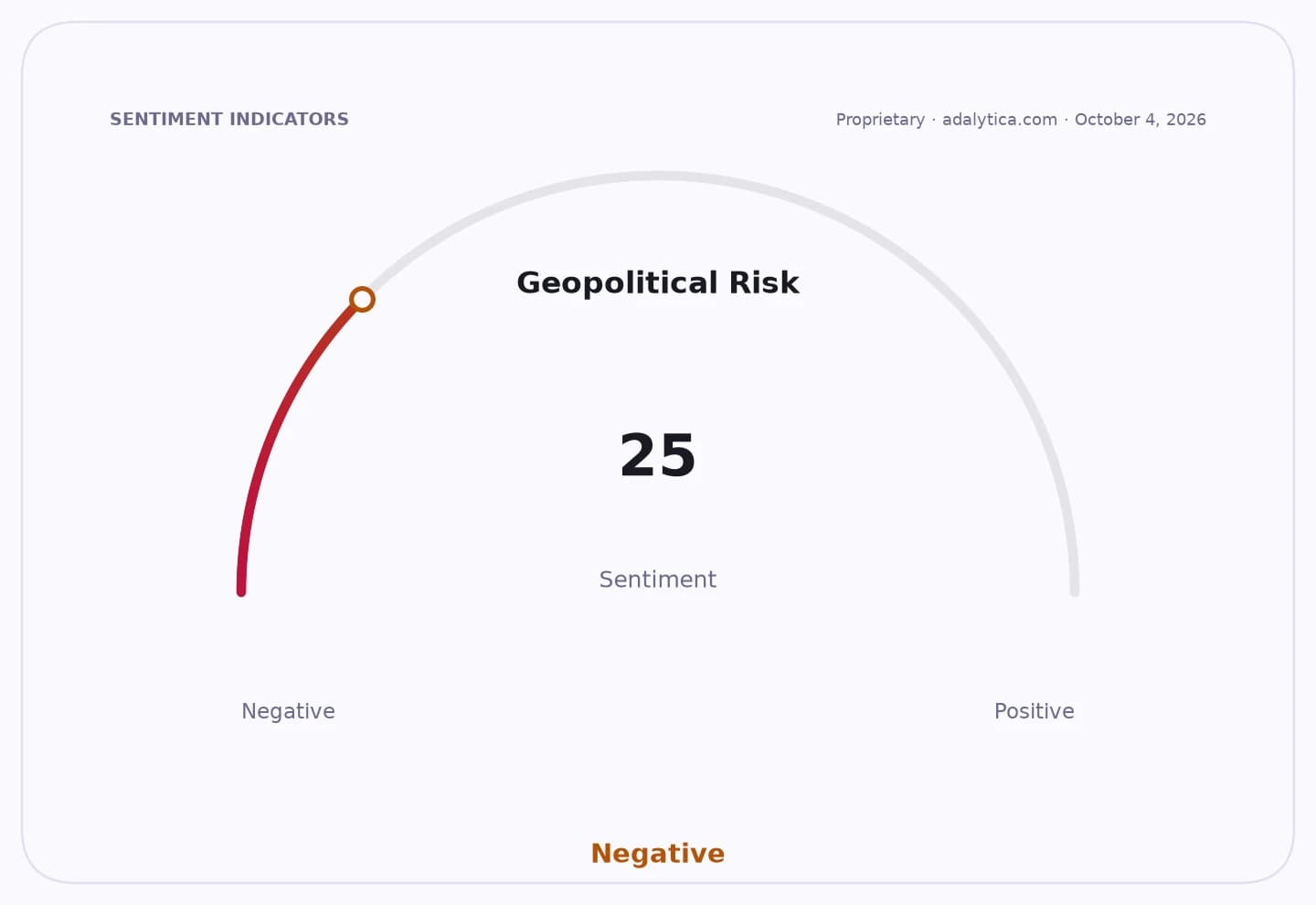
Sentiment IndicatorsⓘProprietary · adalytica.com · October 7, 2026
This is a snapshot — live sentiment, awareness and momentum for 130+ markets update continuously in the dashboard.Open AlphaPulse
The economic significance is immediate. Bridges over the Dnipro are not just local infrastructure; they are bottlenecks for freight, emergency services and military resupply. Any sustained damage raises transport times and costs, complicates evacuation and repair work, and can force detours that strain roads and fuel supplies. For a wartime economy already operating under extreme pressure, even temporary disruption to a major crossing can ripple through regional commerce and public services.
For investors and markets, the episode is less about direct asset pricing than about the broader war-risk premium. Repeated strikes on infrastructure increase the likelihood of further escalation, higher reconstruction needs and more uncertainty around Ukraine’s medium-term recovery path. They also reinforce the view that the conflict remains highly asymmetric, with Russia able to impose economic costs through relatively low-cost attacks on fixed assets.
The tactical message is also important. The Dnipro has long served as a natural defensive line, and bridges are among the most strategically sensitive targets in the war. Hitting them does not just damage concrete and steel; it seeks to constrain movement, complicate logistics and test Ukraine’s ability to keep key routes open under pressure. That makes each strike on a crossing more than a local incident, even if repairs are eventually made.
The risk for Ukraine is that repeated attacks force a costly cycle of repair, protection and rerouting at a time when its infrastructure base is already under strain. For Russia, the strategy may deliver short-term disruption, but it also increases the eventual reconstruction burden and keeps pressure on Western support for Ukraine’s civil and military infrastructure. Investors watching the conflict should expect renewed attention on transport corridors, repair capacity and the resilience of the country’s logistics network as the war continues.
| Entity | Gains | Losses |
|---|---|---|
| Russia | ▲Tactical disruption leverage | ▼Reconstruction burden later |
| Ukraine military | ▲Hardens defensive planning | ▼Supply-line flexibility |
| Ukraine civilians | ▲— | ▼Travel and evacuation access |
| Global lenders/donors | ▲Reconstruction urgency | ▼Higher funding needs |