Russia’s announcement that it carried out a “massive” overnight strike on communications and energy infrastructure in Kyiv and the Kharkiv region underscores a widening campaign against the systems that keep Ukraine’s cities, industry and military logistics running.
Russia strikes Kyiv and Kharkiv infrastructure

The immediate economic significance is less about battlefield damage than about the cumulative strain on an already fragile wartime economy. Power substations, logistics hubs, rail assets and communications nodes are the connective tissue of industrial production and transport. When those are hit repeatedly, the impact ripples beyond the capital into manufacturing output, freight capacity, repair costs and winter resilience, while raising the cost of doing business for what remains of Ukraine’s private sector.
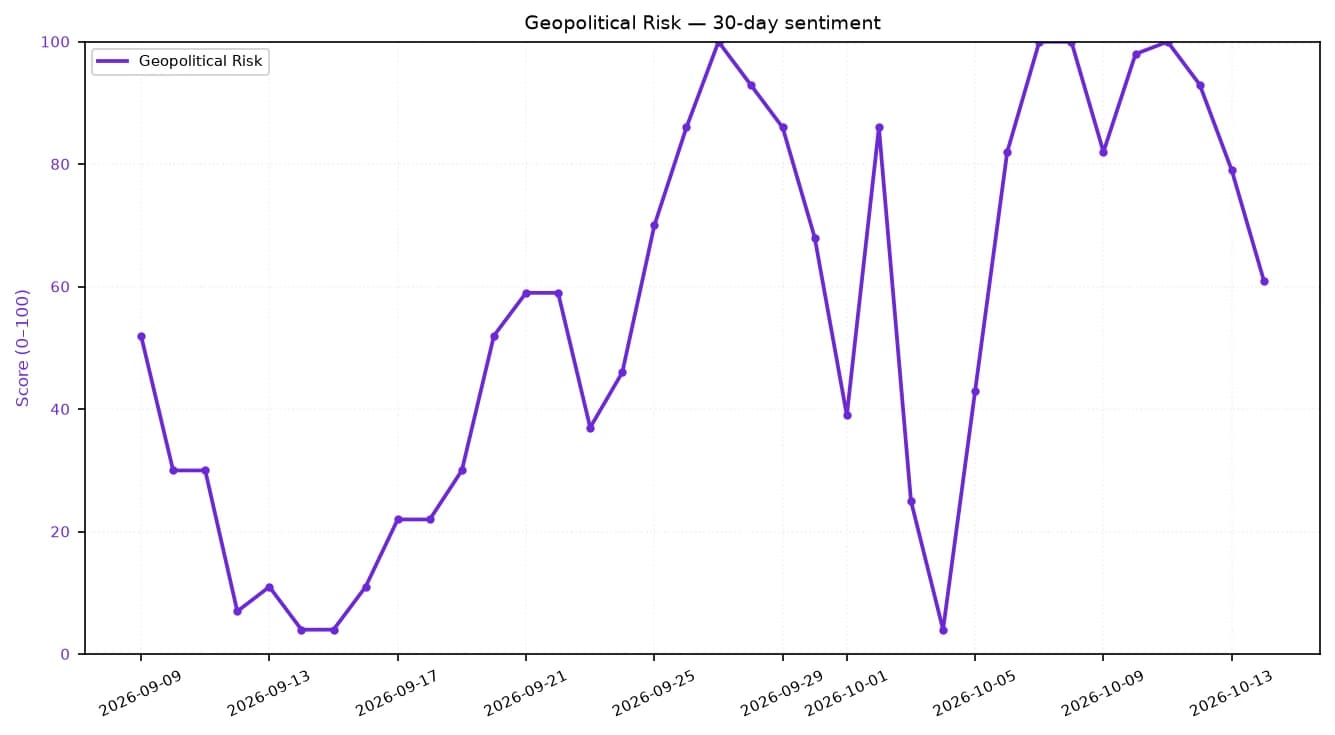
Sentiment IndicatorsⓘProprietary · adalytica.com · October 14, 2026
This is a snapshot — live sentiment, awareness and momentum for 130+ markets update continuously in the dashboard.Open AlphaPulse
Russia’s defense ministry said it used precision ground weapons and long-range attack drones against facilities tied to Ukraine’s military-industrial complex and armed forces, including production buildings near Kyiv and a substation near Vyshhorod. It also said separatist or allied units targeted a radar station, a logistics center and a locomotive on a rail line. The messaging matters: Moscow is not describing isolated battlefield strikes but a deliberate campaign to degrade the infrastructure that sustains Ukraine’s war effort.
That fits a broader escalation dynamic already visible in the conflict. Ukraine has increased its own strikes on Russian oil refineries and other energy assets, aiming to raise fuel costs, disrupt supply chains and pressure Moscow’s war economy. Russia has responded by vowing harder attacks on Ukrainian civilian and economic facilities. The result is a tit-for-tat cycle that is increasingly aimed at industrial capacity rather than front-line positions alone.
For investors, the relevance is indirect but material. Energy and infrastructure shocks in a major war can feed into European risk premia, defense spending expectations and commodity volatility. The clearest market read-through is in hard-asset hedges and geopolitical-risk trades rather than in Ukraine itself, where listed exposure is limited. The Adalytica Global Stability Sentiment gauge at 61 is still labeled neutral, but its awareness reading has sunk to 21, a fear signal that points to rising market attention even if broader sentiment has not collapsed.
The conflict also keeps pressure on European utilities, transport-linked businesses and energy markets already sensitive to supply disruption. Natural gas, power and oil markets have been less reactive than in the early phases of the war, but persistent attacks on infrastructure can still tighten regional risk pricing, especially if strikes broaden or trigger disruptions to cross-border flows, repairs or insurance costs.
There is also a strategic industrial angle. Ukraine’s ability to maintain rail movement, power generation and communications capacity has been central to sustaining exports, domestic production and military resupply. Repeated damage to those networks can slow reconstruction, impede metallurgy and heavy industry, and force greater dependence on imported equipment, emergency fuel and donor-funded repair programs.
The near-term outlook is for more of the same: escalating infrastructure strikes, repeated repair cycles and continued pressure on Ukraine’s economic resilience. Unless there is a pause in the retaliatory pattern, investors should expect the war to remain a source of episodic volatility in energy, defense and broader geopolitical-risk assets.
| Entity | Gains | Losses |
|---|---|---|
| Russia | ▲Pressure on Ukraine’s war infrastructure | ▼Higher sanction and retaliation risk |
| Ukraine | ▲Western sympathy and aid focus | ▼Power, rail and industrial disruption |
| European defense names | ▲Higher spending expectations | ▼Prolonged regional instability |
| Energy markets | ▲Risk premium support | ▼Volatility from strike escalation |