Russia’s war in Ukraine has spilled across Europe’s borders through a mounting campaign of hybrid attacks that now includes drone strikes, sabotage, cyberattacks and airspace provocations, sharpening the economic and security costs for NATO states far from the frontline.
Russia hybrid attacks raise Europe security costs
The most important development is not a single incident but the scale and dispersion of hostile activity since Moscow launched its full-scale invasion in February 2022. European governments now increasingly treat the pattern as a deliberate effort to weaken infrastructure, pressure public opinion and complicate Western support for Kyiv without crossing the threshold into open war with NATO. That matters because it raises defense and resilience spending, disrupts trade routes and energy flows, and keeps a geopolitical risk premium embedded in European assets.
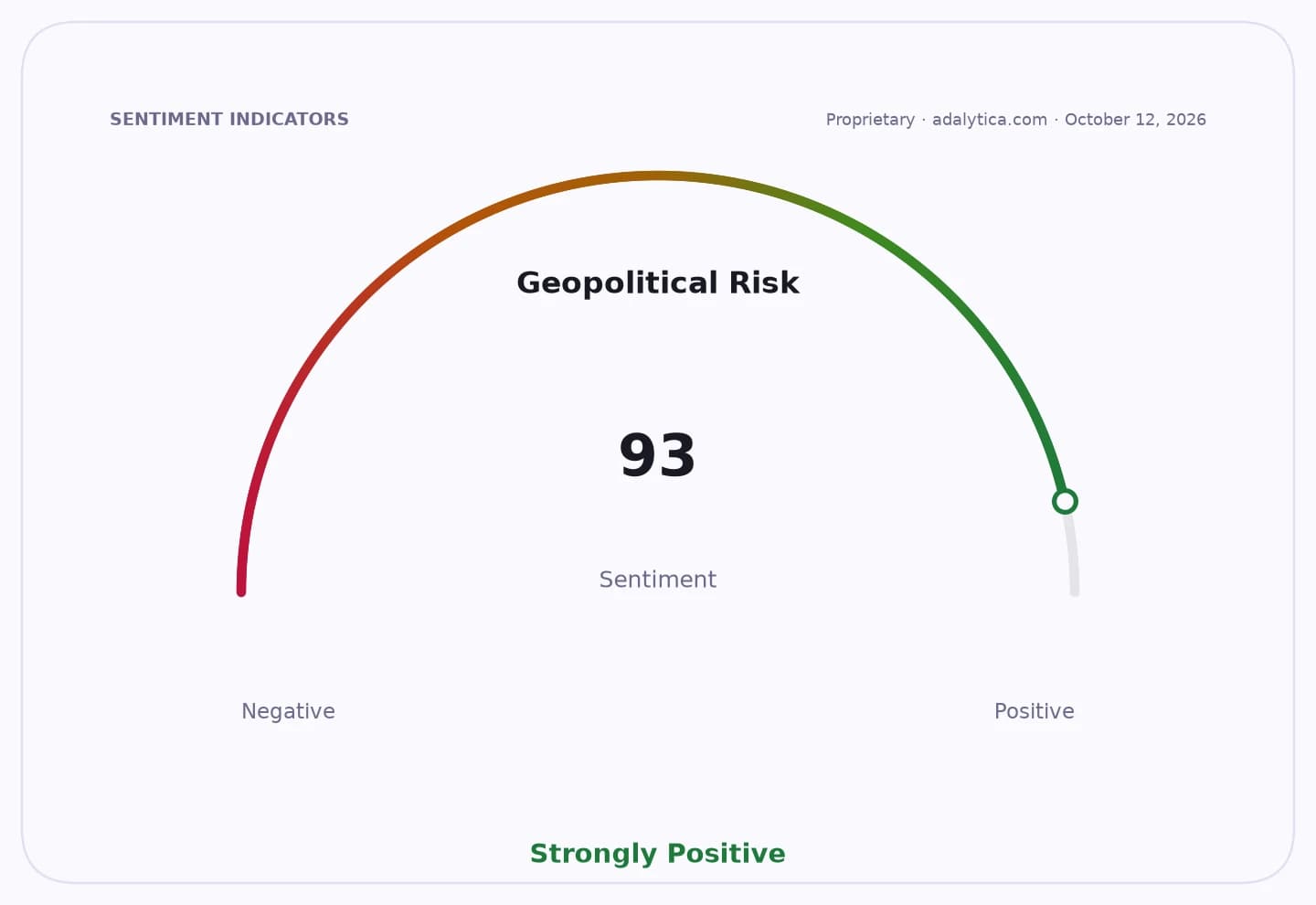
Sentiment IndicatorsⓘProprietary · adalytica.com · October 14, 2026
This is a snapshot — live sentiment, awareness and momentum for 130+ markets update continuously in the dashboard.Open AlphaPulse
The latest evidence underscores how far the conflict has spread. In the Black Sea, two vessels were hit by drones near Bulgaria’s coast in mid-October, according to Bulgarian authorities, prompting Sofia to prepare a diplomatic protest to Moscow. A week earlier, two merchant ships were struck inside Bulgaria’s exclusive economic zone. The Turkish maritime chamber says 226 civilian ships have been targeted in the Black Sea since the war began, illustrating how commercial shipping has become part of the battlefield.
Those incidents fit a broader pattern across the continent. Since 2022, Russian-attributed hostile acts have ranged from cyber intrusions and sabotage to deliberate airspace incursions, according to the map compiled in the source material. The strategic objective appears to be to destabilize democratic societies, strain critical infrastructure and raise the cost of backing Ukraine. For Europe, that turns what began as a war in eastern Ukraine into a long-term security burden affecting ports, power networks, logistics corridors and public finances.
For investors, the implications are broader than headline risk. Defense contractors, cybersecurity firms, energy infrastructure operators and maritime security providers stand to benefit as governments harden borders and raise preparedness budgets. At the same time, shipping, industrial production and insurers face higher operating costs, more rerouting and potentially larger claims if attacks intensify around the Black Sea and other sensitive corridors.
The market backdrop suggests investors remain alert but not yet in full panic mode. EWU, the iShares MSCI United Kingdom ETF, recently traded at $46.91, above its 200-day moving average of $46.41 but just below its 50-day average of $47.75, while its RSI reading of 46.4 points to neither extreme fear nor clear momentum. EWG, the Germany ETF, closed at $40.94, still below both its 50-day and 200-day moving averages, with RSI at 39.0, reflecting a more cautious stance toward Europe’s largest economy. FEZ, which tracks eurozone equities, ended at $65.37, also below its 50-day average of $69.35 and with RSI at 28.9, a sign that the broader regional market has already priced in a meaningful degree of geopolitical strain.
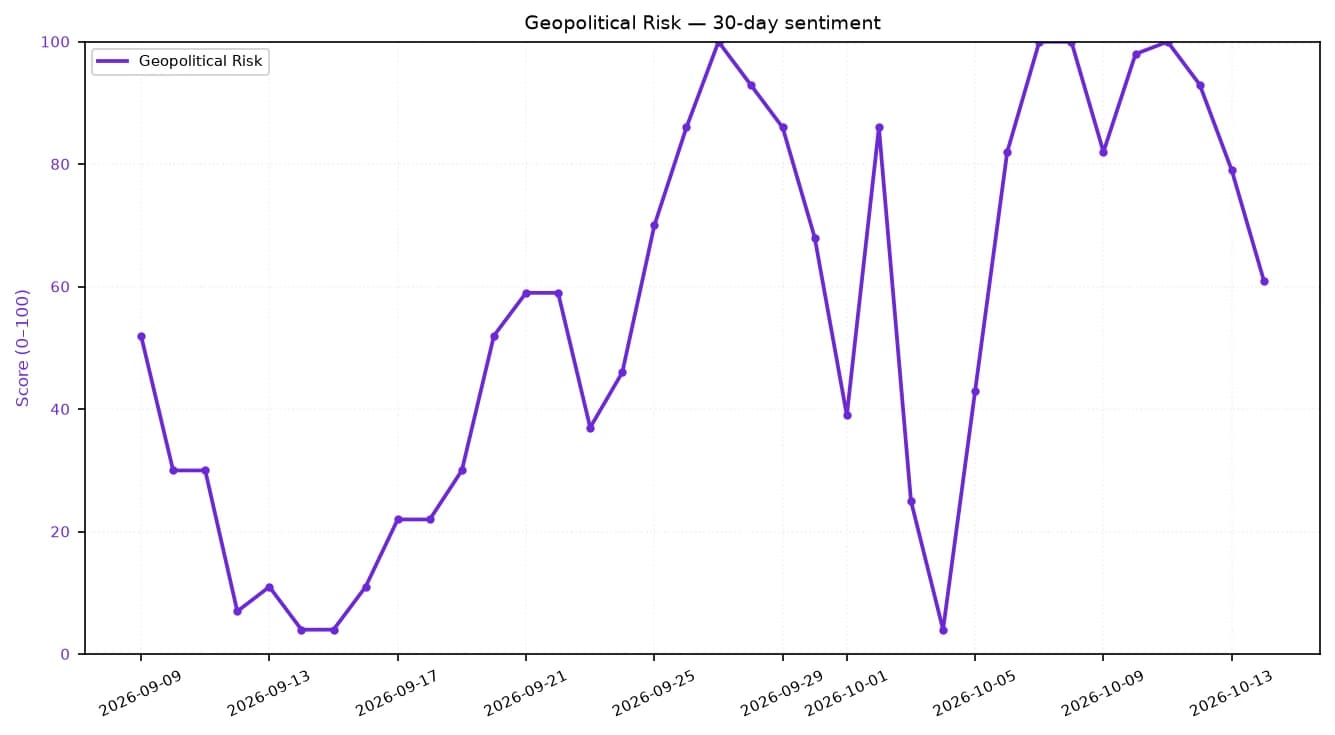
That divergence matters. Britain’s relative resilience in the ETF data may reflect its stronger defense exposure and a different market mix, while Germany and the eurozone remain more exposed to trade disruption, energy shocks and manufacturing weakness if the security environment deteriorates further. The Adalytica Global Stability Sentiment gauge also showed a sharp slide in awareness of risk in the latest reading, with sentiment at 61 and awareness at 21, reinforcing the idea that geopolitical instability has re-entered the market conversation even if equity benchmarks have not yet broken decisively lower.
The bull case for Europe’s defense-oriented assets is straightforward: more sabotage and maritime incidents mean more spending, tighter regulation and higher demand for deterrence technology. The bear case is that a widening hybrid campaign could erode growth, keep transport and insurance costs elevated, and pressure already fragile investor confidence in continental assets. If Moscow continues to test NATO’s perimeter without triggering a direct response, Europe may be forced into a prolonged race to secure everything from ports and pipelines to undersea cables and airspace.
For now, the key investor takeaway is that the war’s economic footprint is no longer limited to Ukraine. Russia’s campaign is increasingly a Europe-wide stress test for infrastructure, markets and policy, and the longer it continues, the more likely it is to reshape spending priorities and asset pricing across the region.
| Entity | Gains | Losses |
|---|---|---|
| Defense and cyber firms | ▲Higher procurement | ▼Limited near-term slowdown |
| NATO governments | ▲Stronger security case | ▼Bigger budget pressure |
| Shipping and insurers | ▲More demand for services | ▼Higher claims and costs |
| Europe-facing equities | ▲Some defense support | ▼Geopolitical discount |