Gasoline shortages are accelerating inflation across regions of the Russian Federation, and the market is underestimating how quickly a fuel squeeze can feed through the broader economy.
Russian Fuel Squeeze Raises Inflation Risk
That matters because fuel is not just another line item in the consumer basket in Russia; it is a transmission mechanism for transport costs, food distribution and industrial input prices. Once gasoline supply tightens, inflation stops being a localized nuisance and becomes a national policy problem that can force the Kremlin to choose between protecting consumers, supporting refiners or letting prices adjust.
Sentiment IndicatorsⓘProprietary · adalytica.com · July 23, 2026
This is a snapshot — live sentiment, awareness and momentum for 130+ markets update continuously in the dashboard.Open AlphaPulse
The pressure is coming at a time when crude oil remains elevated by historical standards. Brent-equivalent U.S. benchmark oil has been trading around the mid-$80s a barrel, with U.S. crude near $85. That is not an outright oil shock, but it is high enough to keep fuel markets tight, especially when refinery bottlenecks, logistics disruptions and geopolitical constraints limit the ability to quickly move product between regions. In that environment, shortages do what they always do: they create price spikes in the places where supply is weakest.
For investors, the signal is bigger than Russia. Energy scarcity is reasserting itself as an inflation driver just as global growth remains fragile. The conventional disinflation narrative assumes fuel costs can glide lower if crude stabilizes. Russia’s regional gasoline shortages are a reminder that refined products, not just crude, determine what households and freight operators actually pay. That is why headline inflation can accelerate even when some global oil gauges look contained.
The market implications are clearest in energy. Refiners and downstream operators benefit when product tightness lifts margins, and the recent strength in U.S. energy shares reflects that reality. The Energy Select Sector SPDR Fund has climbed to around 60.26, while the United States Oil Fund has surged to 140.07, both sitting well above their 50-day and 200-day moving averages. On the U.S. gasoline front, RBOB futures around 3.30 remain elevated enough to keep refiners incentivized, even after recent swings. That is the kind of backdrop that supports the bulls on refining capacity, fuel logistics and integrated oil names.
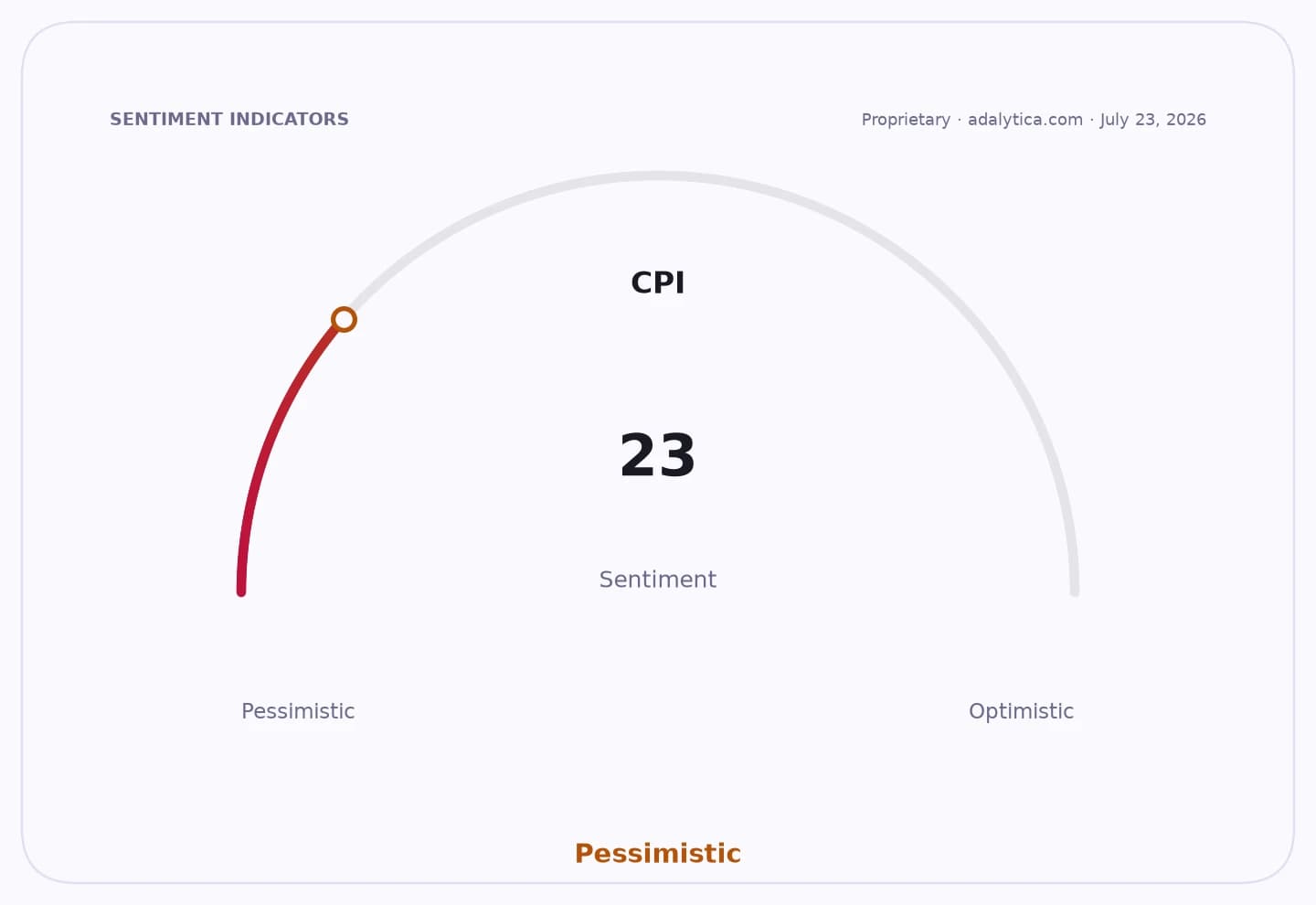
Adalytica’s proprietary CPI sentiment gauge has already turned to Fear at 23, while consumer spending sentiment has slipped to 39, underscoring how quickly energy stress can bleed into demand. The market may still be treating fuel inflation as a regional problem. It is not. It is a second-round inflation risk, and those are the ones central banks and equity markets tend to price too late.
The investment takeaway is straightforward: stay overweight the energy infrastructure and refining complex, and be cautious on consumer and transport names most exposed to fuel pass-through. In an inflation regime driven by constrained product supply, the winners are the toll roads on energy flows, not the end users absorbing the shock.
| Entity | Gains | Losses |
|---|---|---|
| Refiners | ▲Wider product margins | ▼Political pressure |
| Energy ETFs | ▲Momentum inflows | ▼Valuation risk |
| Consumers | ▲None | ▼Higher fuel bills |
| Freight and transport firms | ▲None | ▼Rising operating costs |