San Diego is preparing to hand over its Midway District arena site under a deal that treats affordable housing, parks and a new sports venue as the real payment, leaving rent as a secondary return.
San Diego Midway District Deal Prioritizes Housing
That is the economic core of the proposed Midway Rising redevelopment: the city is not trying to maximize cash from a 100-year land lease, but to extract public value from one of its largest redevelopment opportunities. In present-value terms, the projected $896.3 million in lifetime rent shrinks to just $23.2 million, underscoring how heavily the transaction is weighted toward noncash benefits such as 2,000 affordable homes, 8.1 acres of parks and a privately financed replacement arena.
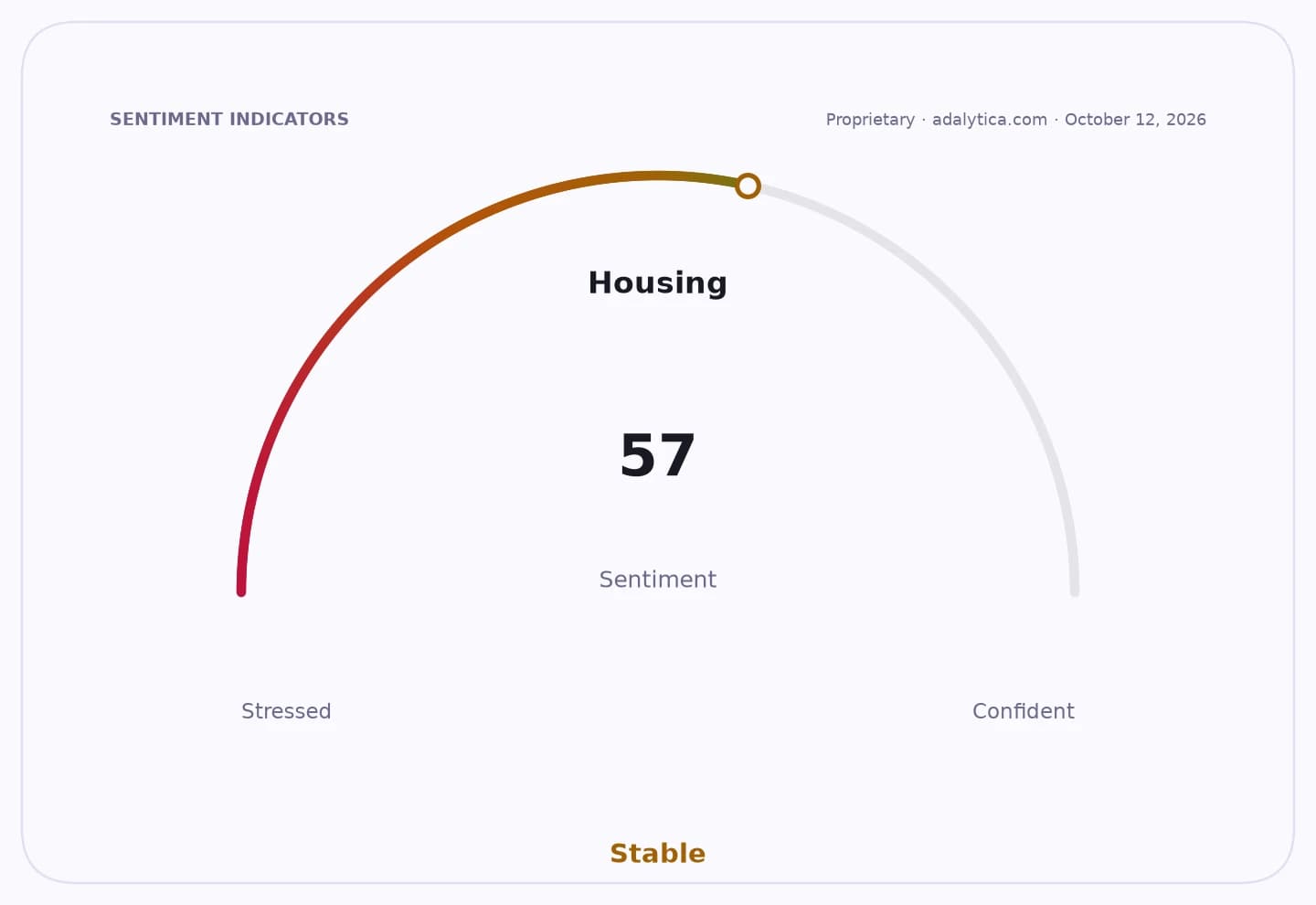
Sentiment IndicatorsⓘProprietary · adalytica.com · October 12, 2026
This is a snapshot — live sentiment, awareness and momentum for 130+ markets update continuously in the dashboard.Open AlphaPulse
The fine print, released Friday ahead of an Oct. 16 committee hearing, shows how San Diego is using land-use leverage rather than a conventional real estate sale to reshape a distressed corridor around the aging Sports Arena. The city appraised the land at $75.6 million in March 2025, but the agreement is structured as a participation rent deal, with payments tied to revenue from market-rate housing, retail and later the new arena. There is no rent from the subsidized apartments, which are required for households earning 80% or less of area median income.
For investors and developers, the structure matters because it exposes both the promise and the fragility of large mixed-use public-private projects in a high-rate environment. The city’s own consultant said the project’s infrastructure costs are estimated at $462 million, while the affordable housing component carries a $1.6 billion price tag, or about $794,000 per unit. A university economist said the numbers do not “pencil” without an infrastructure financing district and several hundred million dollars in low-income housing tax credits, arguing the deal only works if borrowing costs ease.
That tension is the narrative running through the transaction: San Diego wants to convert an underused asset into housing supply, public space and civic infrastructure, but the financing depends on a project that is still sensitive to rates, subsidies and timing. The proposed phasing plan does not begin major construction until 2029, with the first arena work in 2032 and full completion not expected until 2050, meaning the project is as much a long-duration infrastructure bet as a real estate redevelopment.
The city’s upside is not limited to rent. Officials say the project would deliver 936 more low-income housing units than required under state law, $400 million in neighborhood improvements and a $520 million venue, while an enhanced infrastructure financing district under discussion could generate about $1.16 billion to reimburse site and infrastructure work. Even after property-tax diversion, San Diego estimates it would still collect $151.6 million in tax revenue over 30 years, while the broader project could create 23,610 construction jobs and $18.4 billion in regional economic impact.
For residents, the deal is framed as a turnaround of a declining district rather than a land monetization exercise. For the developer group led by Zephyr, Chelsea Investment and Legends, with the Kroenke Group as lead investor, the trade-off is clear: accept lower direct land economics in exchange for entitlement certainty, public support for infrastructure and a politically durable project structure. For investors, the key question is whether falling financing costs and tax-credit availability can turn a highly structured civic deal into a bankable one.
The Oct. 16 committee review will show whether San Diego is comfortable with a model that privileges public benefits over near-term cash. If approved, Midway Rising would stand as a test case for how far California cities can push land value capture when the goal is housing production and neighborhood reinvention rather than maximum lease proceeds.
| Entity | Gains | Losses |
|---|---|---|
| City of San Diego | ▲Affordable housing, parks, tax base | ▼Upfront cash rent |
| Midway Rising developers | ▲Long lease, entitlements, project scale | ▼Higher financing complexity |
| Local residents | ▲New homes, open space, arena | ▼Short-term disruption |
| Traditional land seller | ▲Market-value proceeds | ▼Public-benefit tradeoff |