SK Hynix is trying to keep one of its most important manufacturing links to China open by seeking U.S. government approval to export chipmaking equipment there, a sign that semiconductor supply chains remain tightly bound to Washington’s export controls even as AI-related chip demand stays strong.
SK Hynix Seeks US Chip Equipment Export Approval

The stakes go well beyond one company’s procurement plan. If SK Hynix can secure the licence, it would help preserve production continuity at facilities tied to China-based operations and reduce the risk of near-term disruptions to memory-chip output. If it cannot, the company could face higher costs, slower maintenance cycles and greater uncertainty around how long it can sustain Chinese operations under increasingly restrictive U.S. rules.
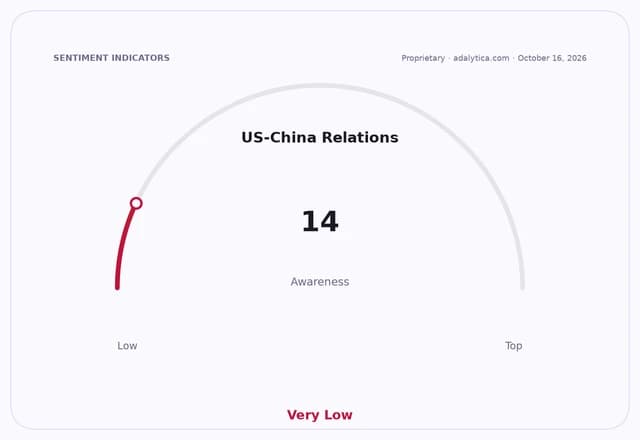
Sentiment IndicatorsⓘProprietary · adalytica.com · October 16, 2026
This is a snapshot — live sentiment, awareness and momentum for 130+ markets update continuously in the dashboard.Open AlphaPulse

That matters because SK Hynix sits at the center of the memory-chip market, where supply discipline and capital spending decisions can move pricing. Any constraint on equipment imports into China could affect production efficiency, product mix and the company’s ability to respond to demand from cloud and AI customers. It also underscores how geopolitical permissions, not just demand, are shaping semiconductor economics.
The request comes against a backdrop of stronger chip trade flows in Asia and elevated investor attention on the sector. South Korea has reported a jump in exports led by semiconductors and storage devices, while Chinese chip exports have also surged, reflecting how deeply integrated the industry remains despite U.S.-China friction. That tension has already begun to shape corporate strategy across the sector, from equipment sourcing to factory siting and capex planning.
For investors, the immediate question is whether the approval process becomes a manageable compliance issue or the start of another operational bottleneck. SK Hynix’s share price has already shown how quickly sentiment can reverse: after a sharp rally that pushed technical readings into overbought territory, the stock has since fallen back well below its 50-day moving average, with the RSI in oversold range, suggesting markets are recalibrating expectations as policy risk returns to the foreground.
The broader read-through is that semiconductor equities remain exposed to policy headlines even in an otherwise constructive demand environment. A favourable ruling would support the bull case that memory demand and AI spending can outweigh regulatory drag. A denial would reinforce the bearish view that China exposure is becoming a structural handicap, not just a quarterly headline risk, for suppliers with large footprints in the country.
The next catalyst is likely to be the outcome of the U.S. review, alongside any further guidance from Seoul and Washington on how legacy China operations can be maintained under the current export-control regime.
| Entity | Gains | Losses |
|---|---|---|
| SK Hynix | ▲Operating continuity | ▼Compliance uncertainty |
| U.S. regulators | ▲Policy leverage | ▼Faster approvals |
| China operations | ▲Equipment access | ▼Supply disruption risk |
| Semiconductor investors | ▲Clarity on exposure | ▼China-linked headline risk |