Household lending at South Korea’s five biggest banks has already overshot this year’s revised target, underscoring how quickly credit demand is exhausting the extra room regulators tried to create and why mortgage underwriting is likely to stay tight through year-end.
South Korea’s Big Banks Exceed Household Loan Target
The latest figures show policy-excluded household loan balances at KB Kookmin, Shinhan, Hana, Woori and NH NongHyup rose to 652.3 trillion won ($467 billion) by Sept. 17, up 7.29 trillion won from the end of last year and already about 2 billion won above the banks’ newly reset annual increase goal of 7.11 trillion won. In other words, the additional lending capacity carved out only last month has been consumed in less than four weeks.
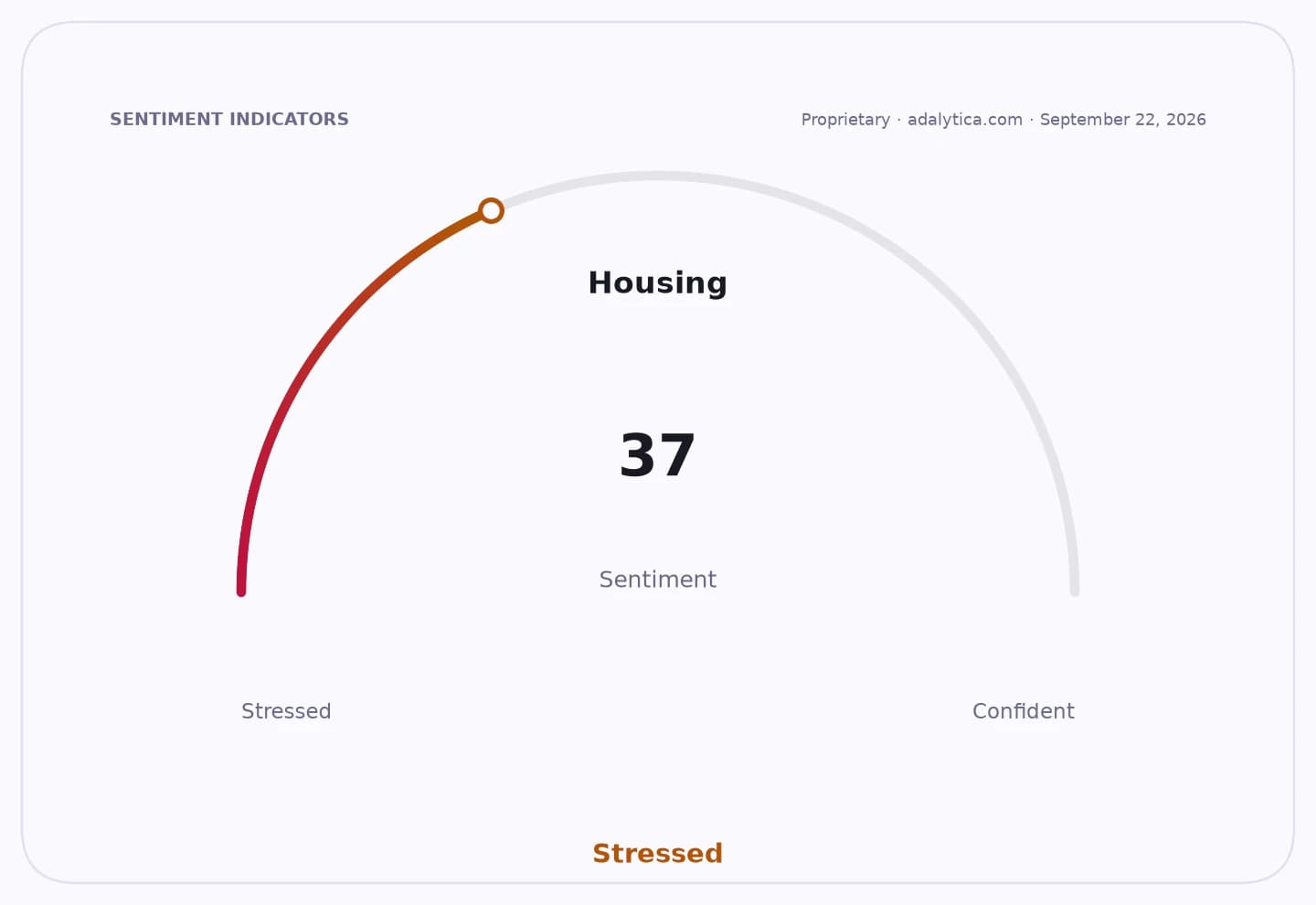
Sentiment IndicatorsⓘProprietary · adalytica.com · September 25, 2026
This is a snapshot — live sentiment, awareness and momentum for 130+ markets update continuously in the dashboard.Open AlphaPulse

That matters because household credit is one of the clearest pressure points in South Korea’s broader financial-stability playbook. Authorities have spent much of the year trying to slow housing-related borrowing without choking off end-user demand, but the data suggest that borrowers are still moving fast enough to absorb any easing. For banks, that leaves little incentive to loosen standards, especially when they are expected to protect their annual quotas and avoid the kind of balance-sheet drift regulators have been warning against.
The numbers also show a split between policy lending and commercial-bank lending. Including policy loans, total household credit at the five banks fell 6.1 billion won from the end of August to 781.5 trillion won, the first decline in six months, as securitization of the government-backed Bogeumjari mortgage program pushed balances off bank books. But stripping out those policy loans, the banks’ own household lending continued to climb, driven by mortgage demand rather than any broad-based credit contraction.

That distinction is important for investors because it suggests the apparent cooling in total household credit may be more cosmetic than structural. Banks are not seeing a material easing in private mortgage demand; they are seeing a transfer of policy balances and a regulatory cap that is being hit again. A bank that runs into loan limits sooner than expected can face slower asset growth, weaker net interest income momentum and a more defensive stance on mortgage pricing.
The impact is not confined to lenders. Tighter household credit can act as a brake on property transactions, home-related consumption and the broader credit impulse, particularly if banks keep the door narrow on new mortgages, bridge loans and refinancing. The regulatory carve-out for some end-of-transaction loans — such as down payment, intermediate payment and final settlement loans — may reduce the risk of a blanket squeeze, but it does not change the fact that overall lending headroom is tight.
There is a case for both views. A more cautious reading is that banks, having already exceeded their targets, will keep standards firm and avoid adding to housing-market leverage. The more benign reading is that seasonal moderation late in the year, plus exemptions for certain project-related loans, should prevent a sharp credit crunch for genuine end-users. Even so, the immediate balance of risk appears tilted toward a higher hurdle for new borrowers rather than any meaningful relaxation.
For markets, the story is less about a single data point than about the persistence of credit demand in a regulated system. If household borrowing continues to outrun administrative targets, South Korea’s banks may be forced to prioritize compliance over growth, and investors will need to watch not just loan volumes but how quickly lending mix, margins and mortgage originations shift in response.
| Entity | Gains | Losses |
|---|---|---|
| South Korean regulators | ▲Financial-stability control | ▼Ease of policy management |
| Major Korean banks | ▲Loan discipline, quota compliance | ▼Asset growth, mortgage volumes |
| Homebuyers/borrowers | ▲Limited access to policy-exempt loans | ▼Mortgage availability, borrowing costs |
| Housing market | ▲Support from some policy lending | ▼Upward leverage, transaction momentum |