Wall Street’s record run is being powered by a familiar formula: investors are paying up for artificial intelligence and chip makers again, while easing Treasury yields are making those growth stocks easier to own.
S&P 500 Hits Record as AI Stocks Lead Gains

The S&P 500 climbed 0.58% to a fresh high of 7,818.93 on Tuesday, with the Nasdaq Composite also setting a record at 27,599.79. The Dow Jones Industrial Average rose 253.38 points, or 0.49%, to 51,521.28. For investors, the message is clear: the market is still rewarding companies tied to AI spending, even with inflation worries and lofty bond yields hanging over the backdrop.
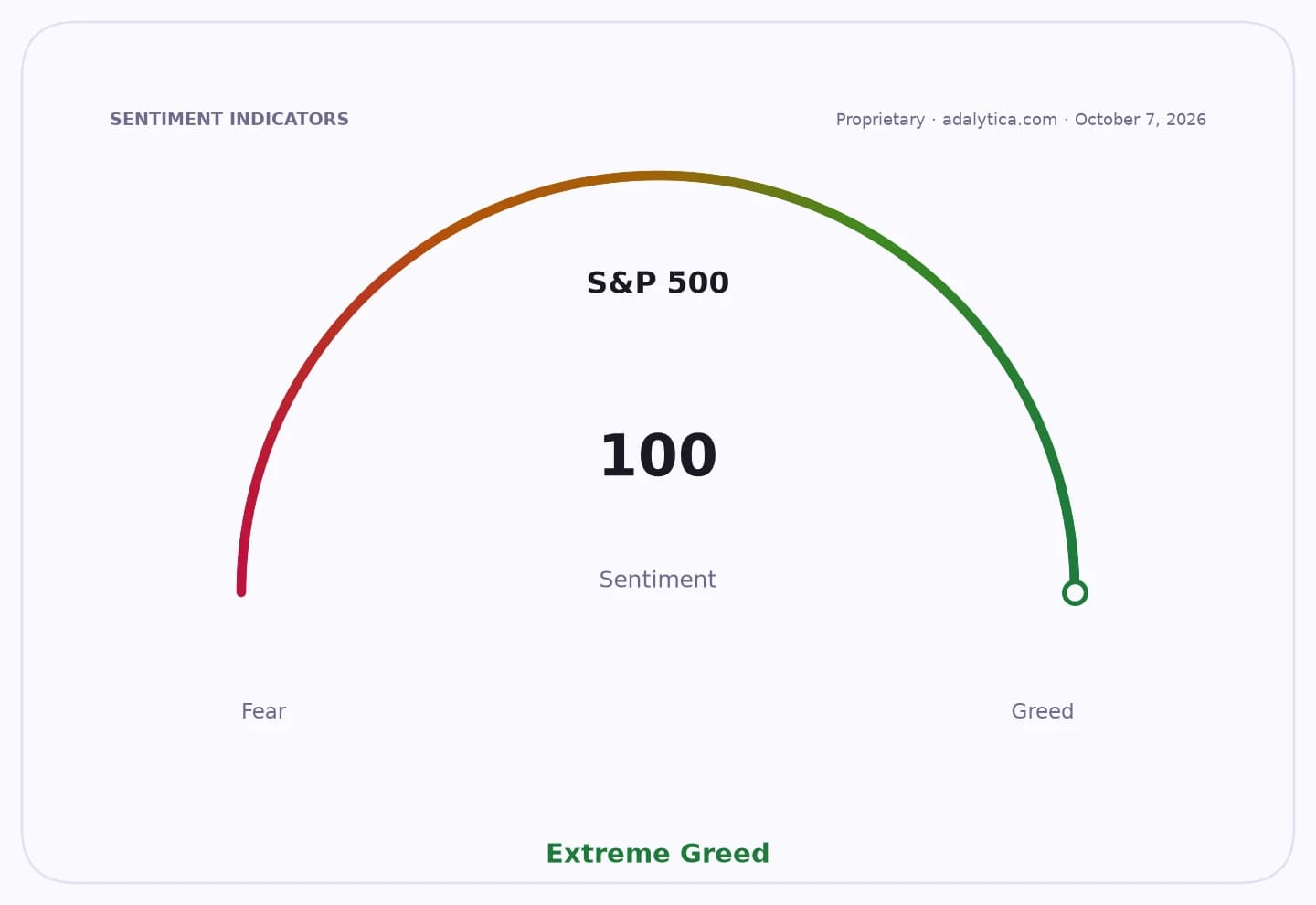
Sentiment IndicatorsⓘProprietary · adalytica.com · October 8, 2026
This is a snapshot — live sentiment, awareness and momentum for 130+ markets update continuously in the dashboard.Open AlphaPulse

Semiconductors were the clearest winners. Marvell Technology jumped 5.8%, AMD gained nearly 3%, and Broadcom rose 3.7% as traders kept chasing the companies most exposed to the AI buildout. Nvidia and Microsoft, two of the market’s most important AI bellwethers, also sat near their highs, with both stocks extending gains after strong technical momentum. Nvidia closed at $239.24, while Microsoft finished at $529.30, underscoring how much of this market strength still flows through a narrow group of mega-cap technology names.
That concentration matters economically because it says something about where capital is going. Instead of spreading evenly across the market, money is flowing into firms with the most credible growth engines, the strongest pricing power and the clearest link to AI infrastructure spending. That can keep the index climbing, but it also means the broader market is leaning heavily on a handful of winners.

Bond yields helped the story, too. The 10-year Treasury yield eased 3 basis points to 5.281% after touching its highest level since 2002 the day before. The 30-year yield was little changed at 5.655%. Lower yields support high-growth stocks because they reduce the discount rate investors use to value future earnings. In plain English, when rates stop rising, it becomes easier to justify paying up for companies whose profits are expected years down the road.
Oil’s steadiness also took some pressure off the tape. Brent crude inched up to $100.58 a barrel and WTI was nearly flat at $89.44, helping calm fears that energy costs would feed another round of inflation. That mattered because investors appeared willing to look past near-term price risks and keep betting that the Fed is closer to the end of its tightening cycle than the beginning.
The next real test comes with the Federal Reserve’s September meeting minutes due Wednesday. Investors will be looking for any hint that policymakers remain comfortable keeping rates higher for longer, or whether the recent jump in yields has already done enough of the Fed’s work for it. That matters for the rally’s durability. If bond yields keep retreating, the case for AI and chip stocks gets even stronger. If inflation or Fed rhetoric pushes yields back up, today’s record highs could prove more fragile.
For long-term investors, the bigger story is not a single record close. It is that the market continues to treat AI infrastructure as a multi-year investment theme, not a short-lived trade. That doesn’t mean every chip stock is a buy, or that valuations can ignore gravity forever. But it does mean the companies building the picks-and-shovels for the AI economy still have the market’s attention, and likely will for years. The best approach remains the boring one: own quality, stay diversified, and let compounding do the heavy lifting.
| Entity | Gains | Losses |
|---|---|---|
| Chip makers | ▲Higher AI demand hopes | ▼Rate-sensitive skeptics |
| AI leaders | ▲Richer valuations | ▼Short-term value hunters |
| Treasury bulls | ▲Easier equity valuation support | ▼Income-seeking bond bears |
| Inflation hawks | ▲Lower oil helps cooling pressures | ▼Higher-yield hardliners |