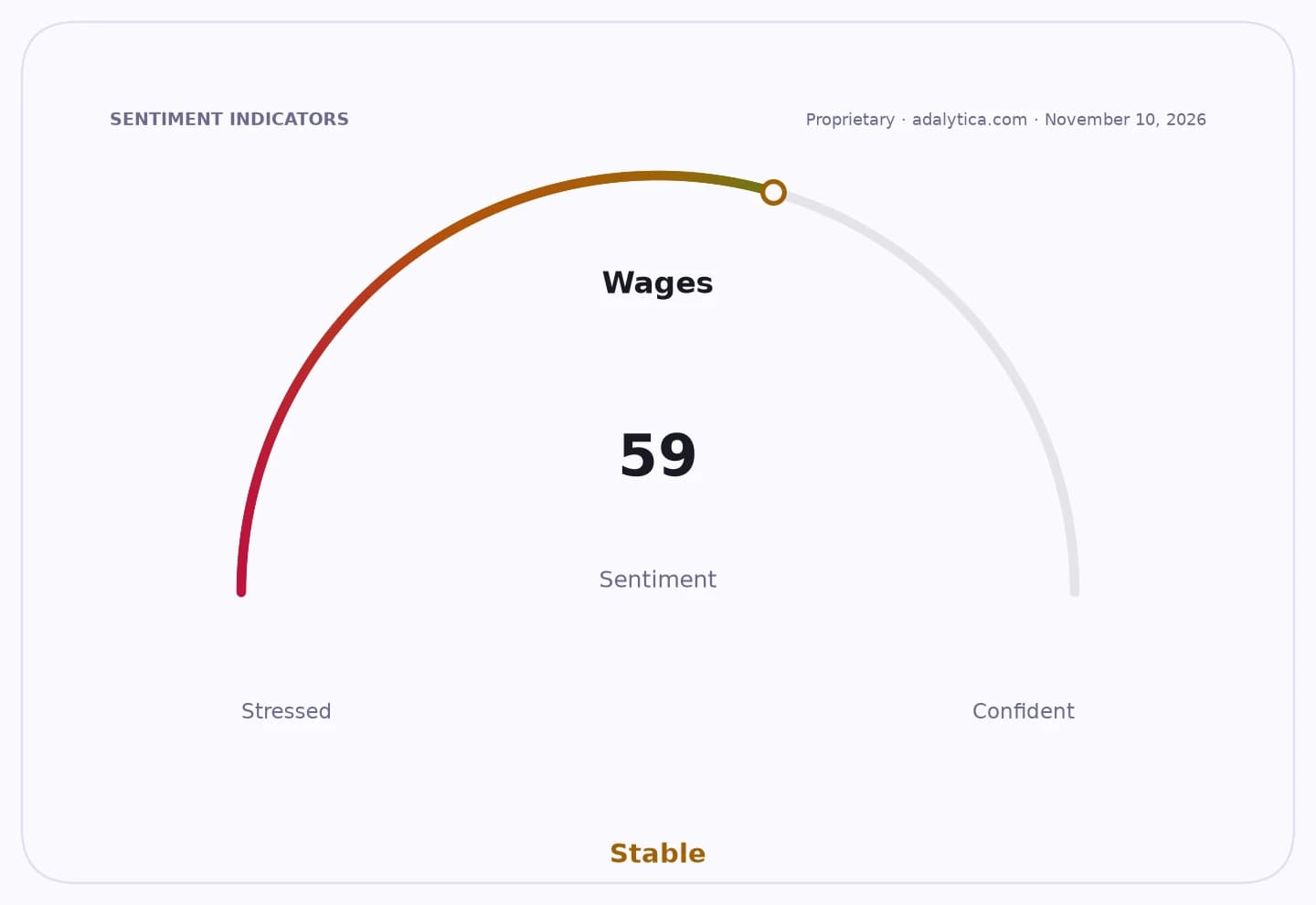
Spain’s corporate sector has widened margins by 66% since before the pandemic even as households still have not fully recovered their pre-2019 purchasing power, underscoring how inflation has redistributed income from workers and consumers to companies in energy, housing and food.
Spain corporate margins rose as households lagged
Consumer Spending
The most important economic shift is not just that prices rose, but that firms were able to defend — and in many cases expand — profitability far faster than wages. According to the Observatory of Business Margins cited by Spanish union CC OO, gross operating surplus for the corporate sector climbed from 207 billion euros in 2019 to an average 342 billion euros through the second quarter of 2026. The margin on sales increased to 12.8% from 11% over the same period.
Sentiment Indicators
That divergence matters because it suggests inflation has not been a neutral shock. The union argues companies used successive price surges tied to the wars in Ukraine and the Middle East to pass through costs and widen profitability, while workers absorbed the hit to real incomes. With households only regaining pre-2019 buying power in the second quarter of this year, the Spanish economy is still dealing with a delayed demand recovery even as firms sit on fatter margins.
The gains have been concentrated in sectors with direct pricing power or exposure to scarce assets. Energy companies nearly quadrupled profits, up 374%, as fuel prices doubled. Financial firms lifted margins 93%, construction 90% and real estate 34% as home prices jumped 53%. Food chains increased margins 51% while food prices rose 39%, and hostelry margins climbed more than 90% even as prices in the sector rose 31%. That mix helps explain why the cost-of-living squeeze remains politically explosive, particularly with a 24-hour general strike planned for Nov. 11 over housing access.
For investors, the story cuts both ways. Strong margin expansion supports earnings, cash generation and valuation resilience in sectors with pricing power, and helps explain why listed European defensive and inflation-linked businesses have remained attractive. But it also raises the risk that margin compression could become a second-stage earnings headwind if wage demands, regulation or weaker consumer demand force firms to absorb more of the inflation shock. In Spain, that risk is now surfacing in housing, labor relations and public debate over the distribution of growth.
The broader narrative is one of an inflationary cycle that has outlasted the initial price shock and become embedded in corporate profitability, household strain and political pressure. If wage growth catches up too slowly, consumption could stay subdued. If it accelerates quickly, margins that have so far been unusually protected may come under pressure.
| Entity | Gains | Losses |
|---|---|---|
| Large Spanish companies | ▲Wider margins, stronger profits | ▼Wage pressure, political scrutiny |
| Households/workers | ▲Higher nominal pay potential | ▼Weak real purchasing power |
| Energy, banks, housing-linked sectors | ▲Pricing power, profit growth | ▼Regulatory risk |
| Consumers and tenants | ▲Little immediate relief | ▼Higher food, fuel, housing costs |