Switzerland’s new collective-bargaining wage schedule for 2026 raises minimum pay by an average 0.8%, but workers in covered sectors are still set to lose ground in real terms as inflation is forecast to run slightly higher at 0.6%.
Switzerland 2026 wage schedule raises pay 0.8%

That matters because the wage update is less a victory lap for labor than a reminder that Switzerland’s tight labor market is still being managed with modest, negotiated pay increases rather than a broad-based acceleration in incomes. For investors, the message is clear: domestic consumption is not getting a meaningful boost from wages, while companies with labor-intensive operations get some relief from the absence of an outsized wage shock.
Sentiment Indicators
The Federal Statistical Office said actual wages will rise just 0.5% on average in 2026, split between a 0.3% increase at the individual level and 0.2% through collective adjustments. More than 1.85 million workers are covered by collective labor agreements with statutory minimum wage provisions, making the announcement relevant well beyond a narrow union audience.
The breakdown shows how uneven the pressure remains across the economy. Transport and storage will see the largest actual wage increase at 1.2%, followed by financial and insurance activities at 1.0% and professional services at 0.8%. Manufacturing and construction, by contrast, are getting only 0.3% and 0.2% respectively. On minimum wages, the largest increase is in unclassified activities at 2.3%, while manufacturing gets just 0.1%.
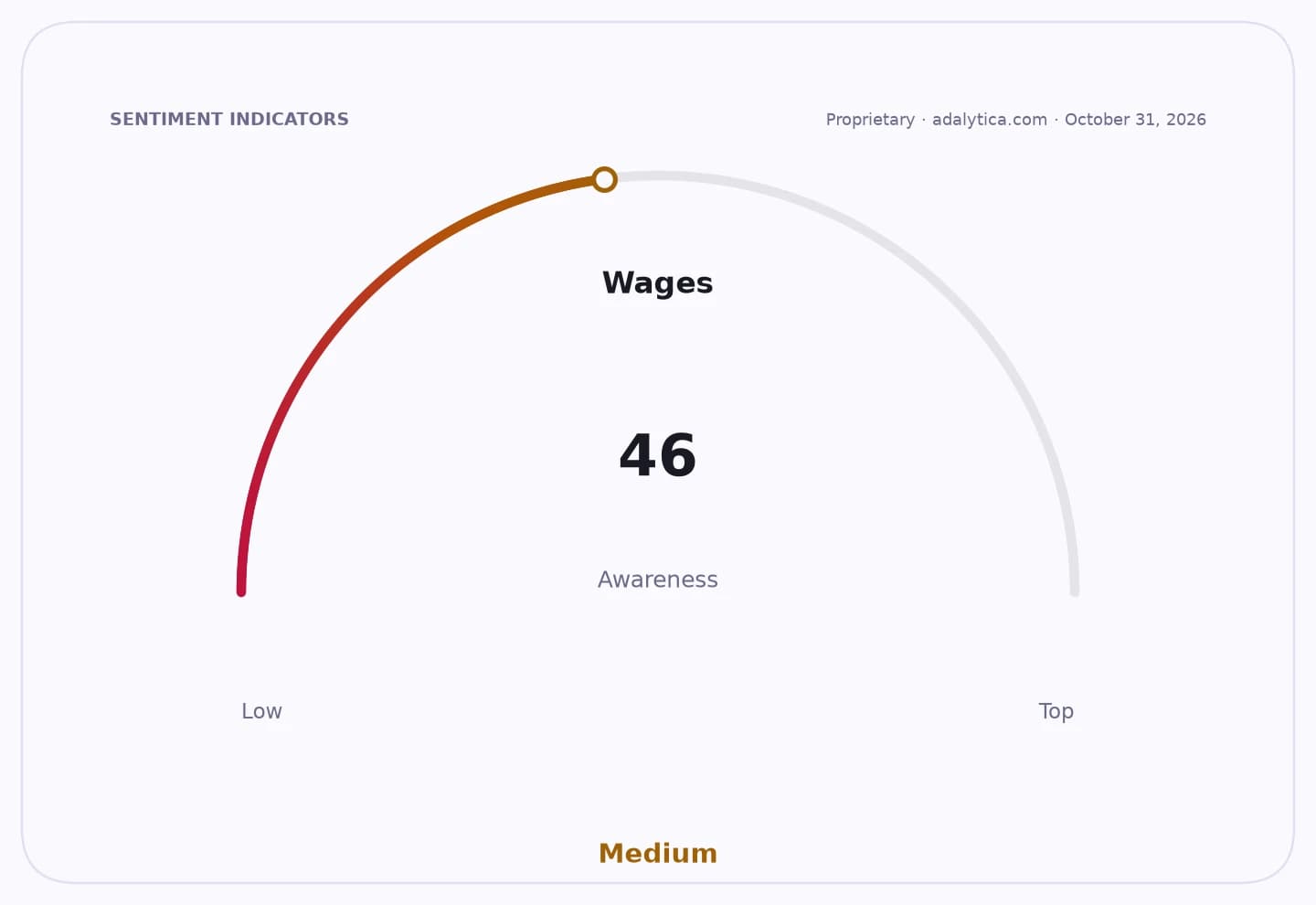
Wages
The key investment takeaway is that Switzerland is still in a low-drama wage environment. That is good for margin stability in sectors exposed to labor costs, but it also limits the upside for retailers, consumer-facing firms and domestic demand plays that depend on stronger household purchasing power. The 0.8% minimum wage rise is also slower than in recent years, after 1% in 2025 and 2% in 2024, reinforcing the view that wage inflation is cooling rather than re-accelerating.
For Swiss equities, that combination usually favors quality exporters, insurers and capital-light service names over businesses dependent on a sharp household spending recovery. The broader lesson is that wage growth in Switzerland remains controlled, sector-specific and largely compatible with a disinflationary backdrop — a setup that should help the Swiss National Bank keep policy flexible, but not one that points to a consumer-led earnings breakout.
| Entity | Gains | Losses |
|---|---|---|
| Employers in Swiss CLAs | ▲More predictable labor costs | ▼Limited ability to pass on wage pressure |
| Workers in covered sectors | ▲Nominal pay increases | ▼No real wage gain |
| Exporters and insurers | ▲Stable margins | ▼Little domestic demand lift |
| Consumer-facing retailers | ▲Lower wage shock | ▼Weak household spending power |